By Vlad Nadymov 55 min read
Data as of
Rerun this study with live data using a free notebook and agent skill
We published the rules and the code. The notebook at github.com/getbeton/how-governments-buy-ai applies the study’s keyword families, its false-match checks and its taxonomy to the current Sell to State data, through the Sell to State API. It builds the main tables of this article: AI tenders per 10,000 records by country and year, what governments buy, what the AI does, and brands. It also gives prices in US dollars and the AI tenders that are open now, with a link to each one.
An agent can get access by itself. It registers at the API with one request and receives a client ID and a payment link. You pay $49 a month on the link, and the agent then sends the client ID with each request. If you already have a Sell to State API key, give it to the agent instead.
A full run on all 65 countries in Sell to State makes about 6,500 API calls and takes about 25 minutes. The API searches titles, buyer names and supplier names, so the notebook counts AI that a title names. In this article that was 55% of all AI procurements, so expect lower shares than ours and the same patterns.
Copy this into Claude, ChatGPT or any agent that can run Python:
Recreate the Sell to State study "How governments buy AI" with current data.
Use the Python notebook at https://github.com/getbeton/how-governments-buy-ai.

1. Clone the repository. Install requirements.txt.
2. Get access to the Sell to State API.
   - If I give you an API key, set it as STS_API_KEY and go to step 4.
   - If not, sign up as an agent: POST https://app.selltostate.com/api/oidc/register
     with the JSON body {"client_name": "<your name> for <my name>"}.
     Keep client_id and payment_link from the answer.
3. Pay for access. The price is at GET https://app.selltostate.com/api/v1/price ($49 a month).
   - Show me the price and the payment_link. Wait for my yes.
   - I pay on the payment_link. If I give you a Stripe payment method token (pm_...) instead,
     POST {"payment_method_token": "pm_..."} to https://app.selltostate.com/api/v1/pay
     with the header Authorization: Bearer client:<client_id>.
4. Check access: GET https://app.selltostate.com/api/v1/whoami must show "active": true.
   Use the header x-api-key: <key>, or Authorization: Bearer client:<client_id>.
   Set STS_CLIENT_ID=<client_id> (or STS_API_KEY). Keep the key and the client_id private.
5. Run notebook.ipynb for these countries: [your countries, or all].
6. Report: AI tenders per 10,000 records by country and year, what governments buy,
   prices in US dollars by region and purchase type, and the AI tenders open now, with links.
7. Compare the results with https://www.selltostate.com/blog/how-governments-buy-ai/.
   Explain the differences: the notebook reads titles only, Sell to State covers other sources,
   and the data is newer.
The same steps are an agent skill in the repository: skills/how-governments-buy-ai/SKILL.md. Copy that folder into the skills folder of your agent, for example ~/.claude/skills/ in Claude Code.
The limits of the data: the search reads words, and the sources count differently
- Sources differ. Rates compare a country with itself first. Countries with the same kind of source (TED countries; national portals with all purchases) compare with each other.
- The search finds words. In our last hand check, AI was one part of a larger purchase in 35 of 100 procurements, and 3 were false matches.
- Gaps. The Japanese source gives a ministry code, and p-portal publishes no code list, so we named the 45 codes from the notice titles of each code. Hebrew and Ukrainian tenders often stay “unclear” on what they buy. Prozorro search gives the buyer and the value but not the winner. 29% of contracts have a winner we could not type.
- Duplicates. The same UK award can appear in Find a Tender and in Contracts Finder. We keep one copy of each AI procurement; the denominators keep both, so the UK share is about 2% too low. TED notices with buyers in several countries count once, outside any country.
- Values. US dollars at 2025 average rates. Framework values above $1.13 million are left out as ceilings. Where a notice does not say that it is a framework, a ceiling can still pass as spending.
Download all 48 charts and the data
Free to reuse with a link to this article. The files hold aggregates only: counts, shares and percentiles. They hold no single procurement records.
- Country table (CSV): procurements, AI procurements and AI per 10,000 for each of the 66 countries, by year and for the last four quarters.
- Country by quarter (CSV): procurements and AI procurements for each country and quarter, Q1 2024 to Q3 2026.
- All aggregates (JSON): the numbers behind every chart, including the open-tender counts of 17 October 2026.
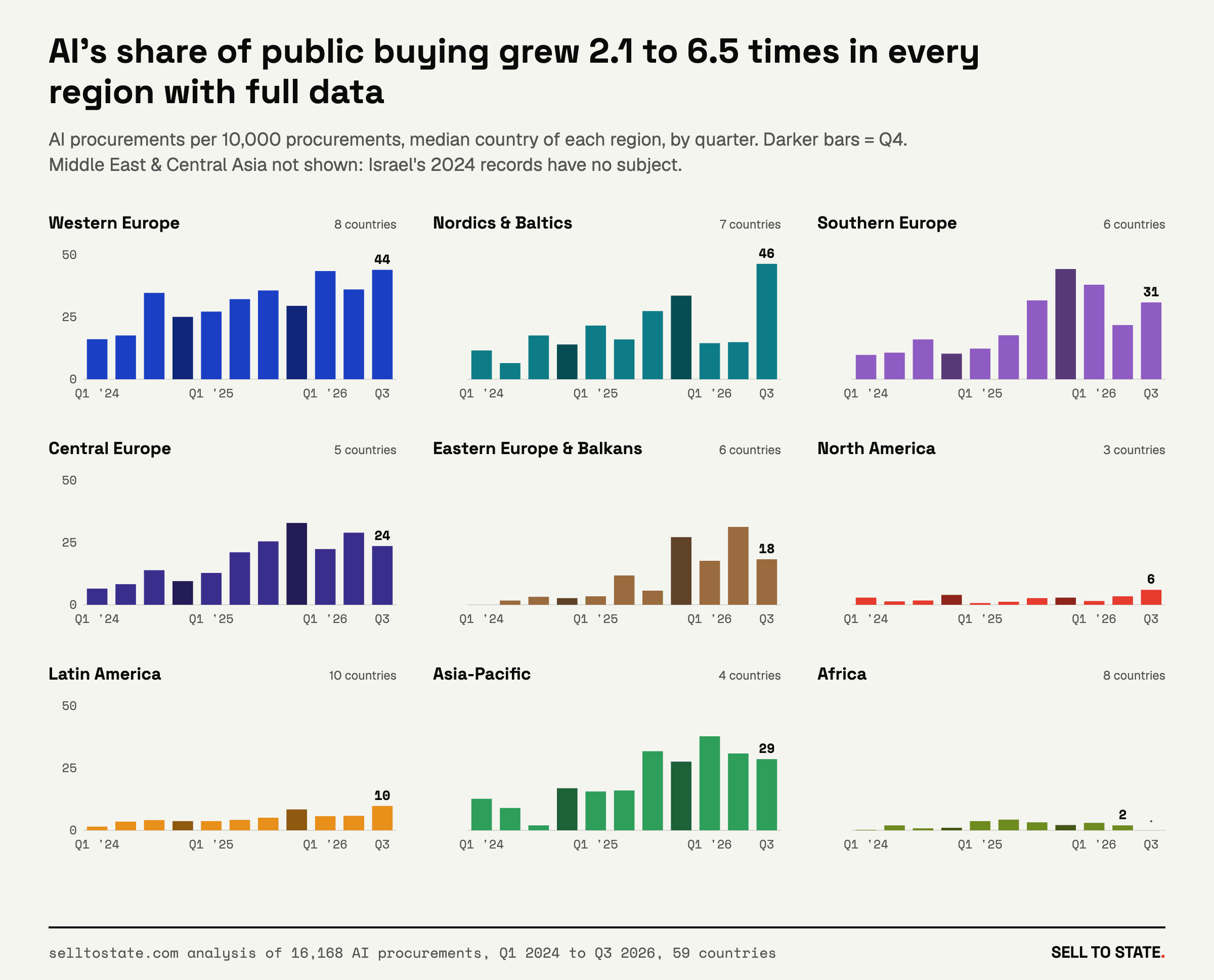
- V1: AI's share of public buying grew 2.1 to 6.5 times in every region with full data. PNG · SVG
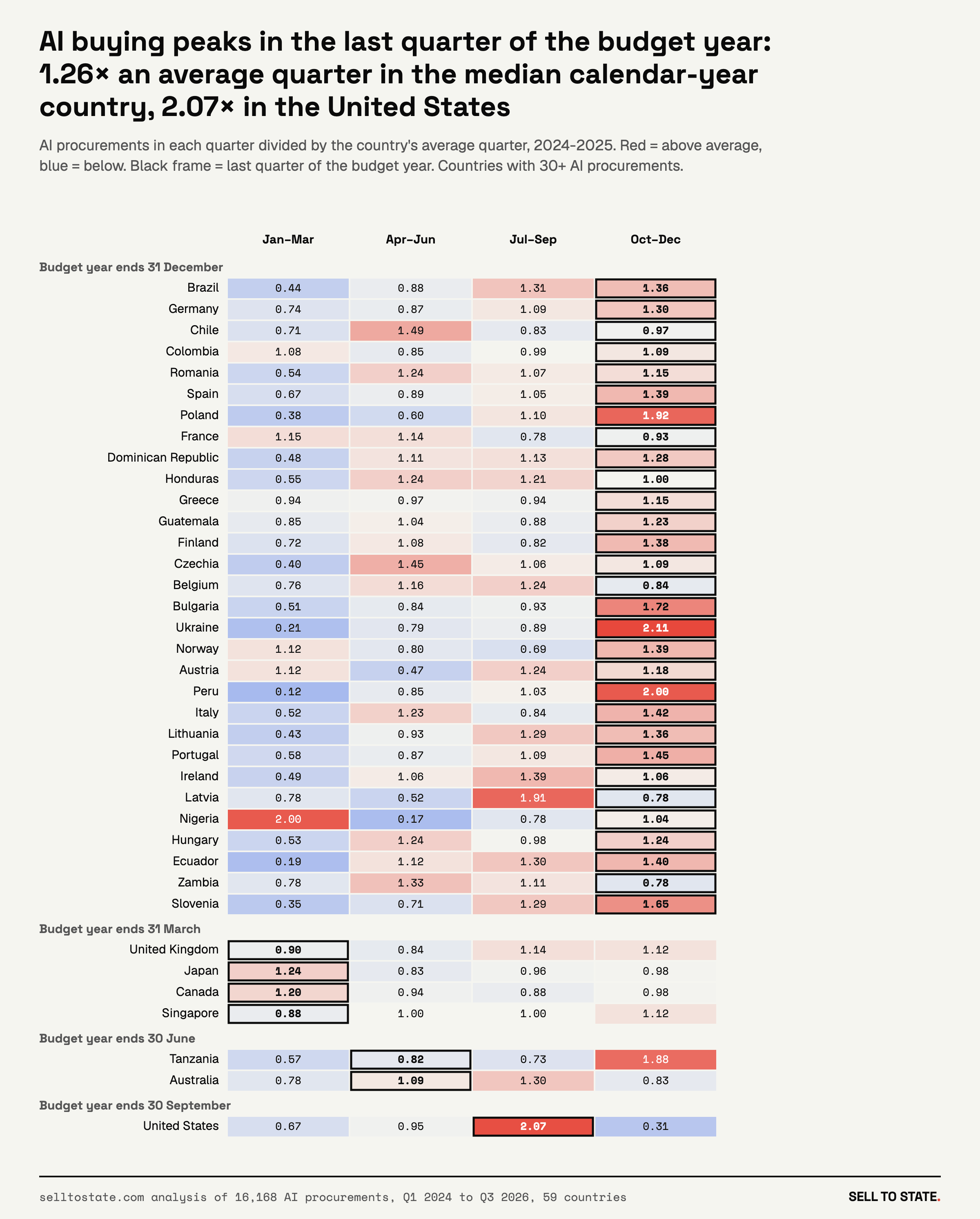
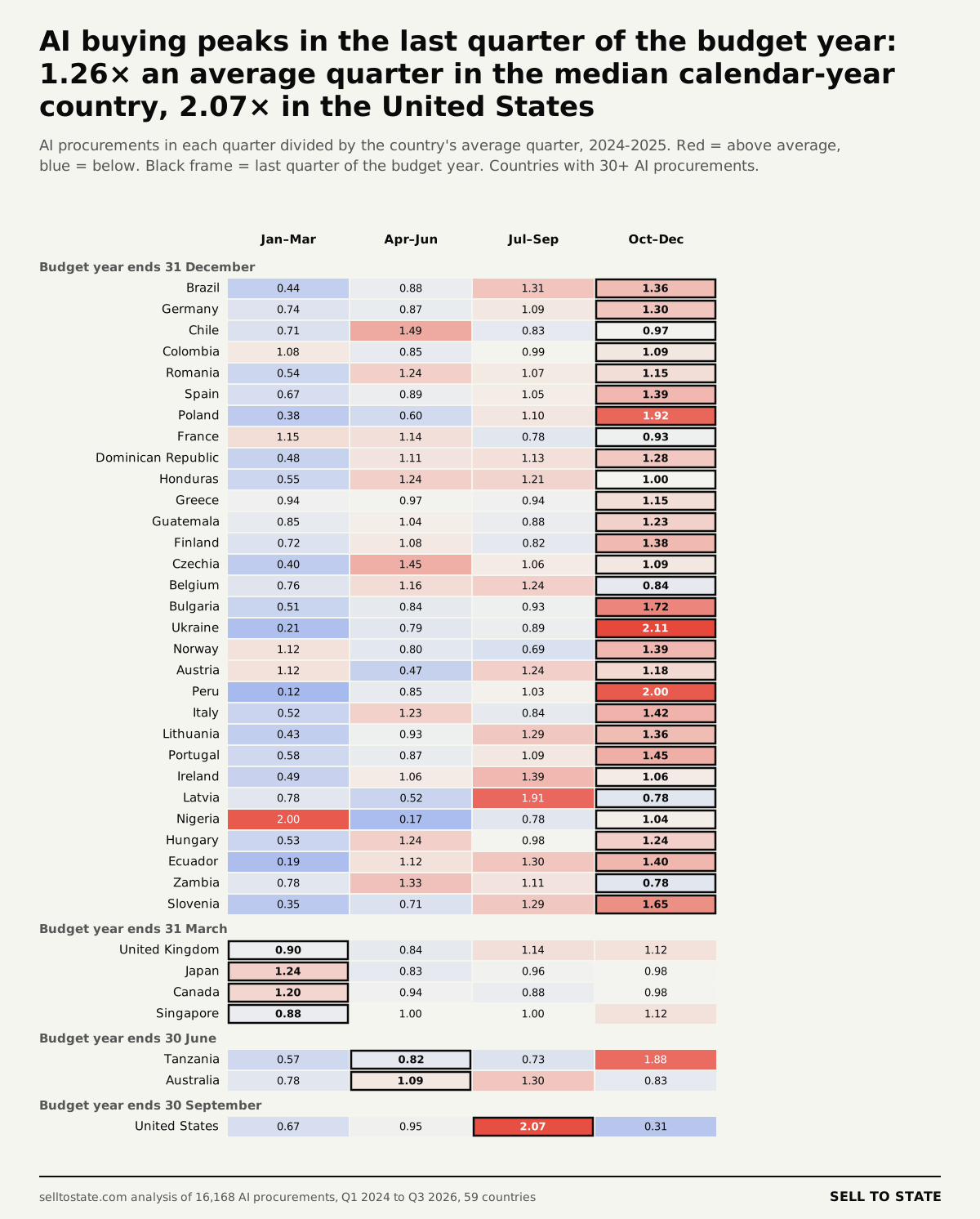
- V2: AI buying peaks in the last quarter of the budget year: 1.26× an average quarter in the median calendar-year country, 2.07× in the United States. PNG · SVG
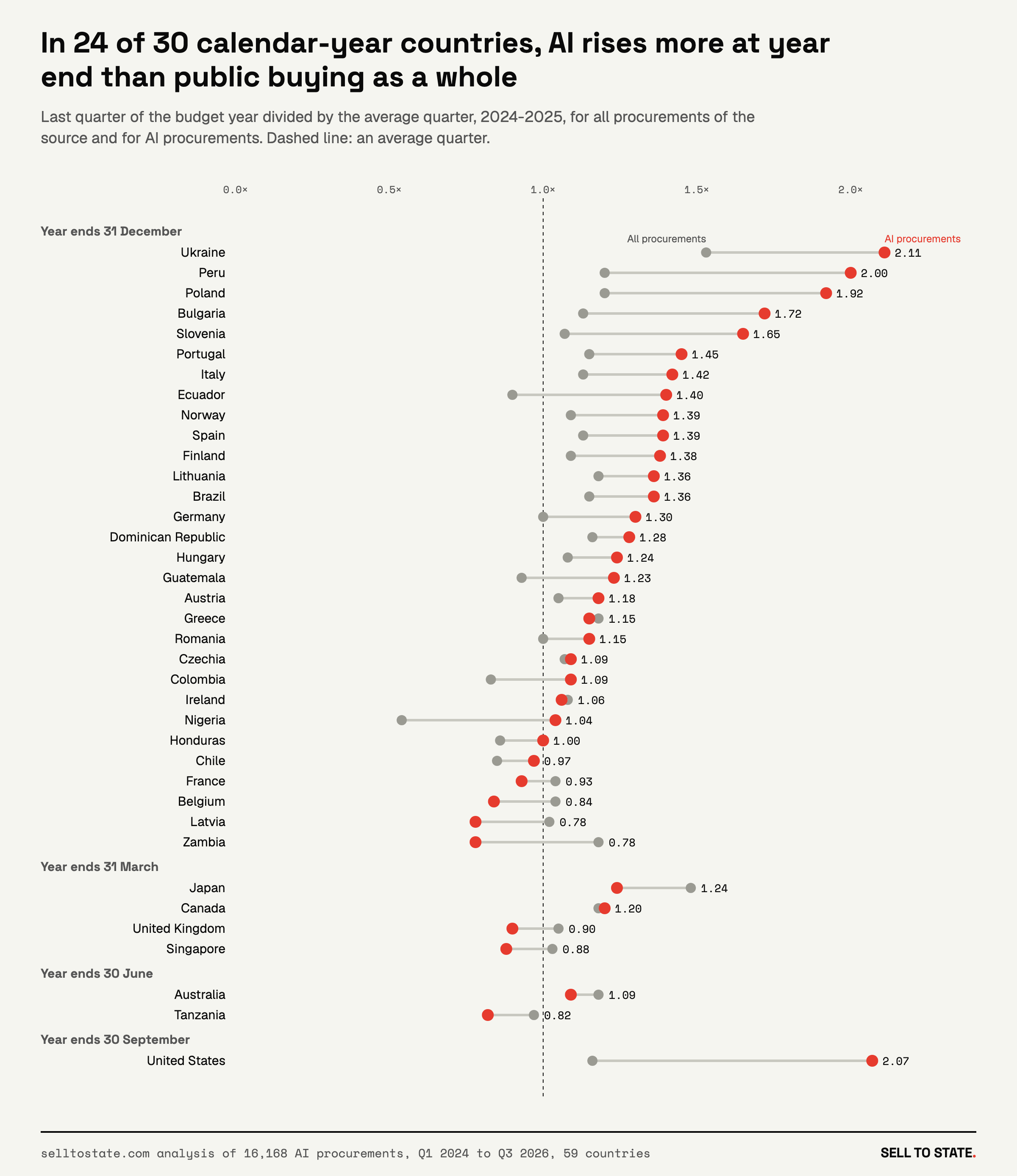
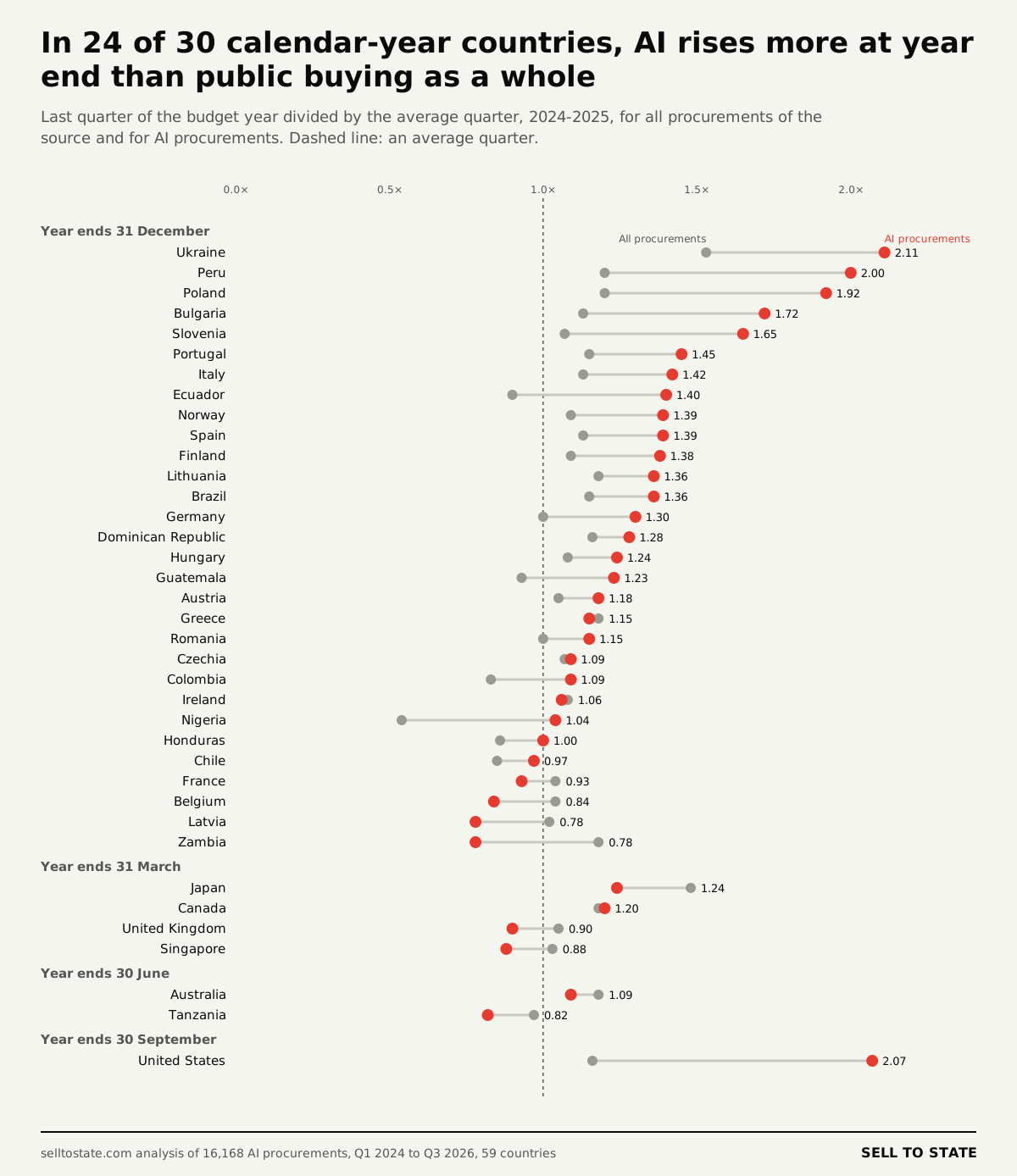
- V3: In 24 of 30 calendar-year countries, AI rises more at year end than public buying as a whole. PNG · SVG
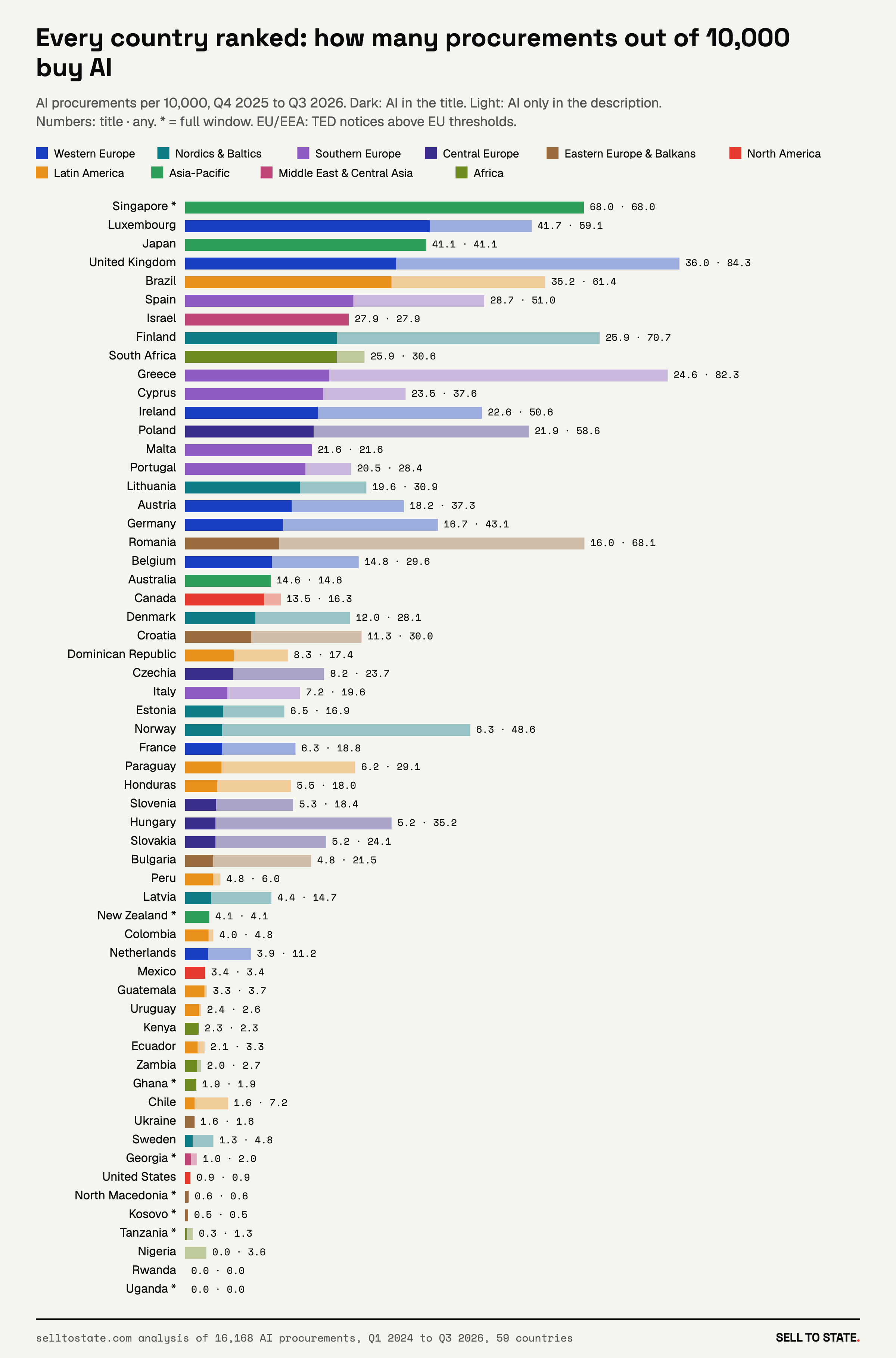
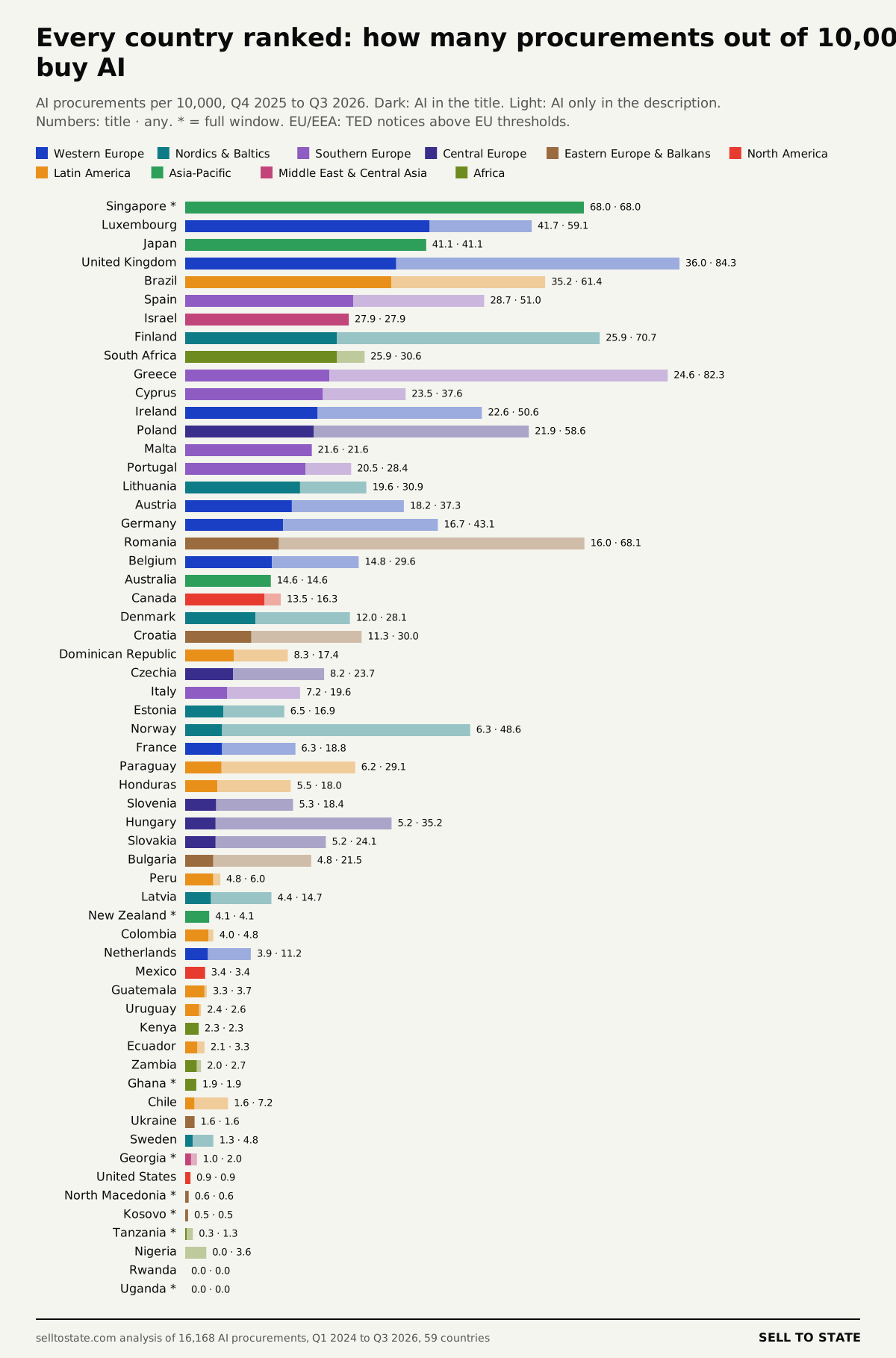
- V4: Every country ranked: how many procurements out of 10,000 buy AI. PNG · SVG
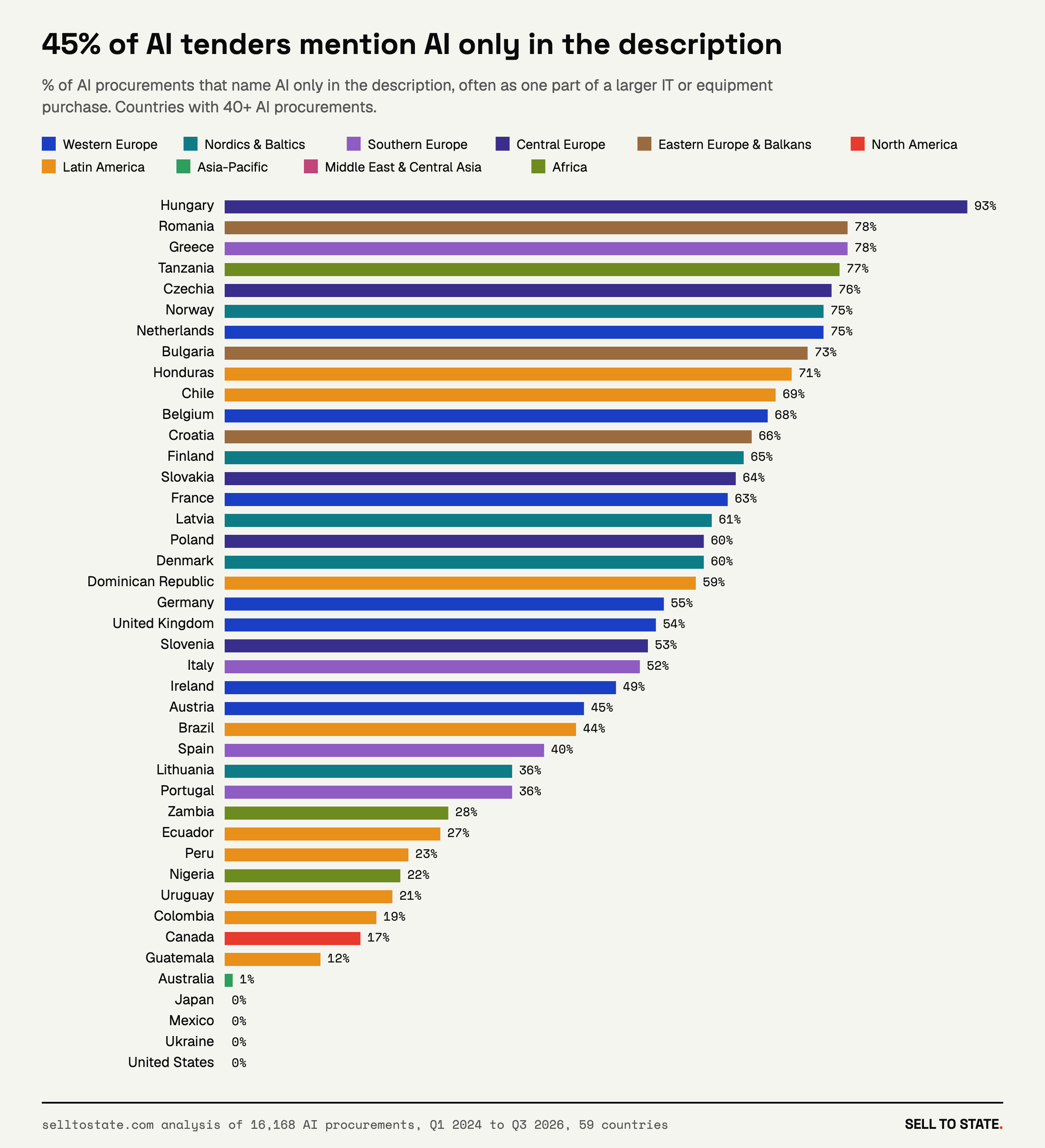
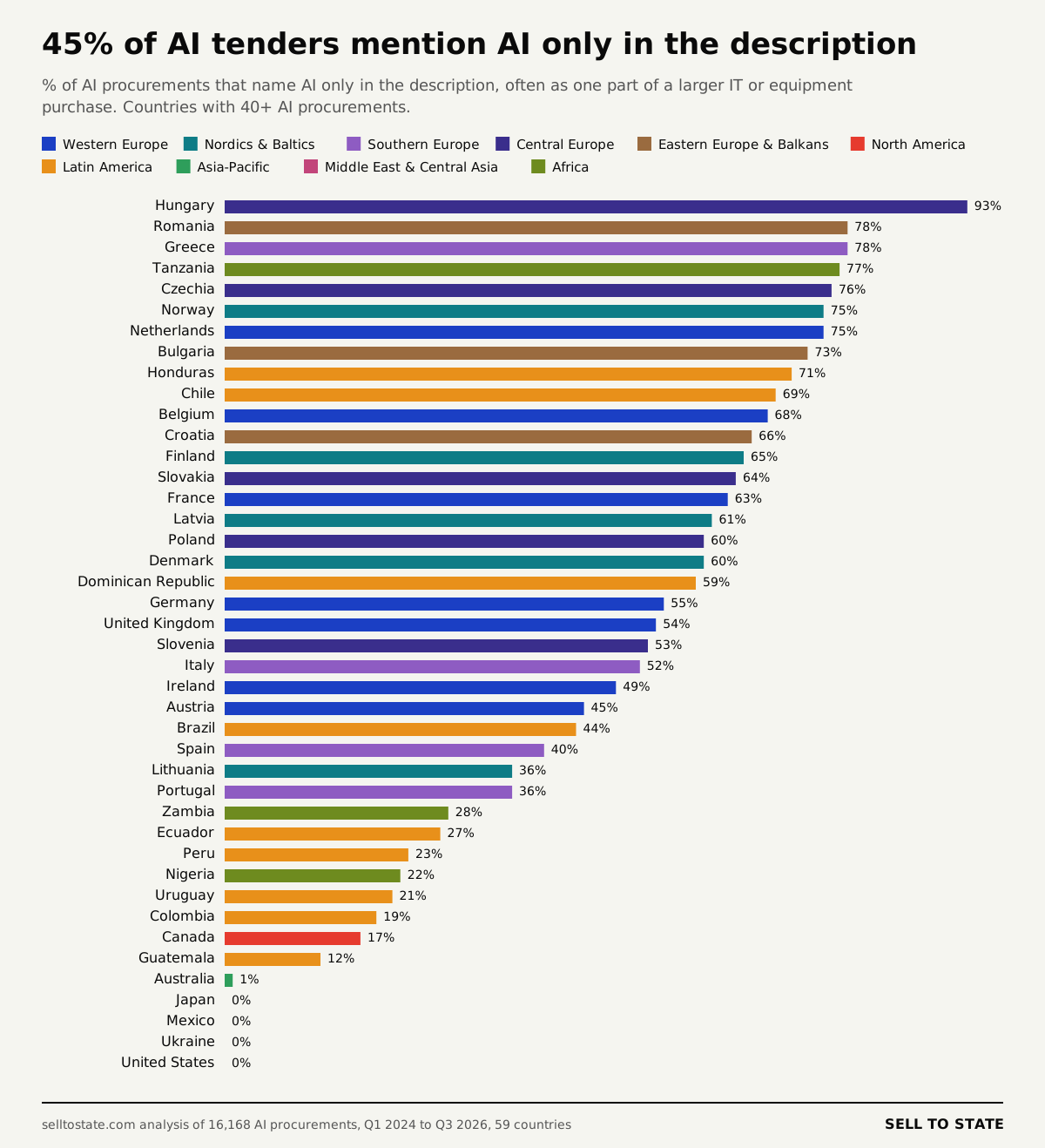
- V5: 45% of AI tenders mention AI only in the description. PNG · SVG
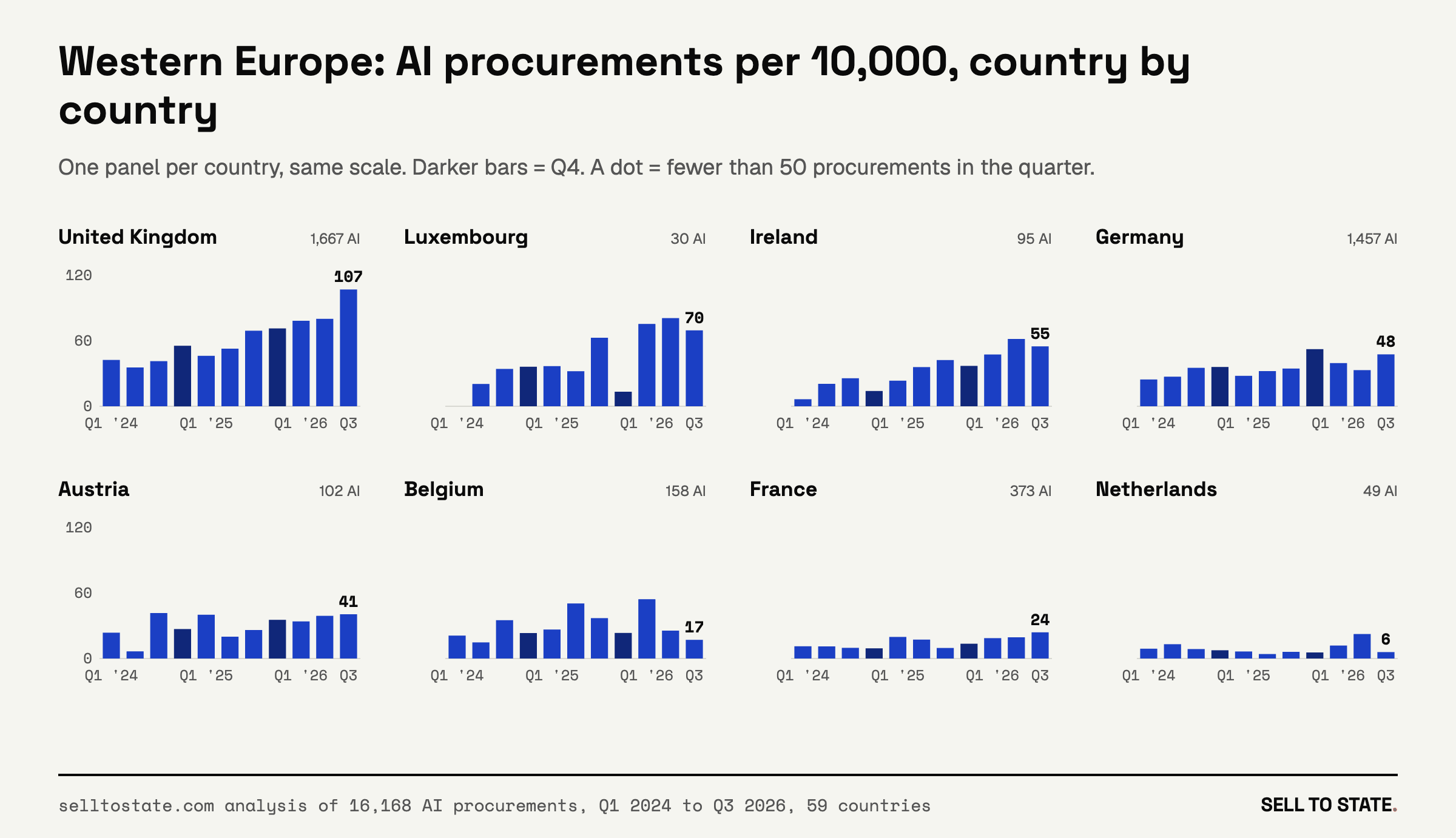
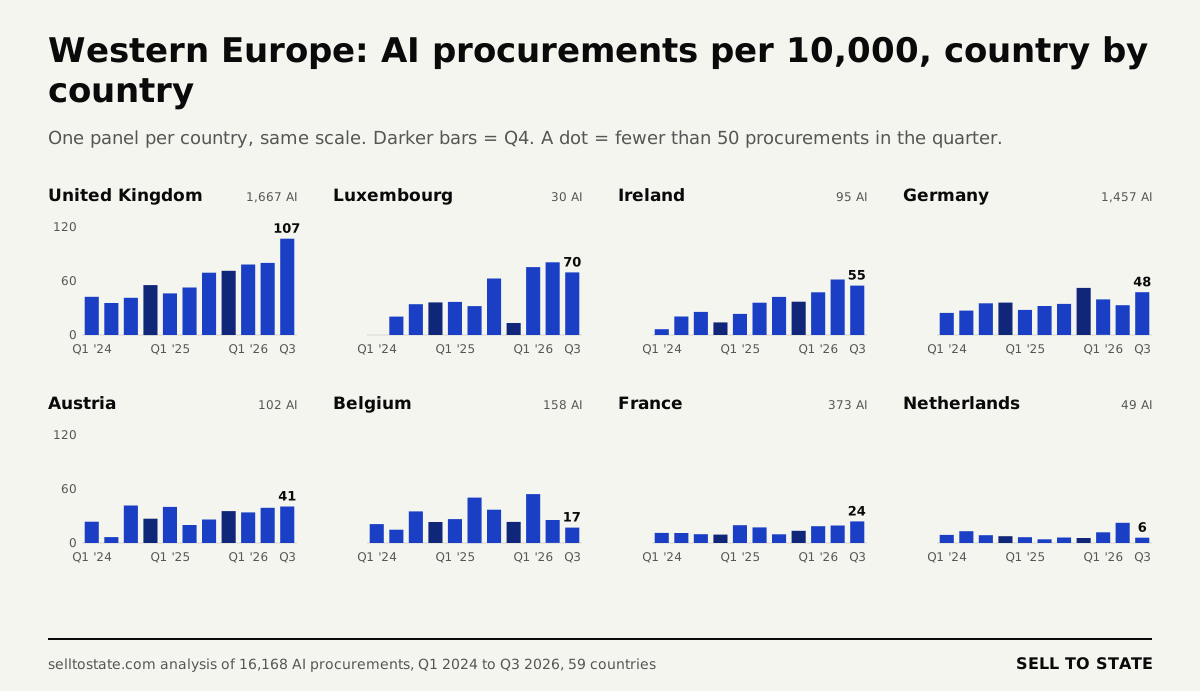
- V6: Western Europe: AI procurements per 10,000, country by country. PNG · SVG
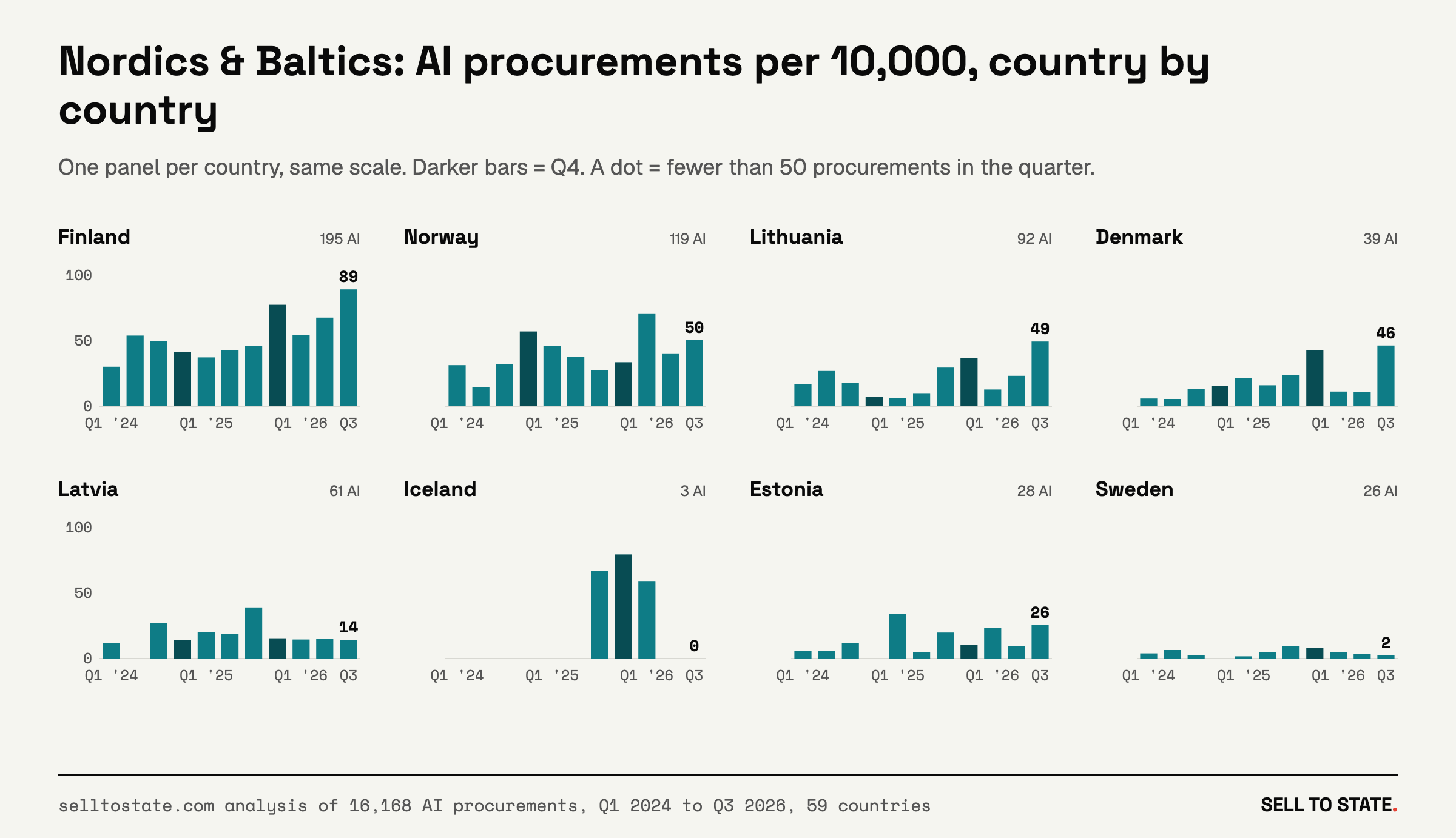
- V7: Nordics & Baltics: AI procurements per 10,000, country by country. PNG · SVG
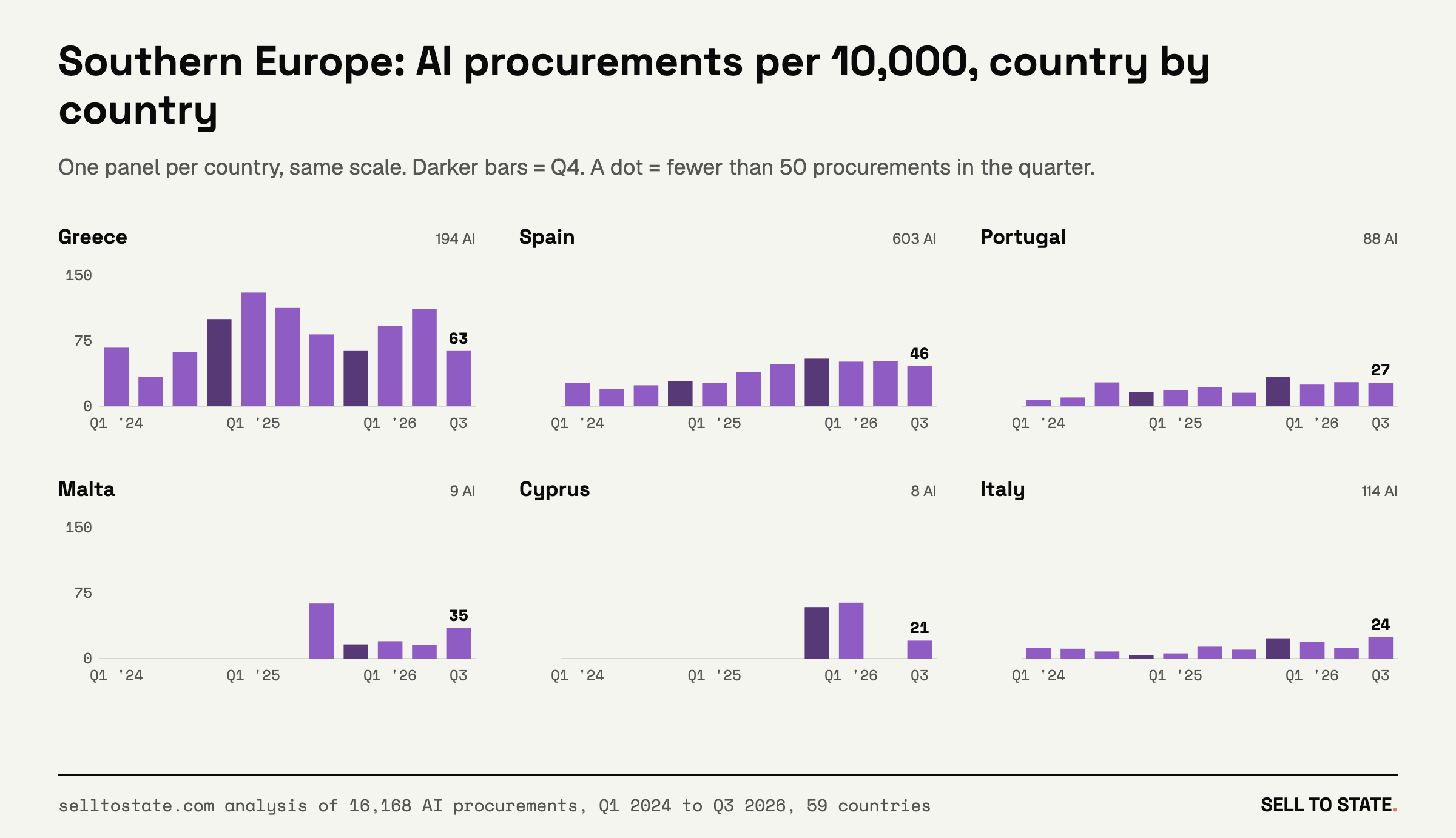
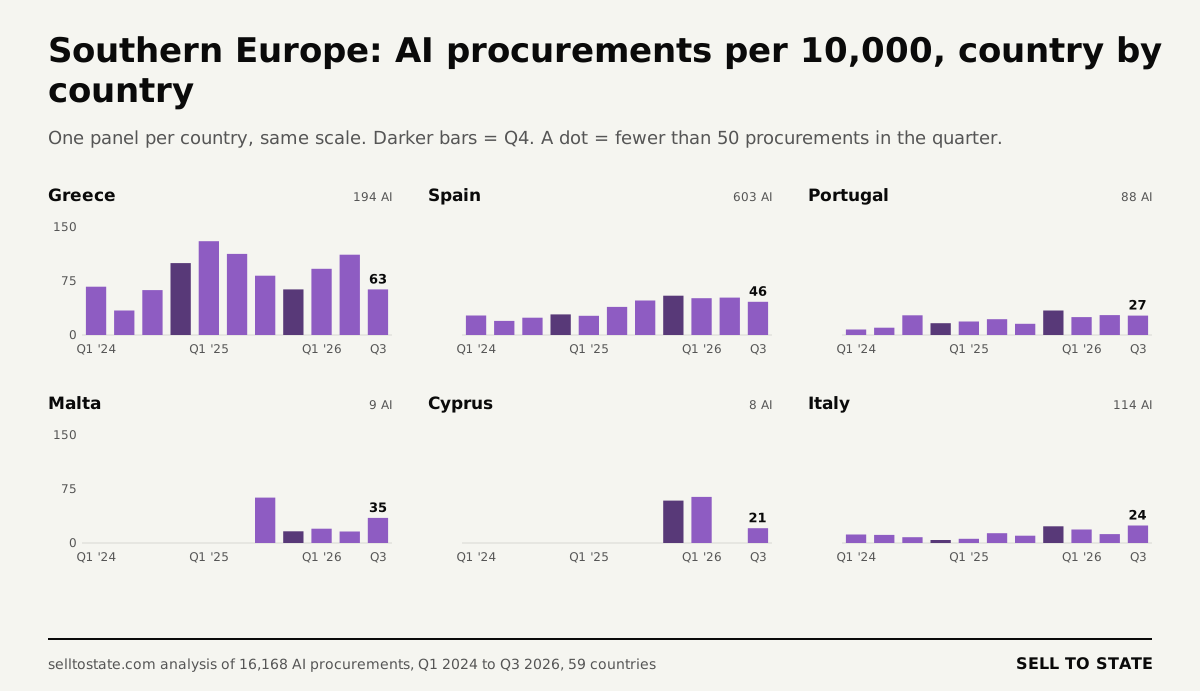
- V8: Southern Europe: AI procurements per 10,000, country by country. PNG · SVG
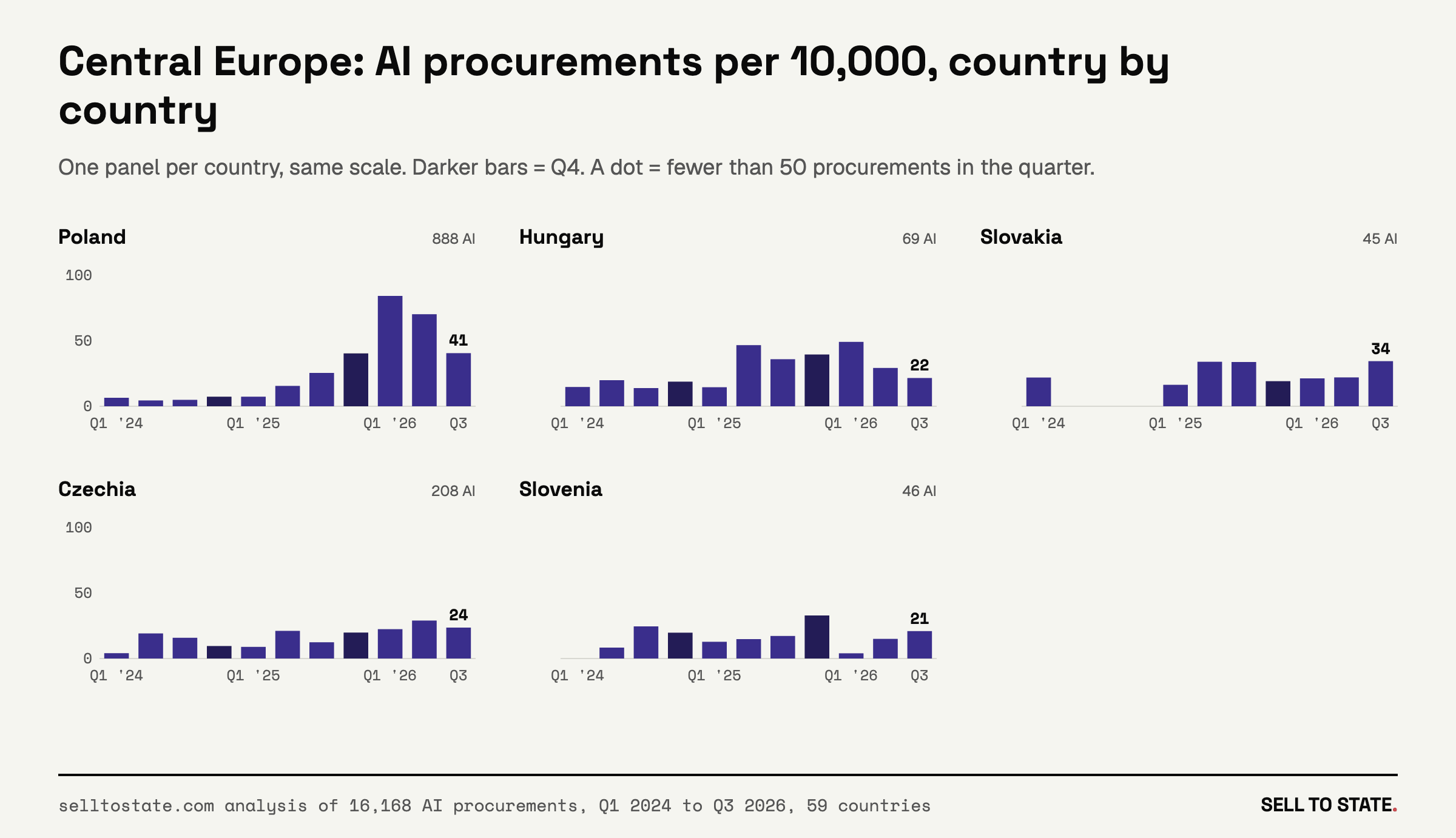
- V9: Central Europe: AI procurements per 10,000, country by country. PNG · SVG
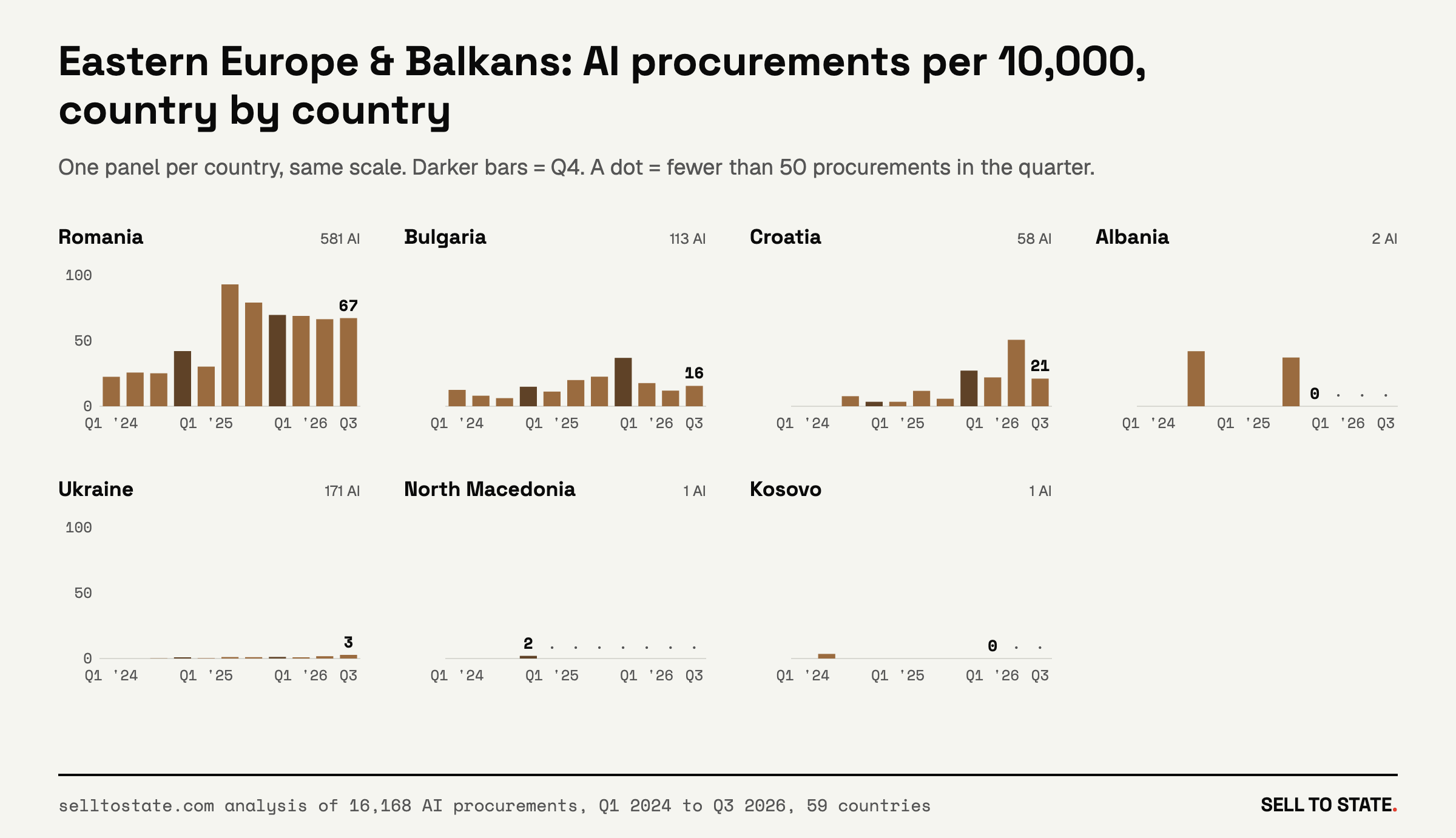
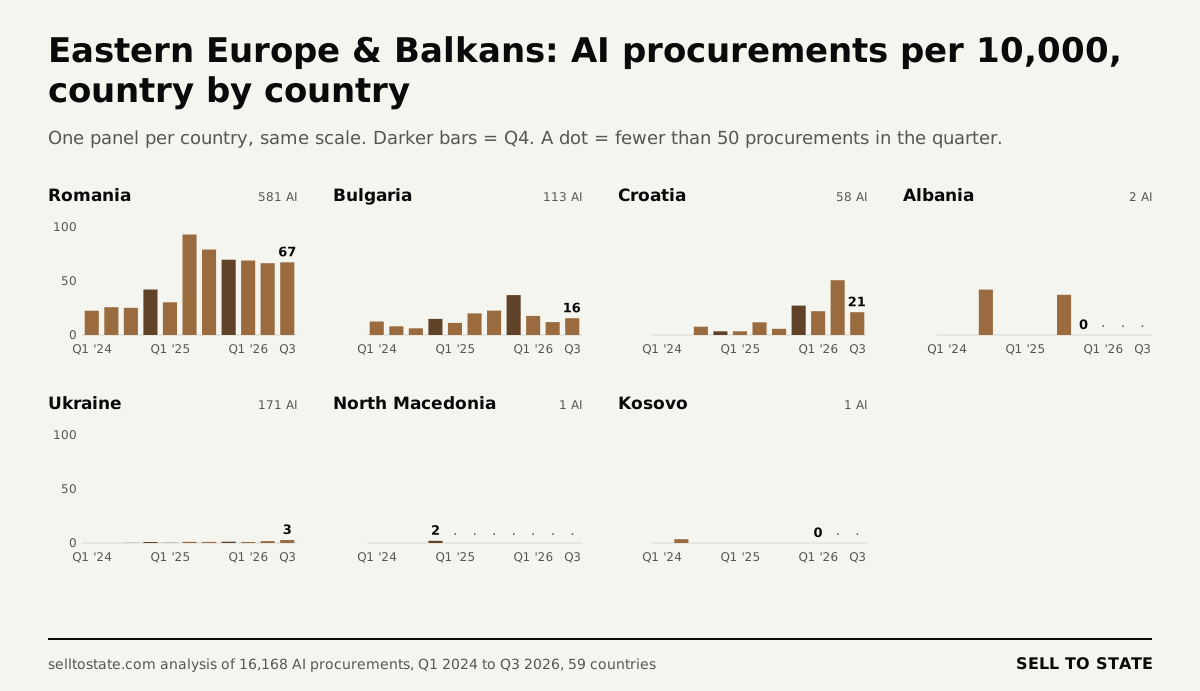
- V10: Eastern Europe & Balkans: AI procurements per 10,000, country by country. PNG · SVG
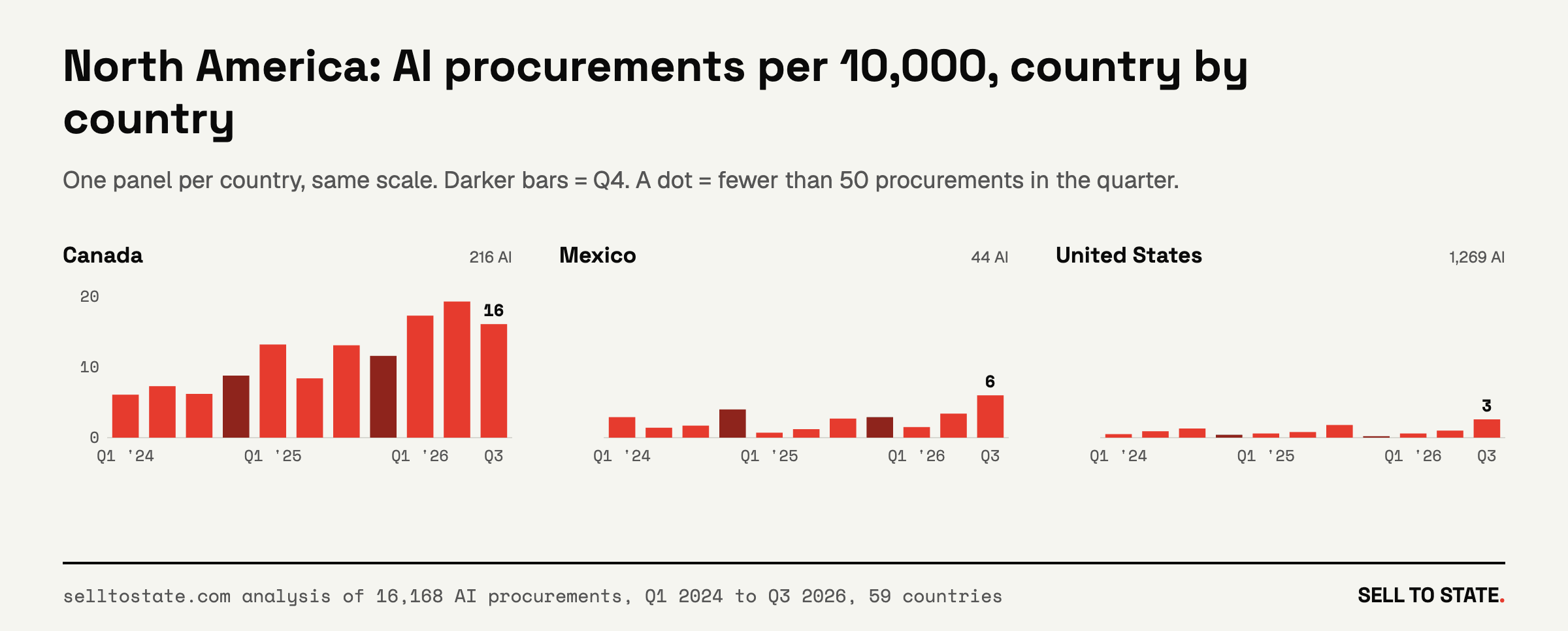
- V11: North America: AI procurements per 10,000, country by country. PNG · SVG
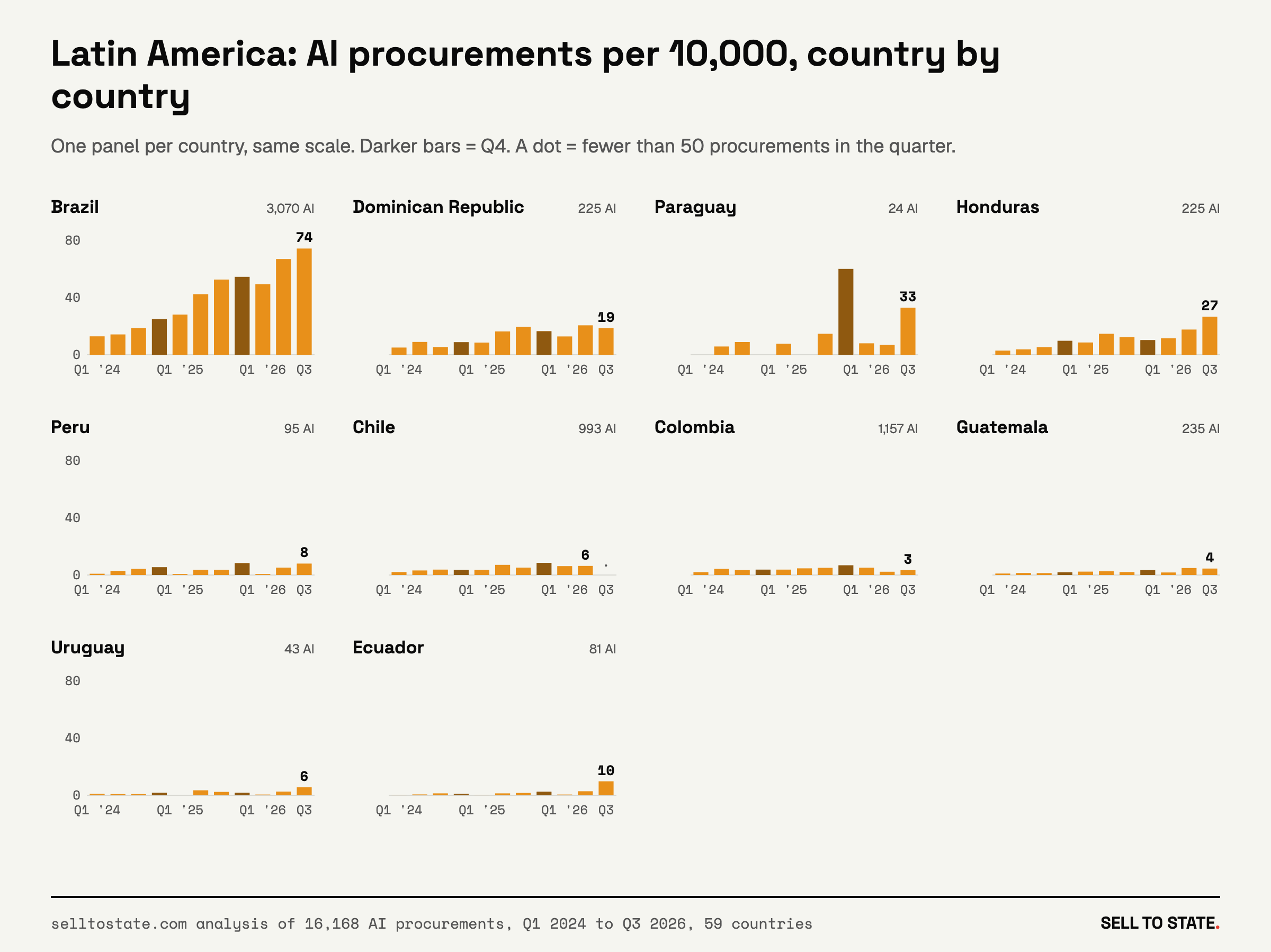
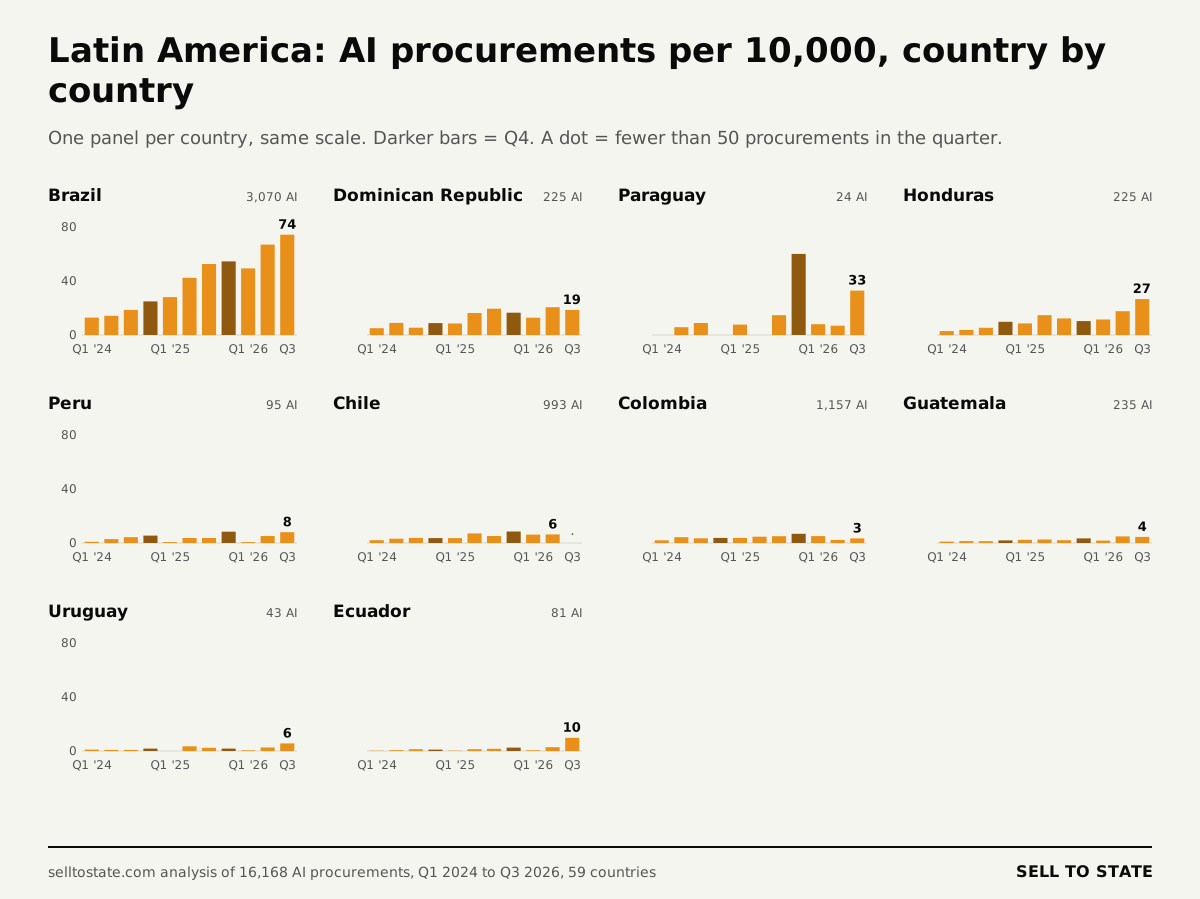
- V12: Latin America: AI procurements per 10,000, country by country. PNG · SVG
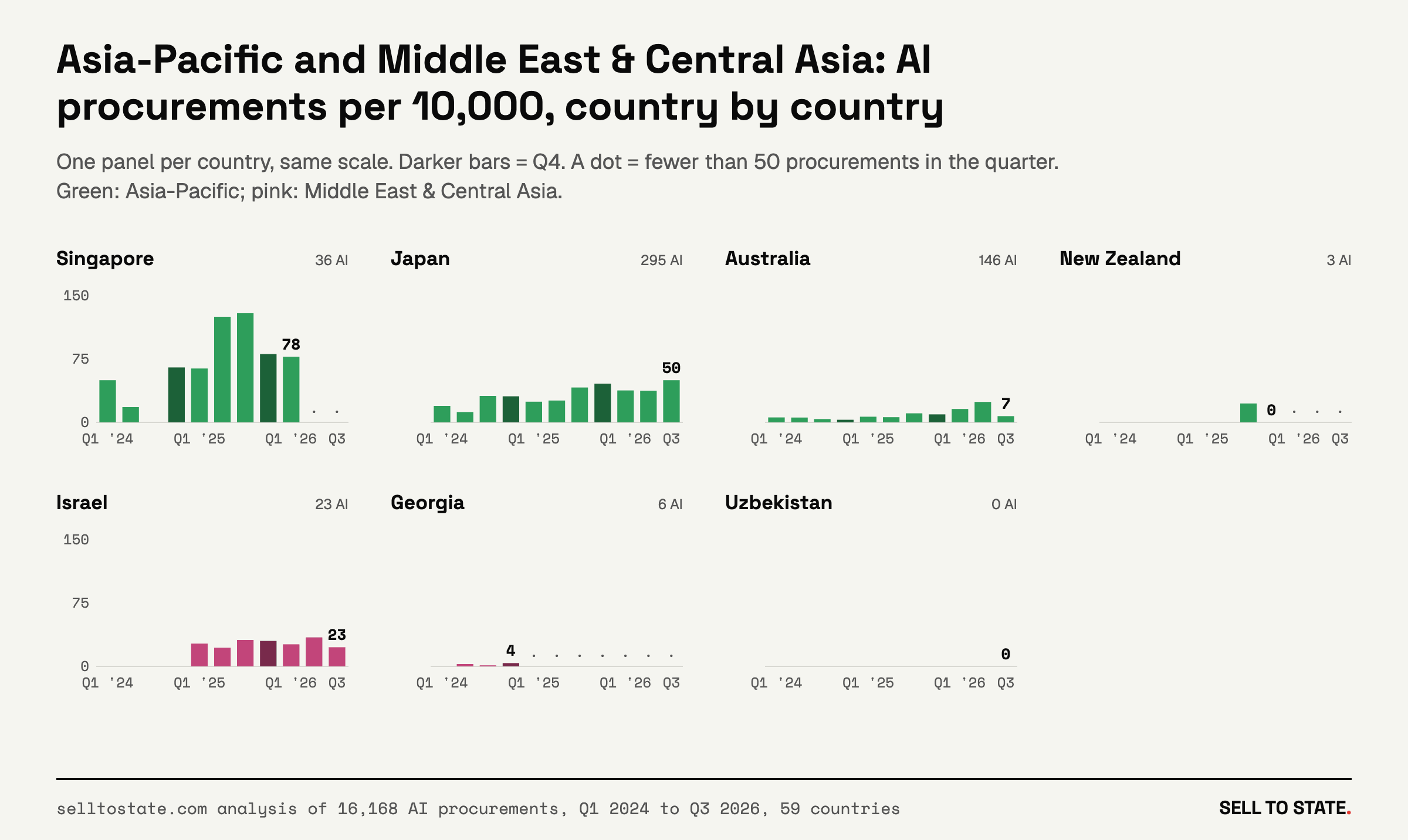
- V13: Asia-Pacific and Middle East & Central Asia: AI procurements per 10,000, country by country. PNG · SVG
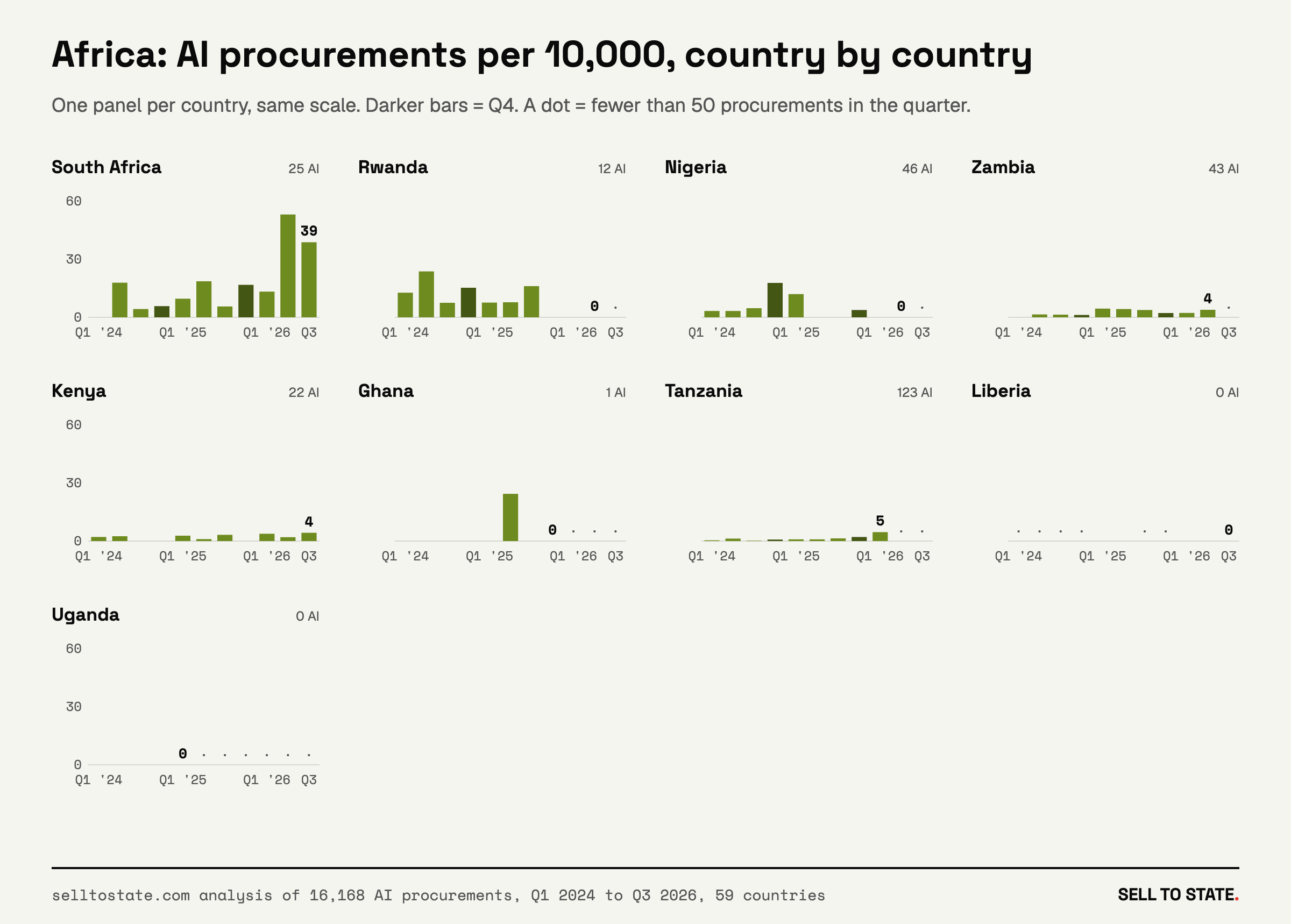
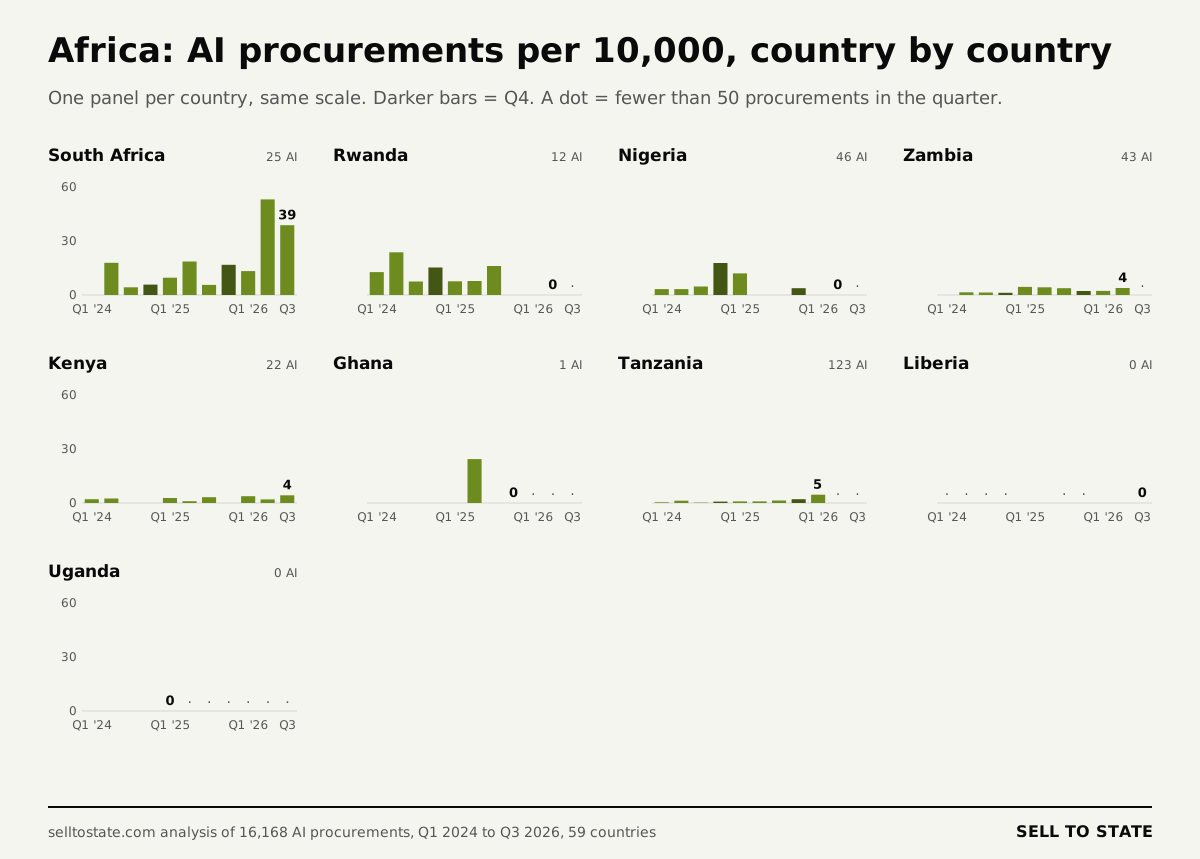
- V14: Africa: AI procurements per 10,000, country by country. PNG · SVG
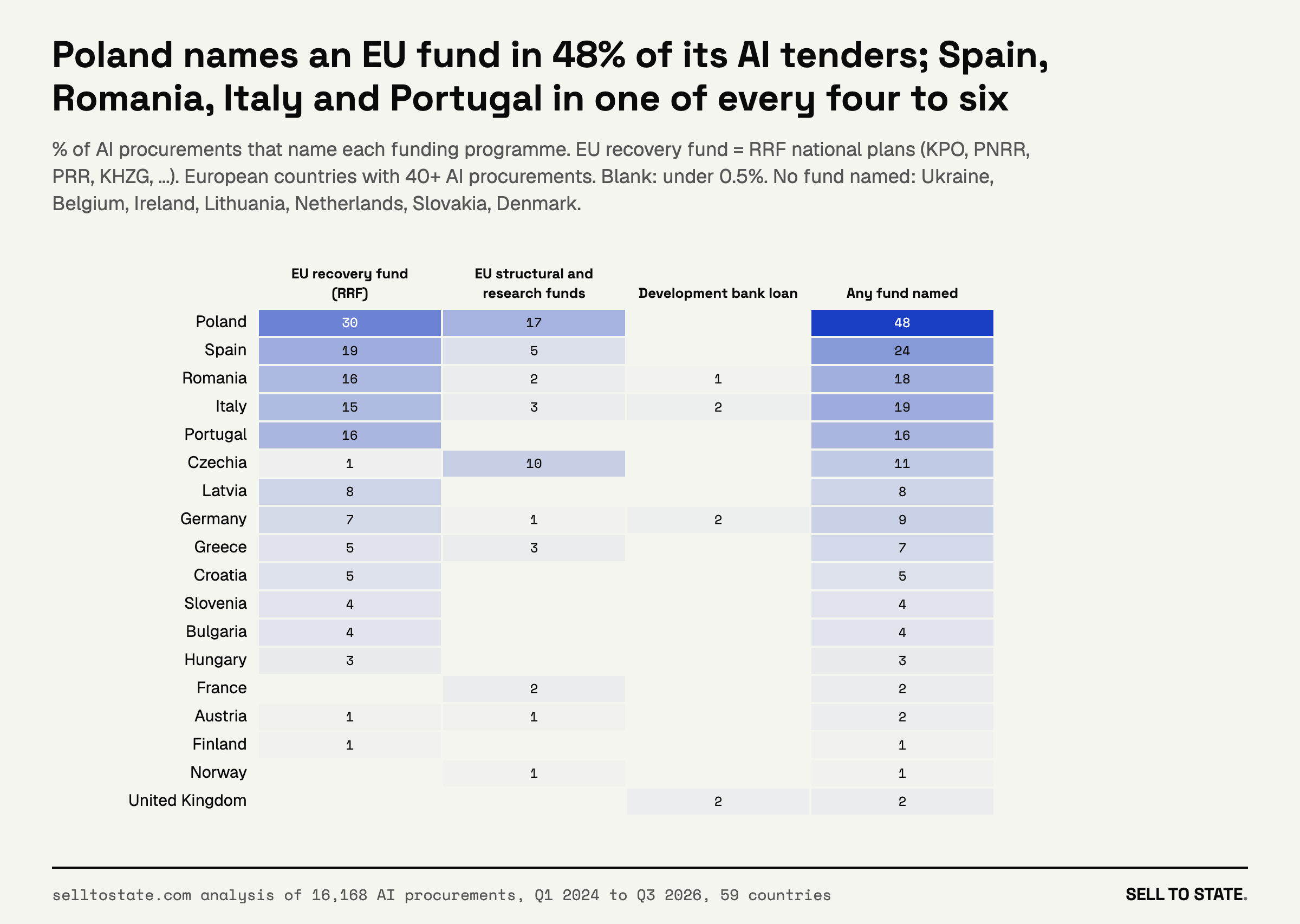
- V15: Poland names an EU fund in 48% of its AI tenders; Spain, Romania, Italy and Portugal in one of every four to six. PNG · SVG
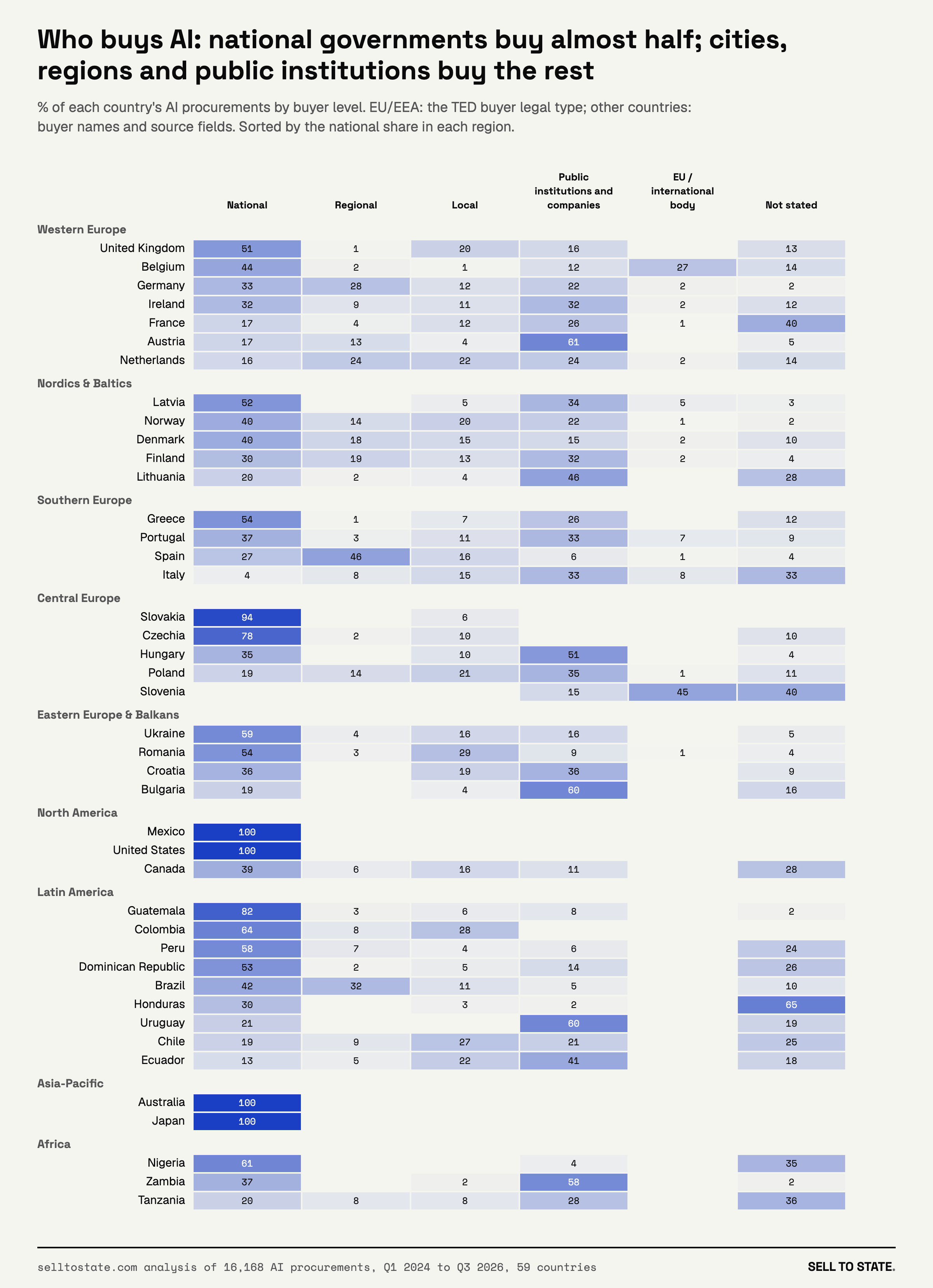
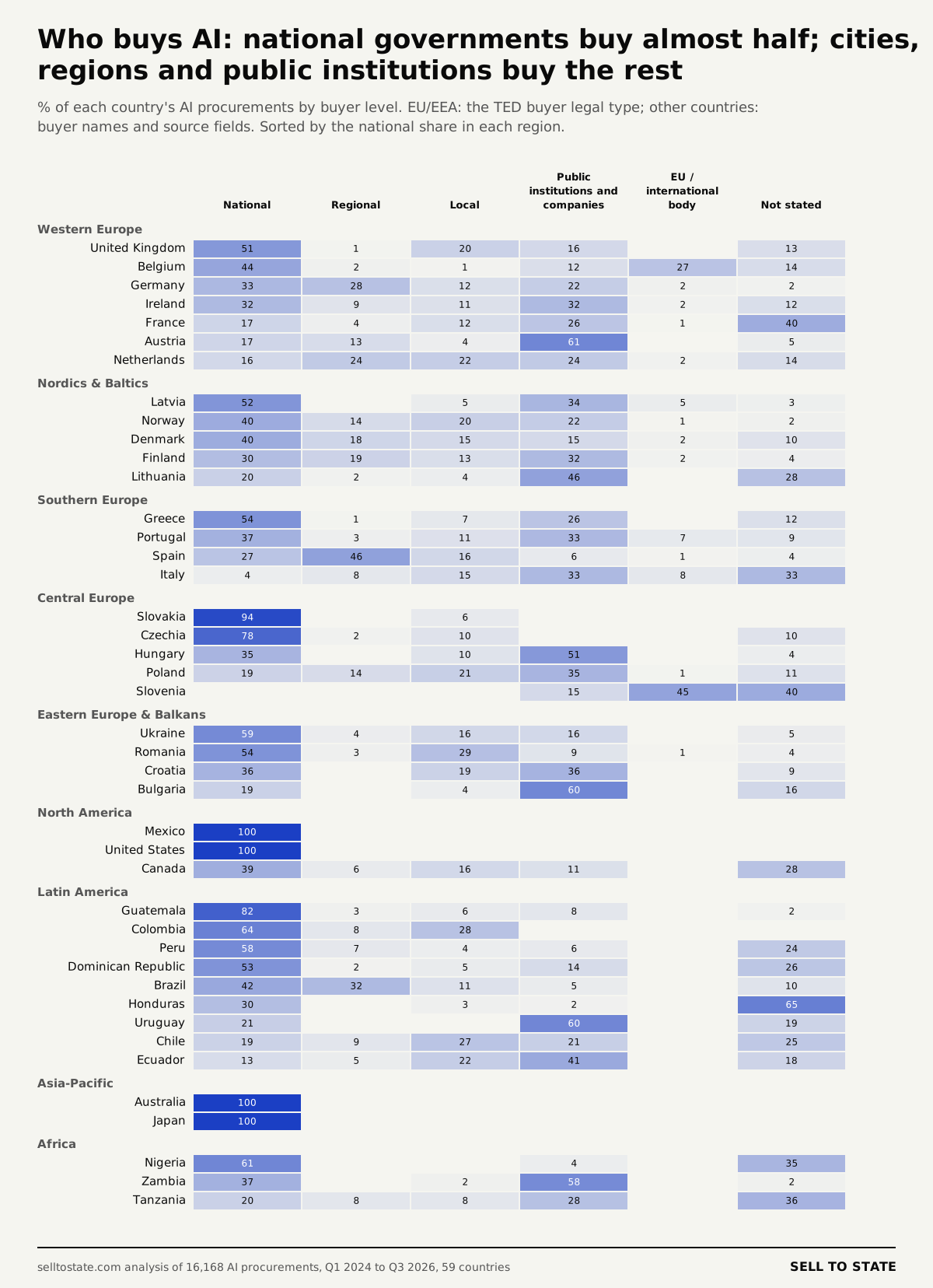
- V16: Who buys AI: national governments buy almost half; cities, regions and public institutions buy the rest. PNG · SVG
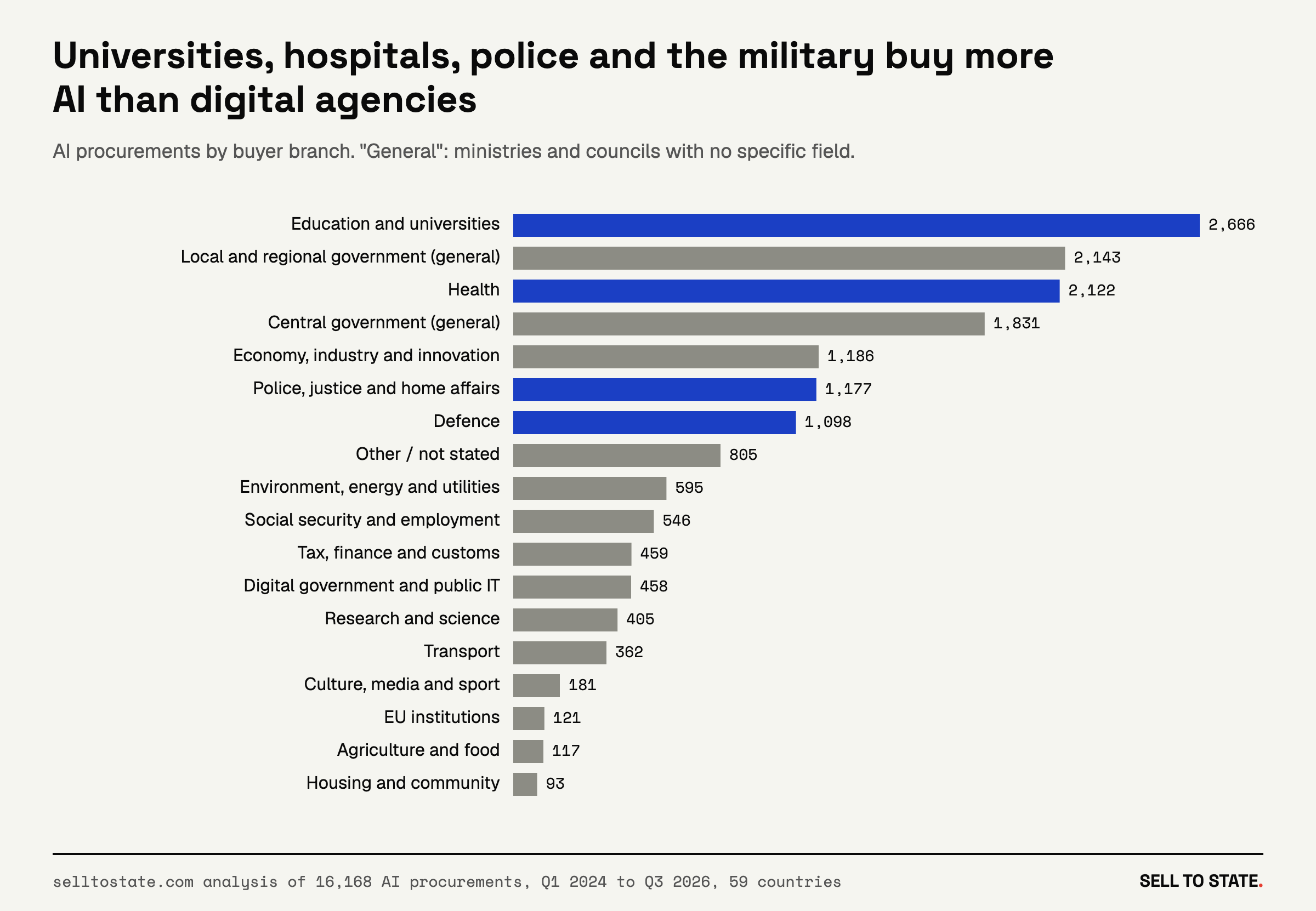
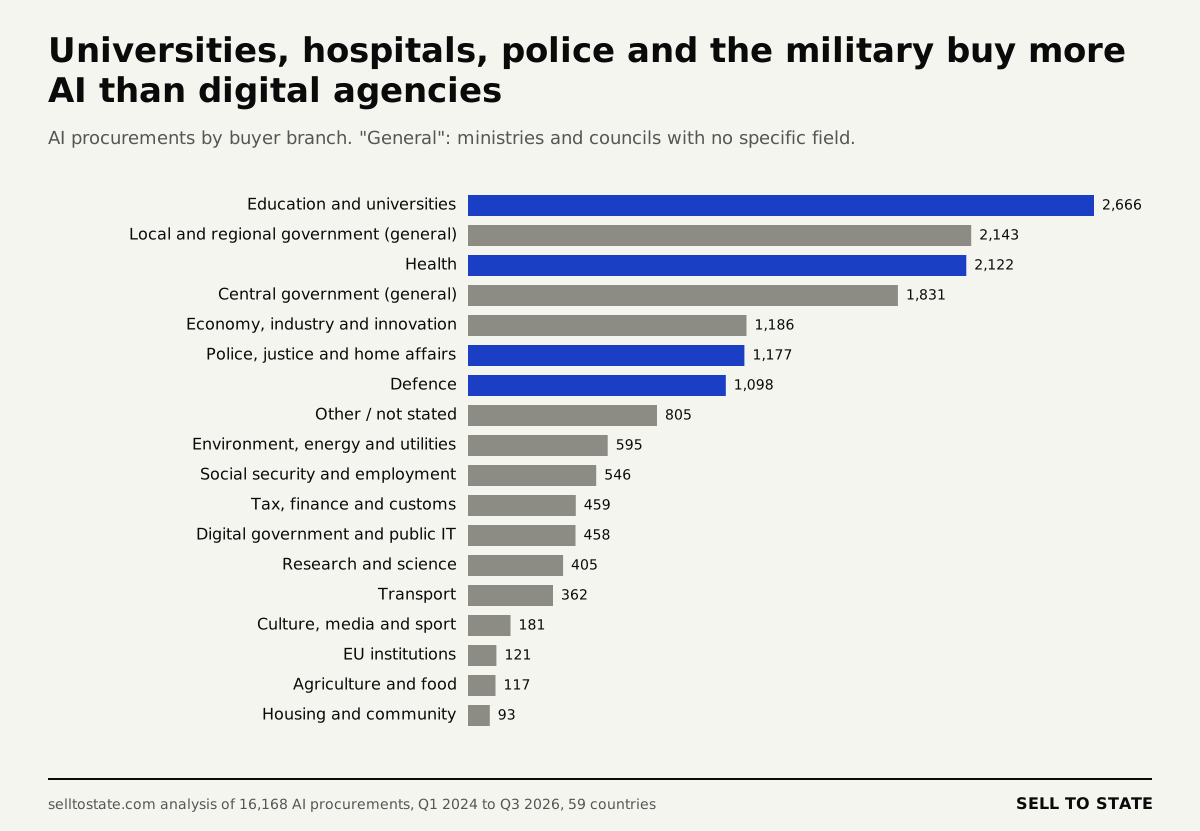
- V17: Universities, hospitals, police and the military buy more AI than digital agencies. PNG · SVG
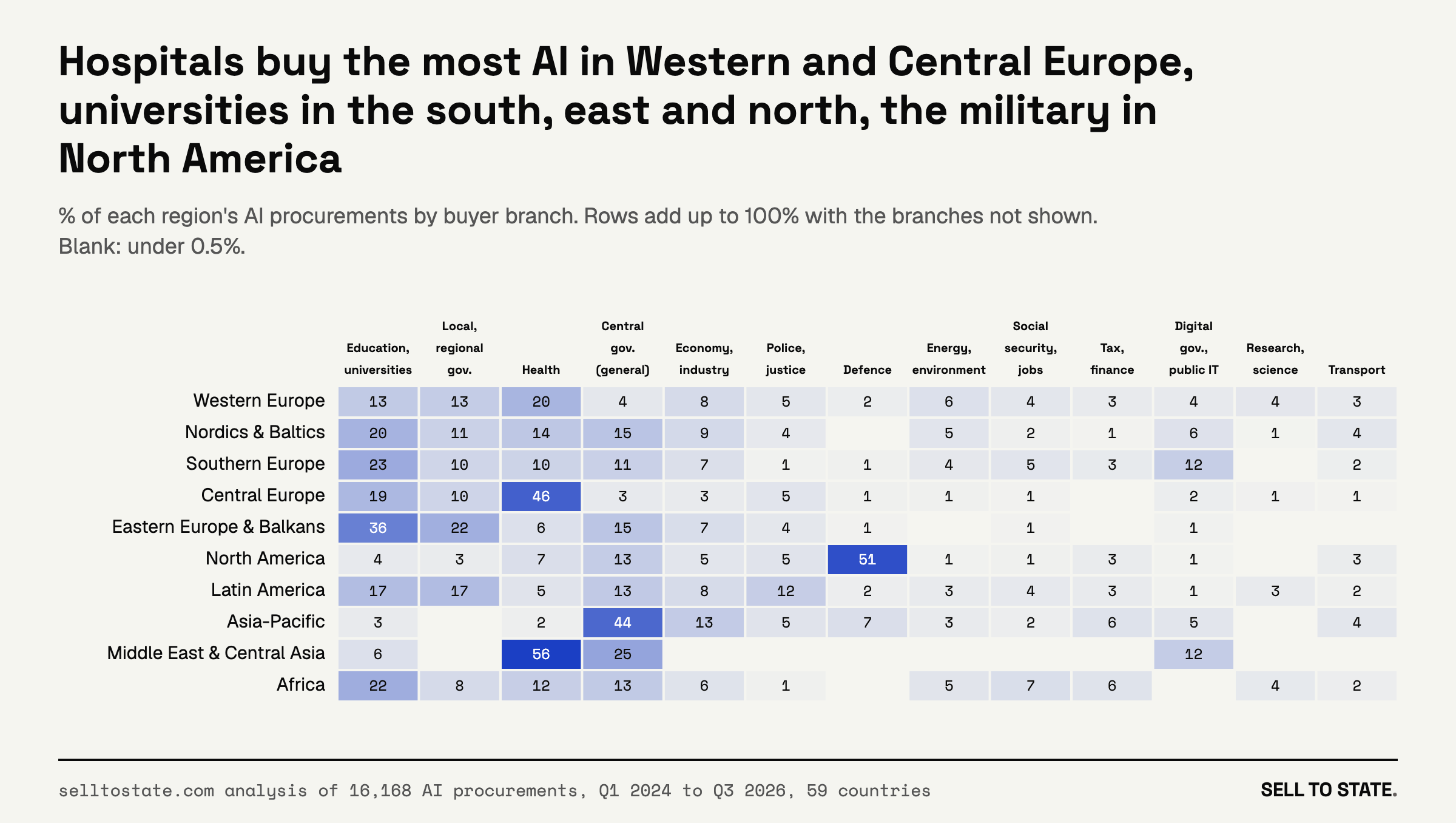
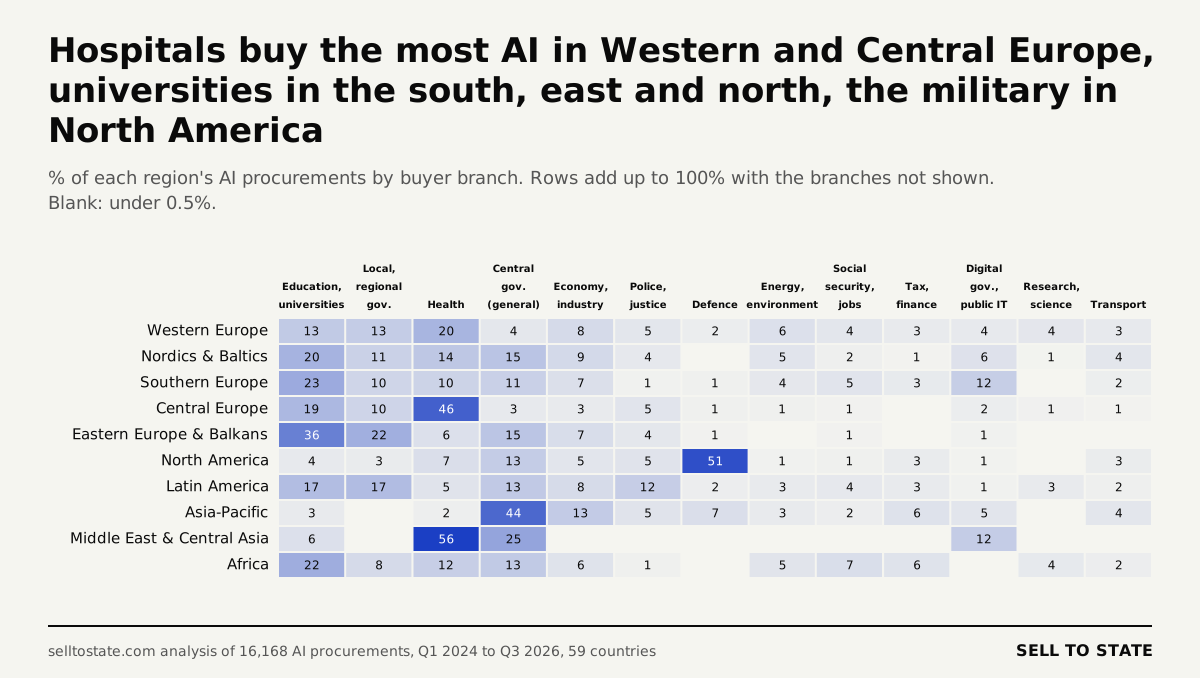
- V18: Hospitals buy the most AI in Western and Central Europe, universities in the south, east and north, the military in North America. PNG · SVG
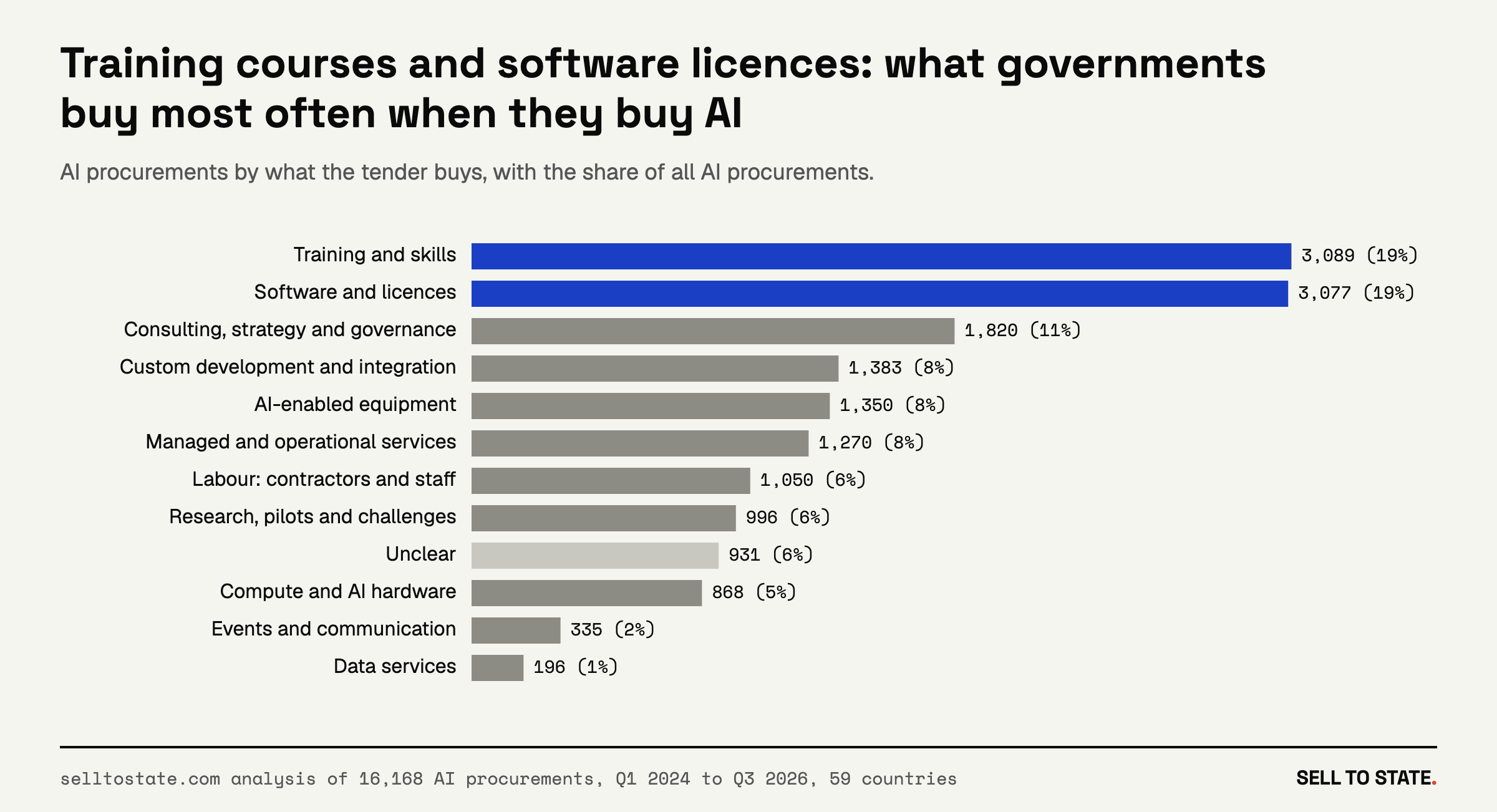
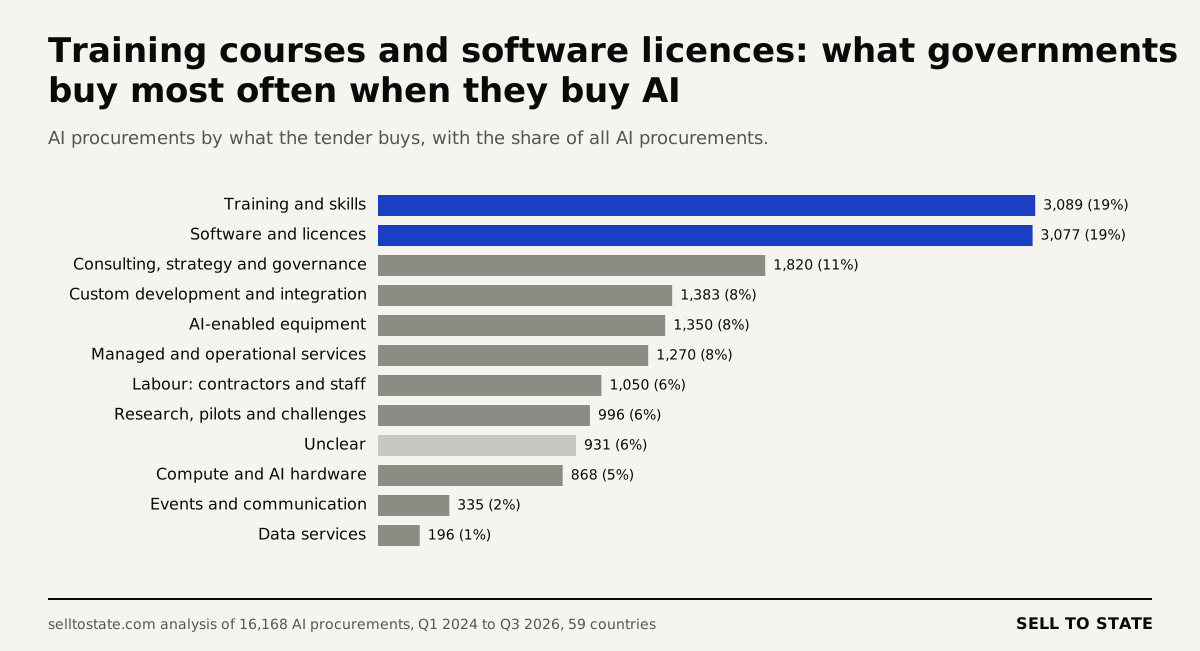
- V19: Training courses and software licences: what governments buy most often when they buy AI. PNG · SVG
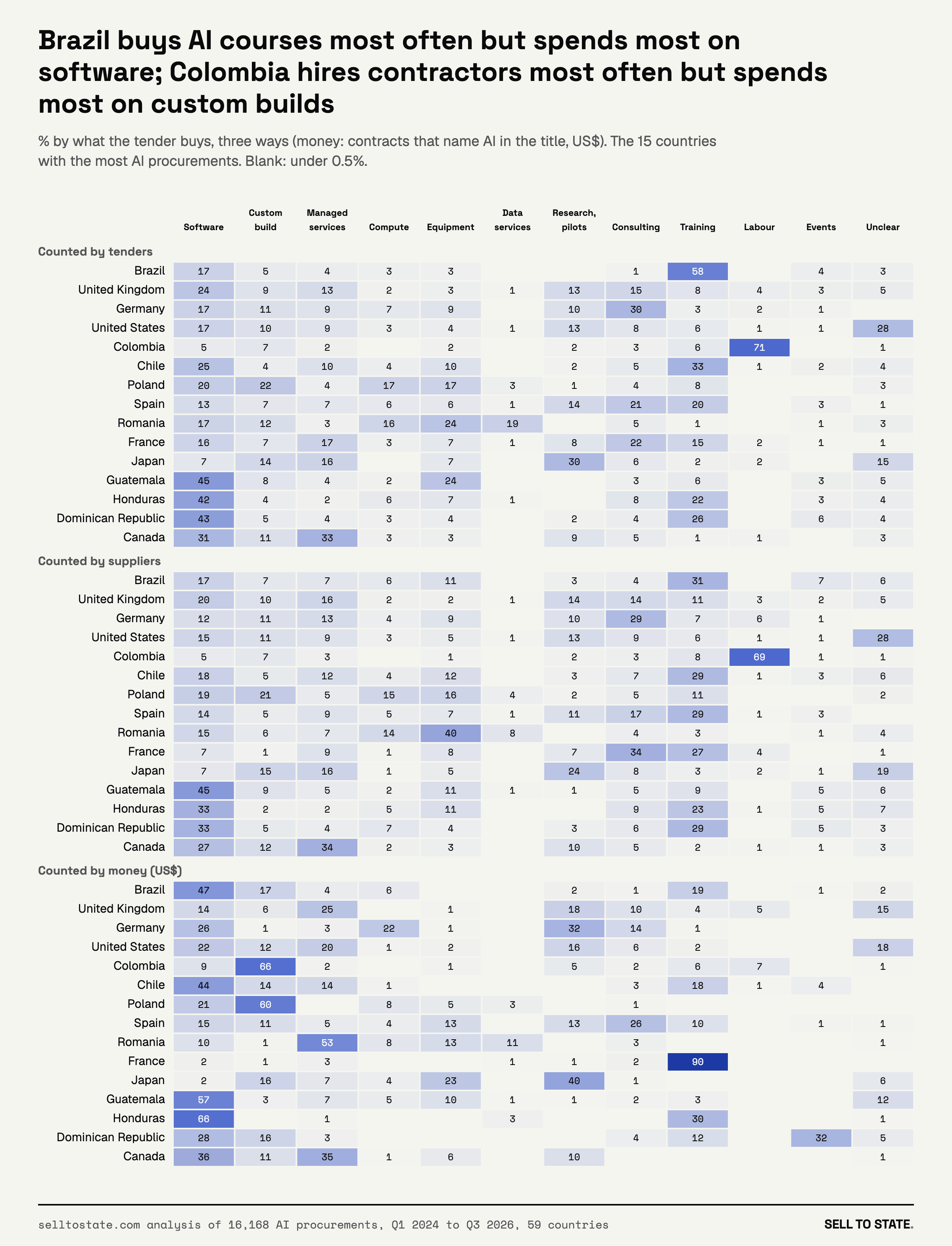
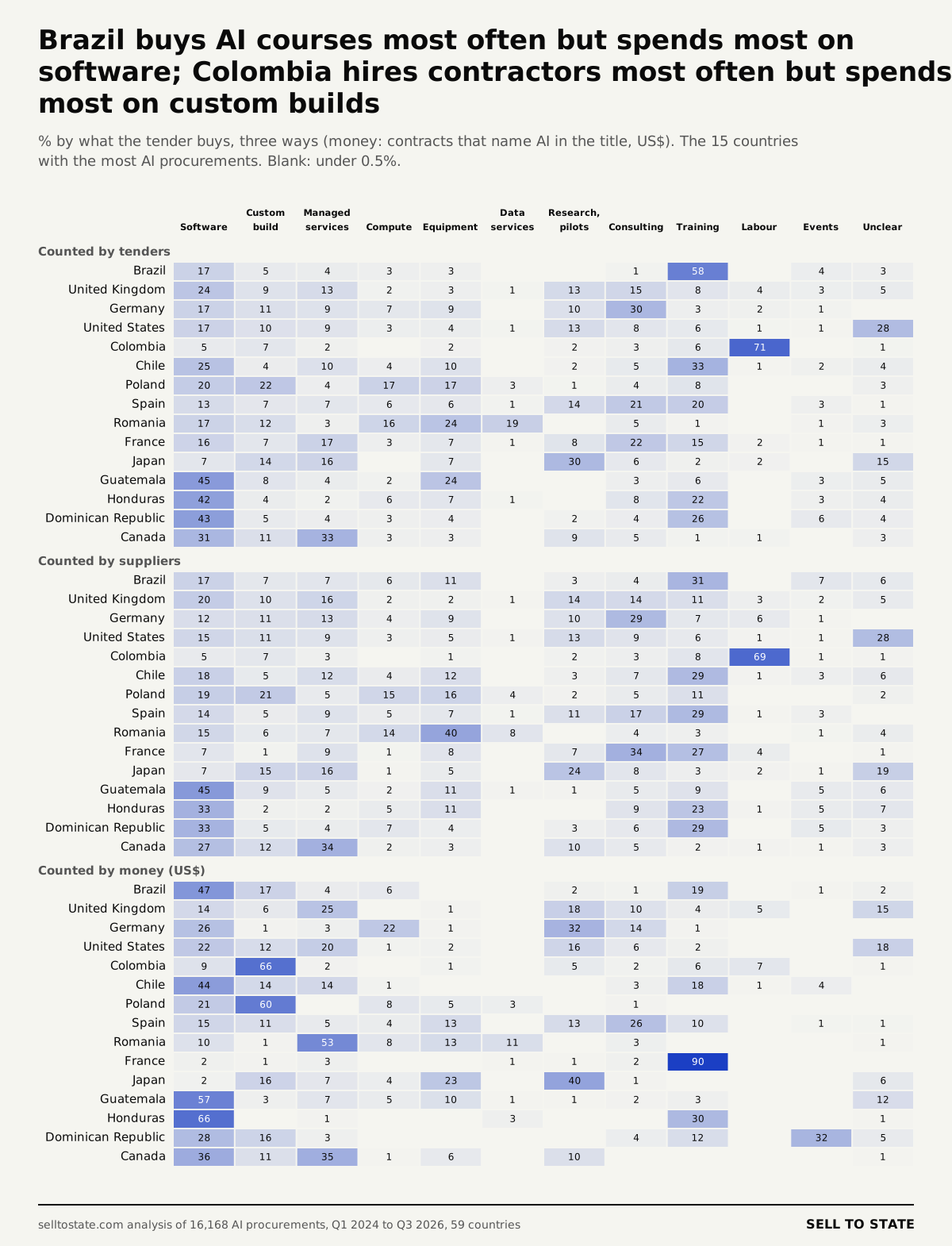
- V20: Brazil buys AI courses most often but spends most on software; Colombia hires contractors most often but spends most on custom builds. PNG · SVG
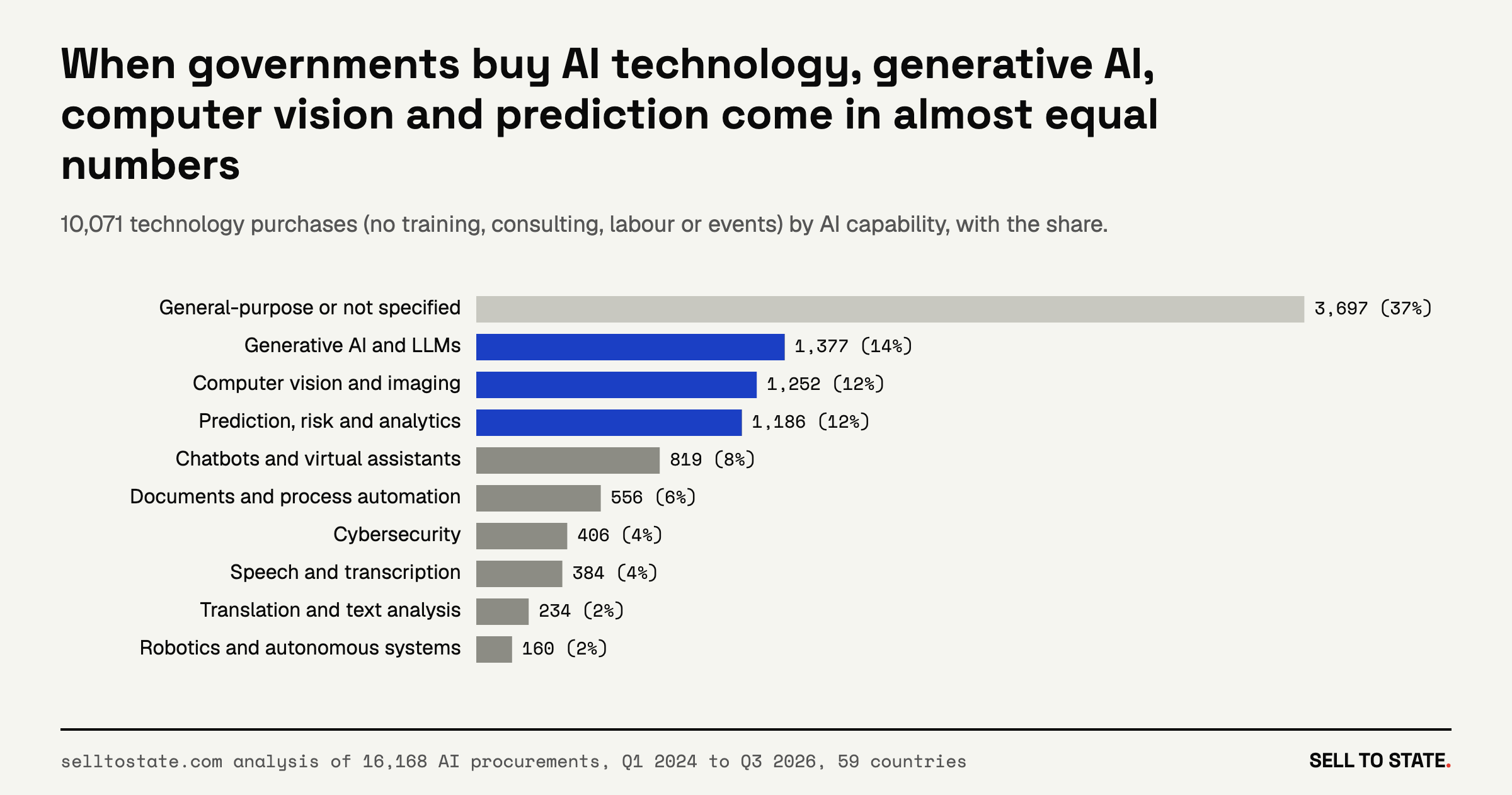
- V21: When governments buy AI technology, generative AI, computer vision and prediction come in almost equal numbers. PNG · SVG
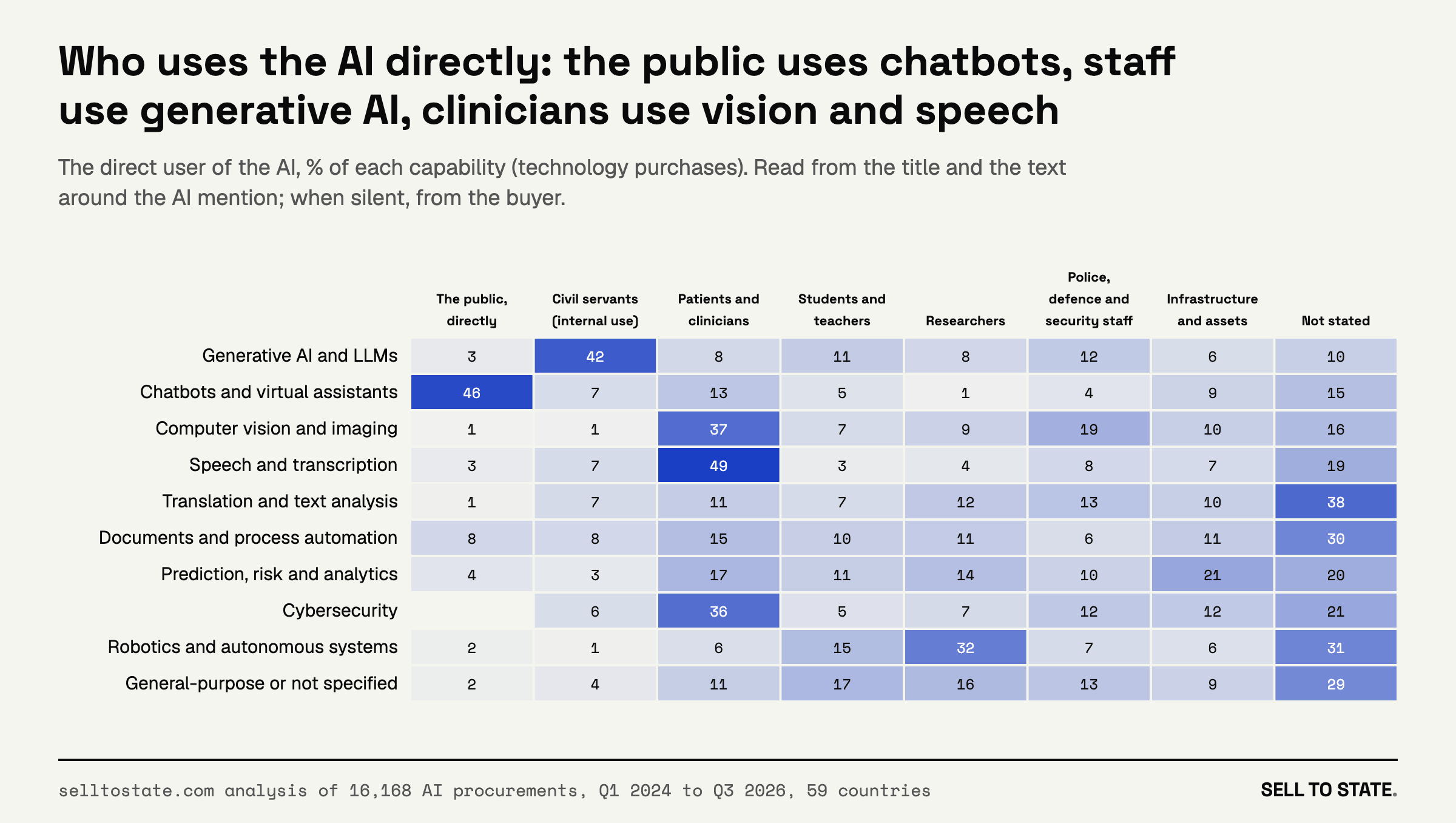
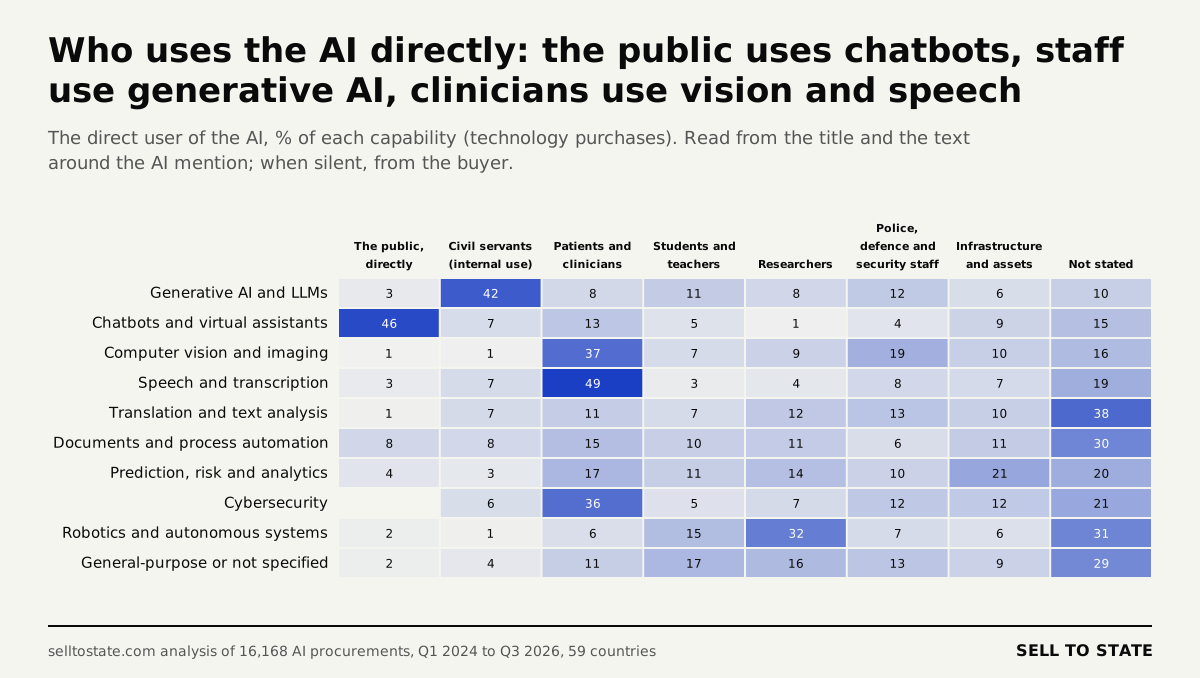
- V22: Who uses the AI directly: the public uses chatbots, staff use generative AI, clinicians use vision and speech. PNG · SVG
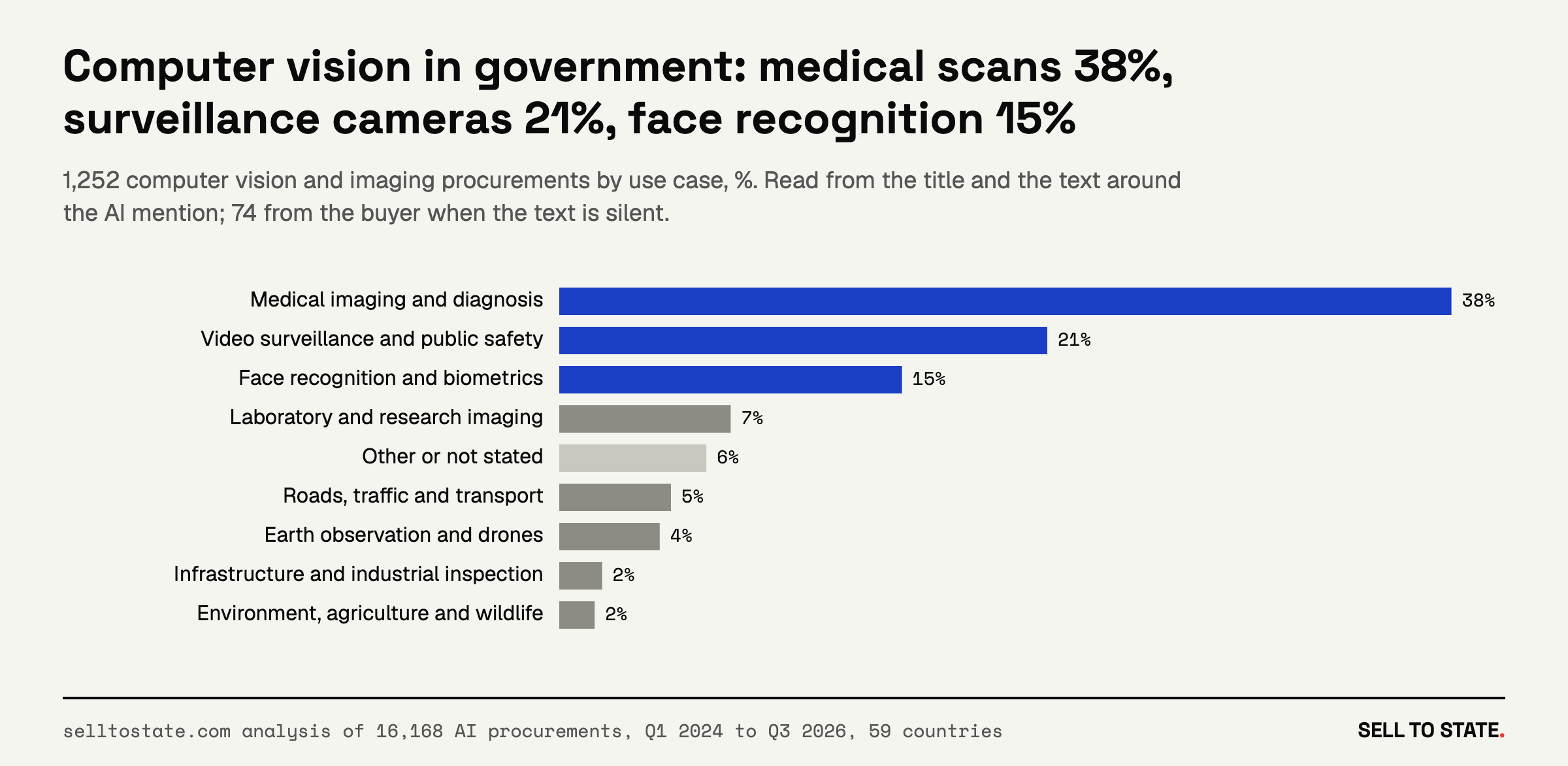
- V23: Computer vision in government: medical scans 38%, surveillance cameras 21%, face recognition 15%. PNG · SVG
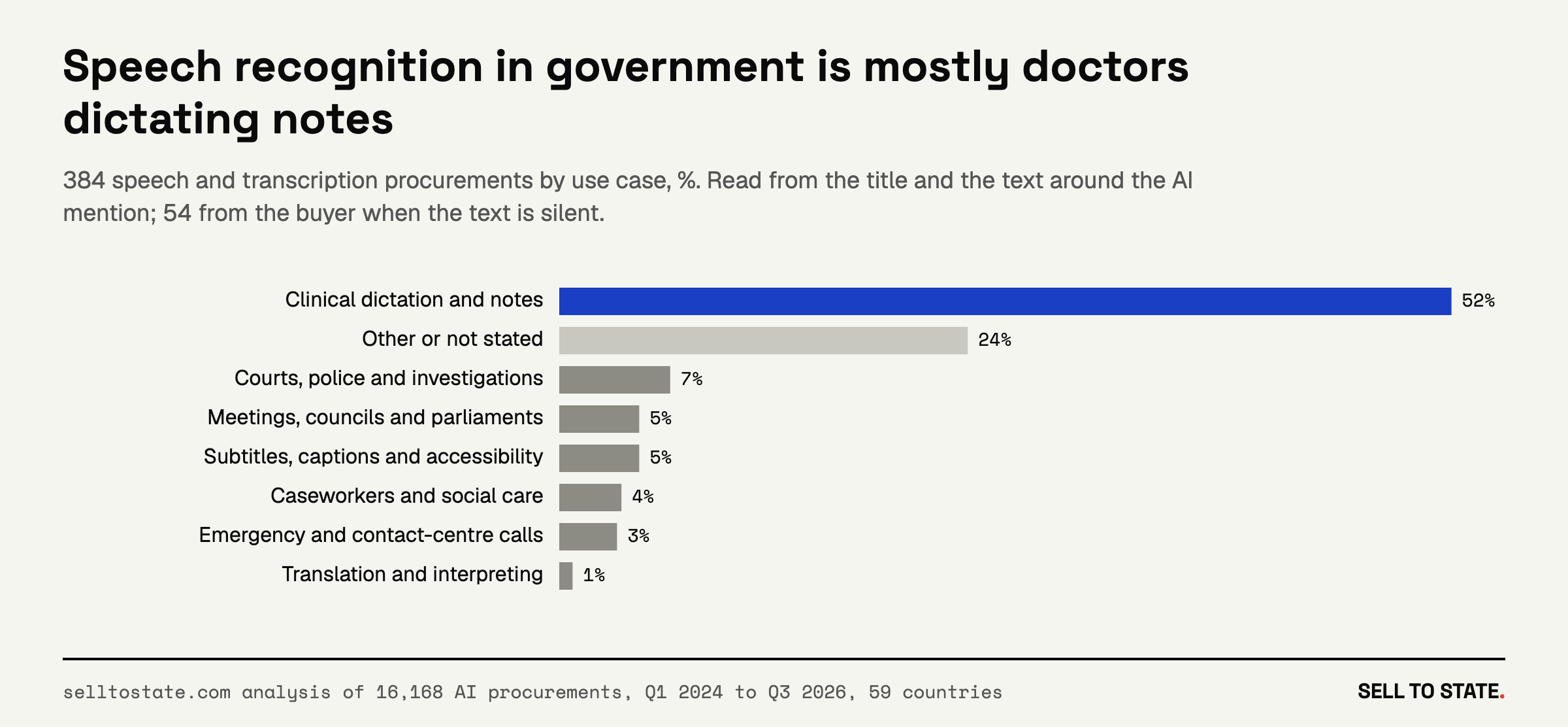
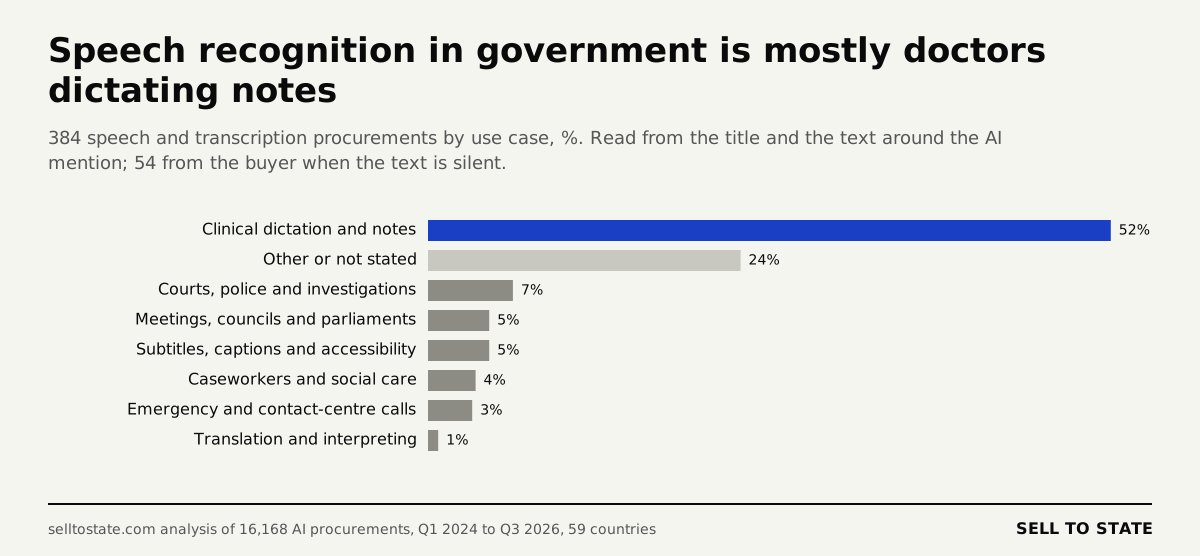
- V24: Speech recognition in government is mostly doctors dictating notes. PNG · SVG
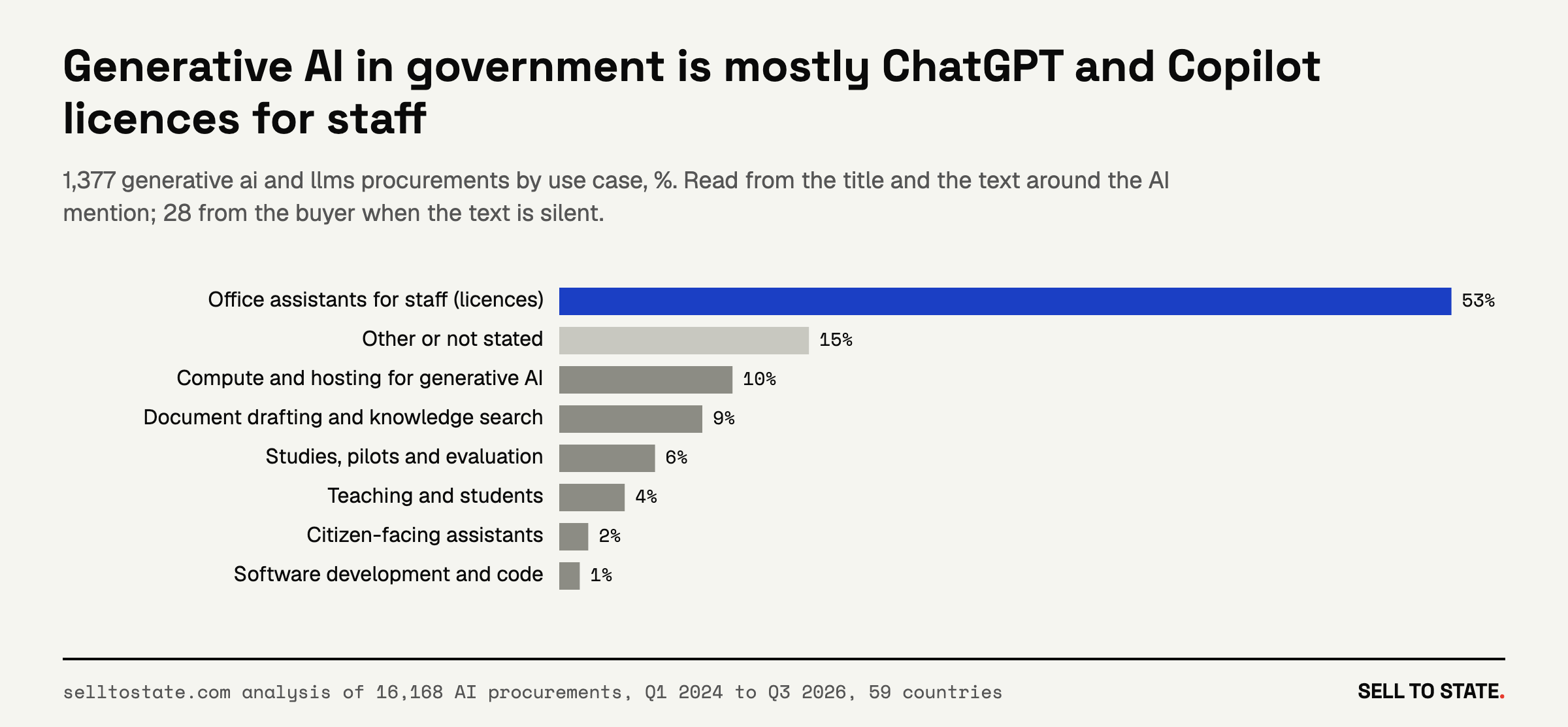
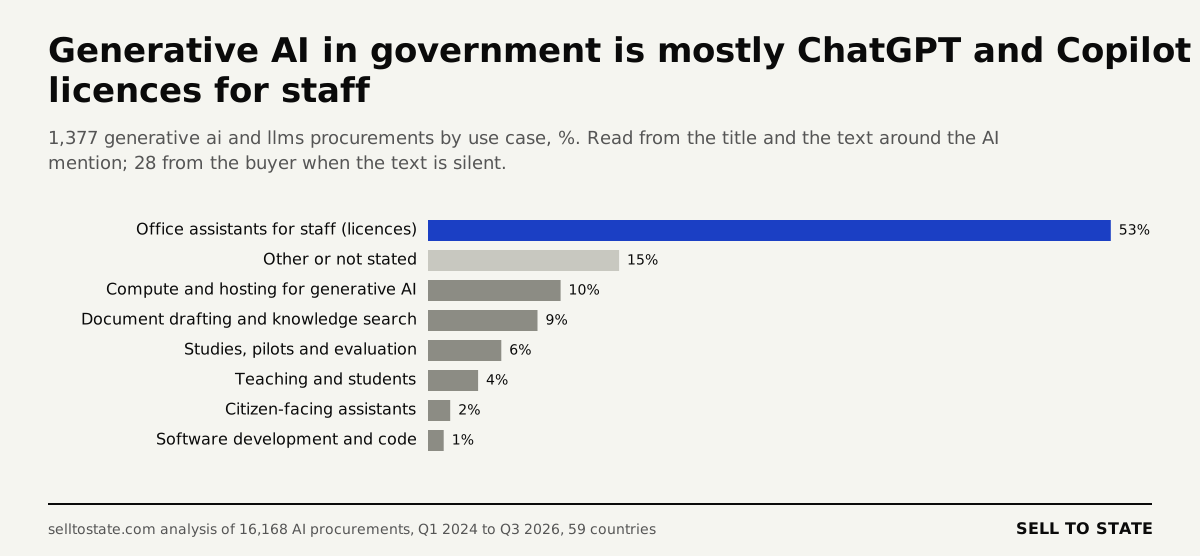
- V25: Generative AI in government is mostly ChatGPT and Copilot licences for staff. PNG · SVG
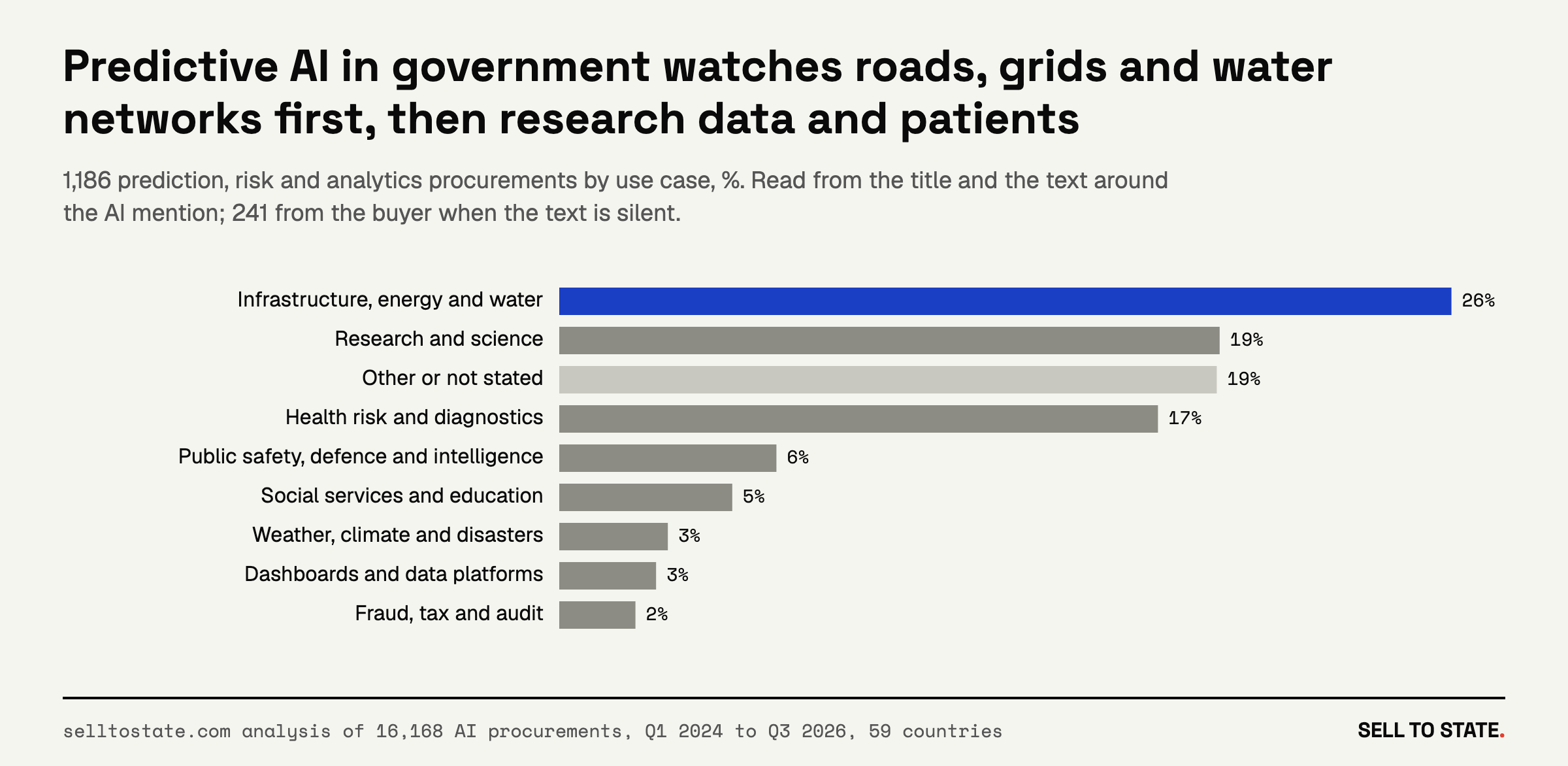
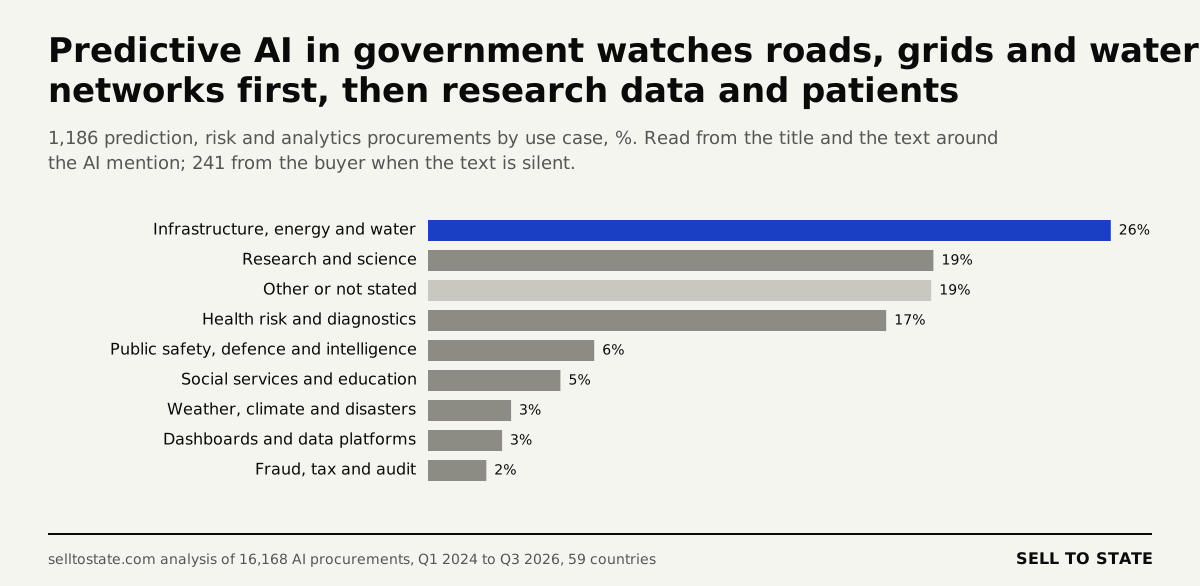
- V26: Predictive AI in government watches roads, grids and water networks first, then research data and patients. PNG · SVG
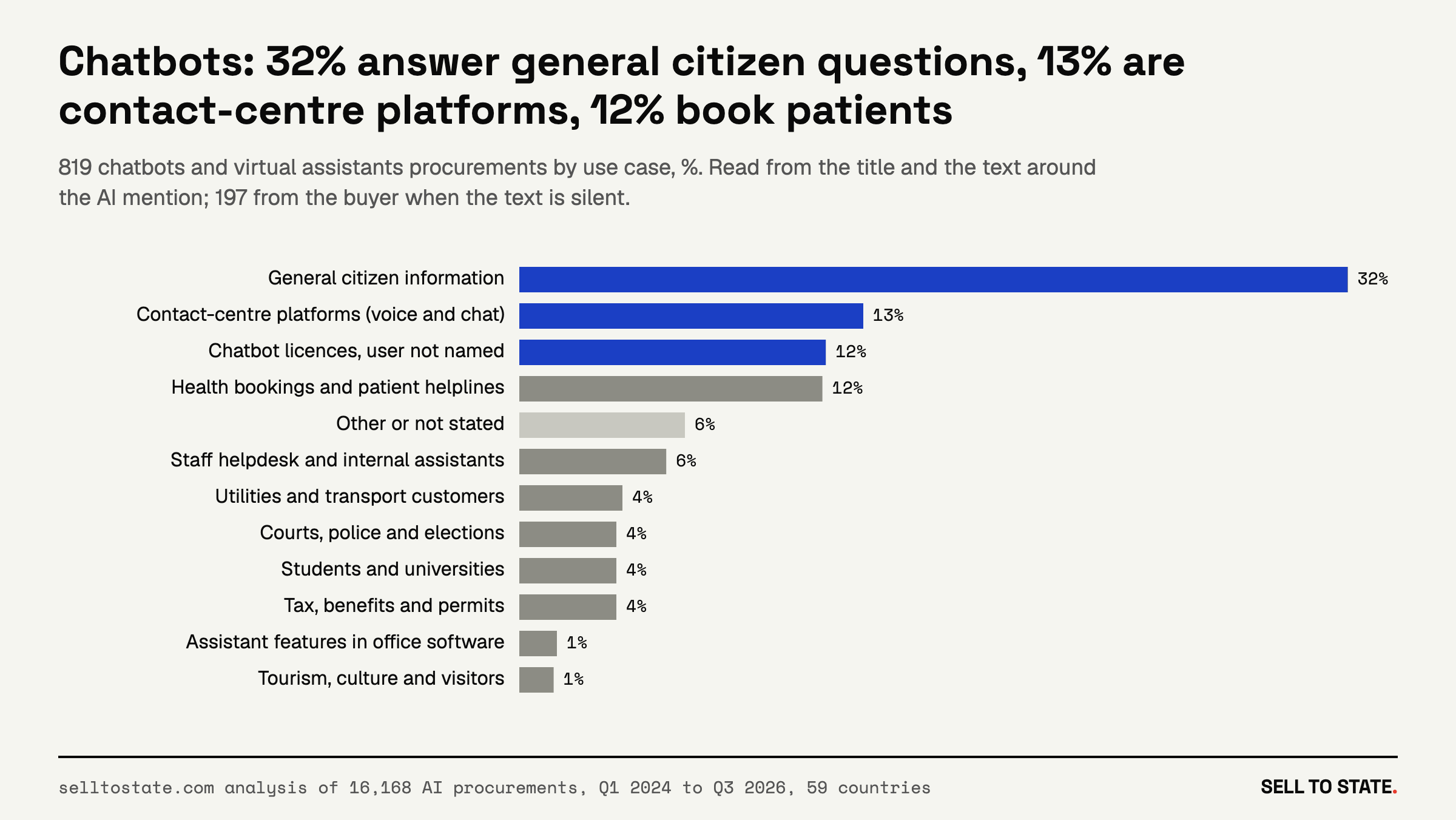
- V27: Chatbots: 32% answer general citizen questions, 13% are contact-centre platforms, 12% book patients. PNG · SVG
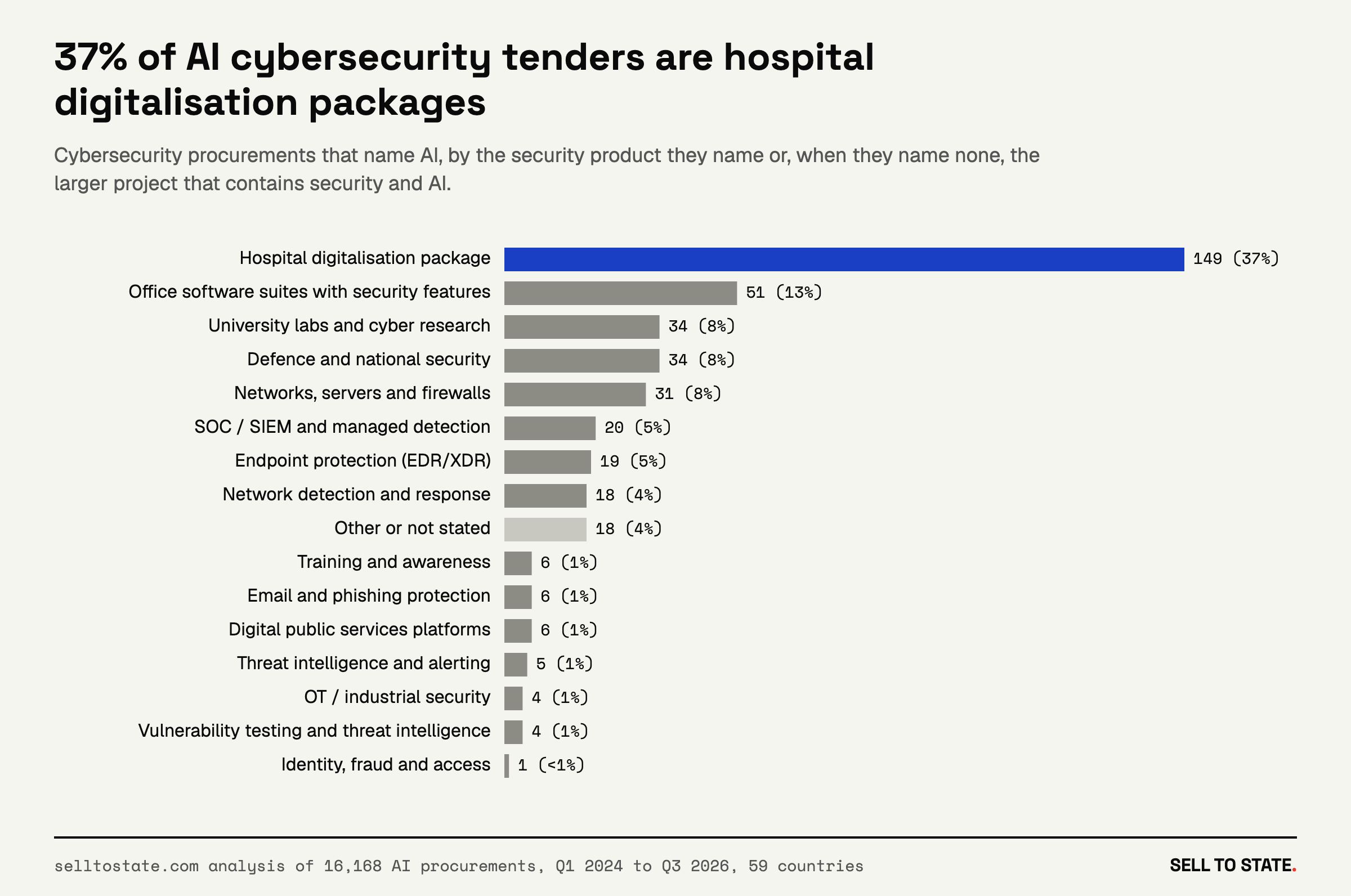
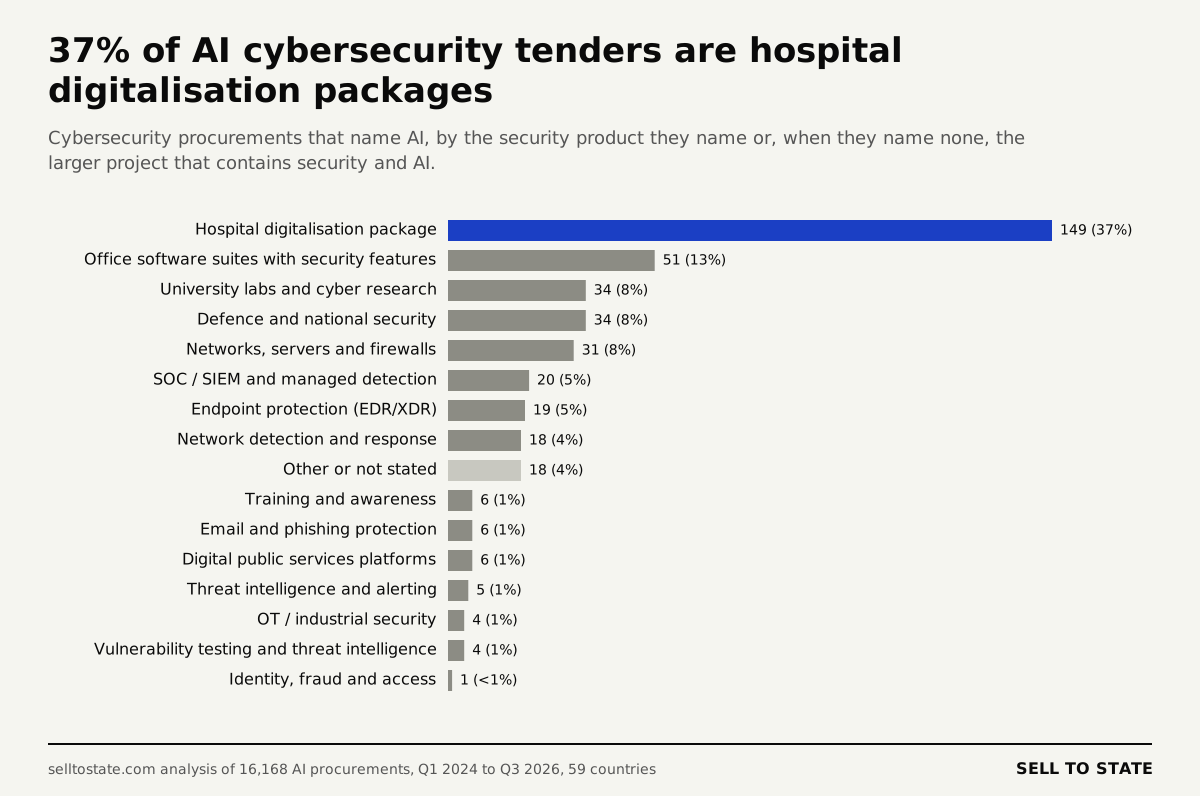
- V28: 37% of AI cybersecurity tenders are hospital digitalisation packages. PNG · SVG
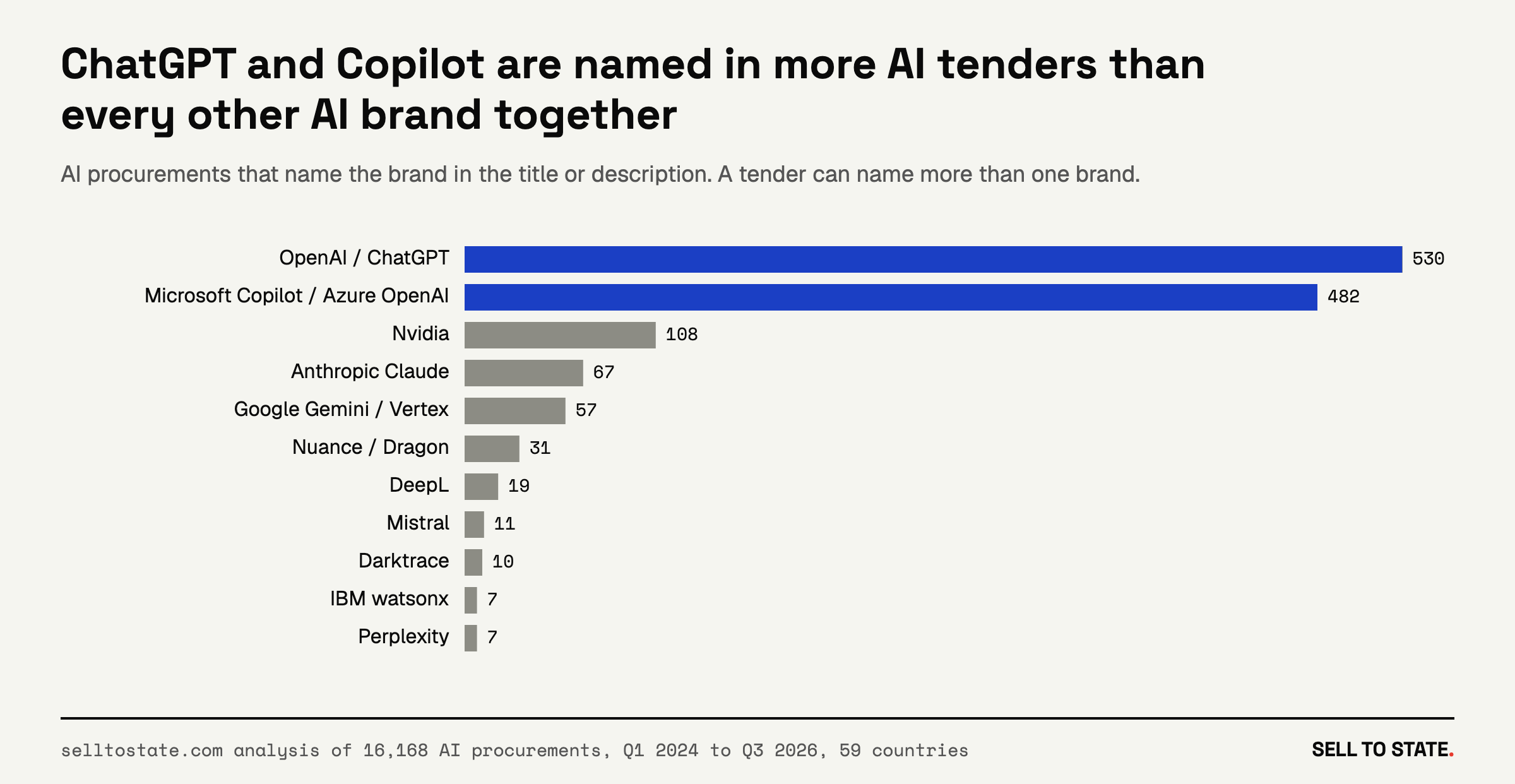
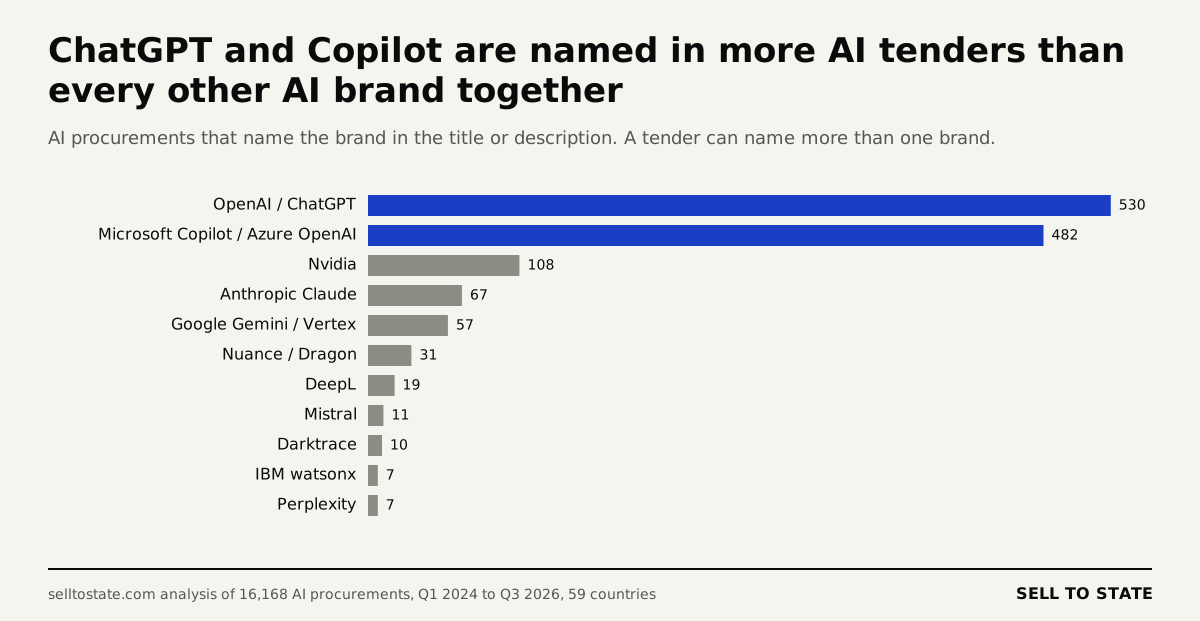
- V29: ChatGPT and Copilot are named in more AI tenders than every other AI brand together. PNG · SVG
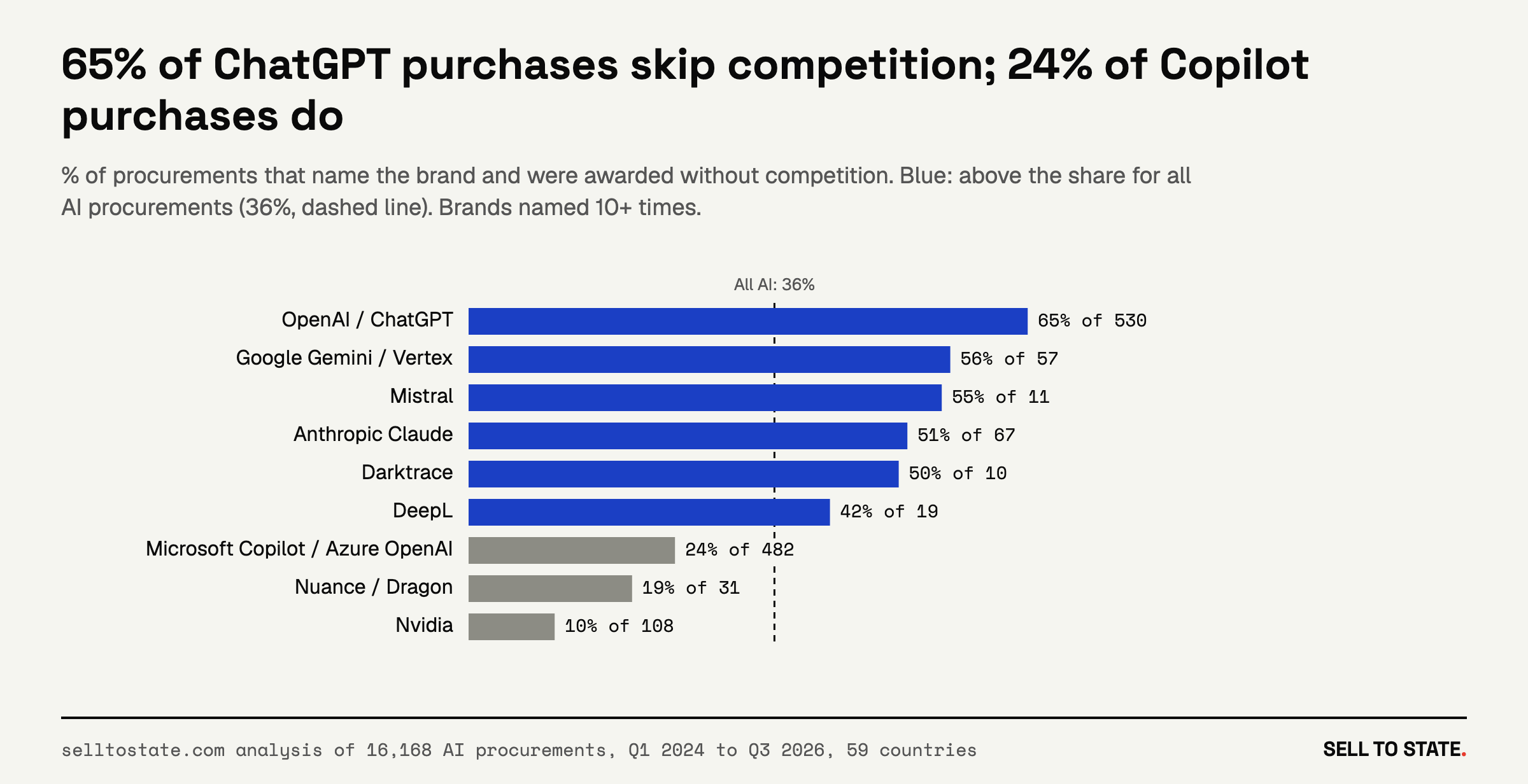
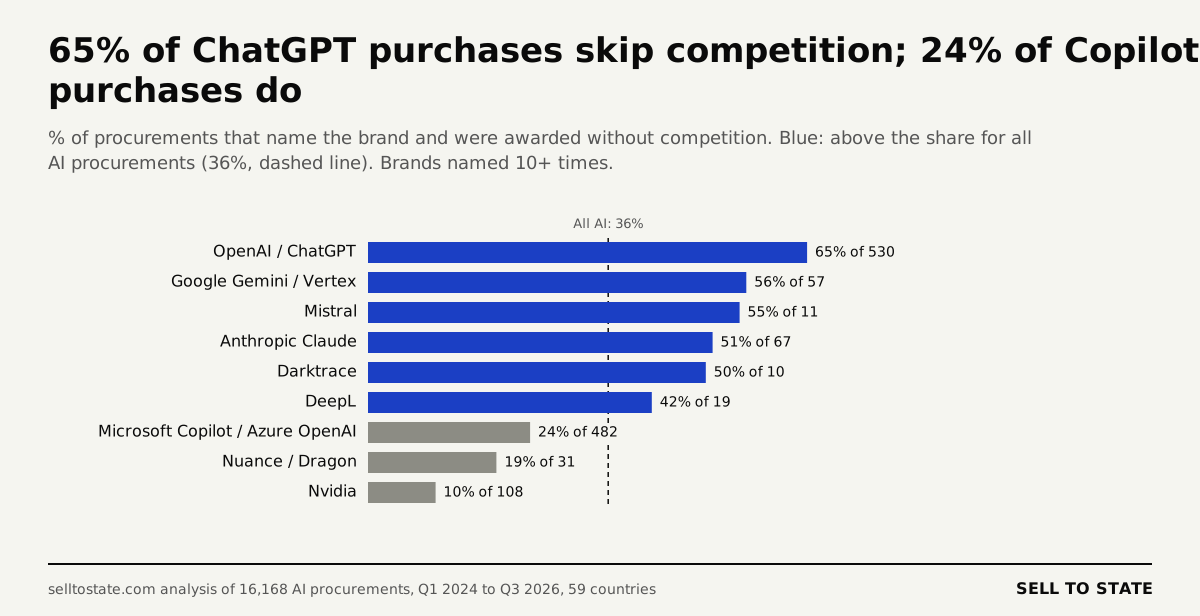
- V30: 65% of ChatGPT purchases skip competition; 24% of Copilot purchases do. PNG · SVG
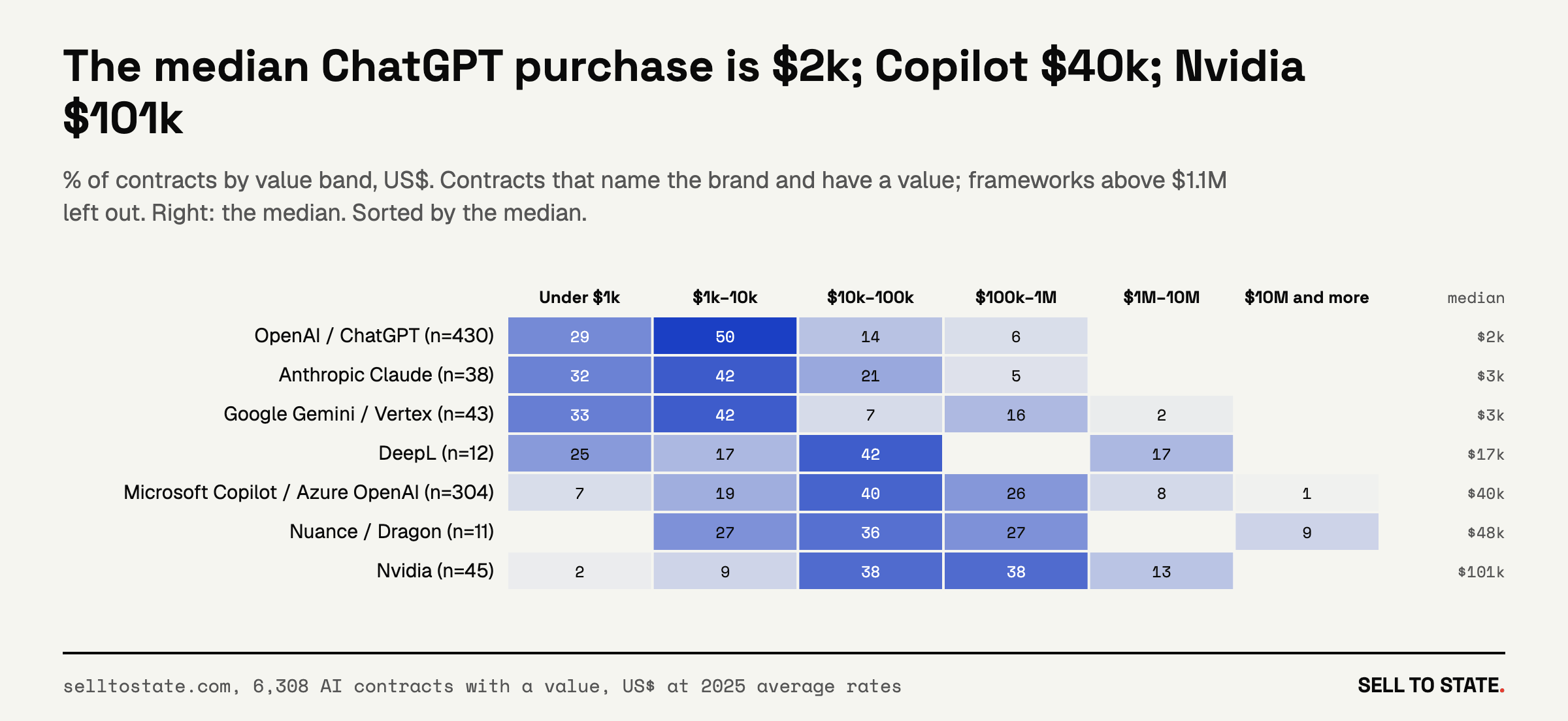
- V31: The median ChatGPT purchase is $2k; Copilot $40k; Nvidia $101k. PNG · SVG
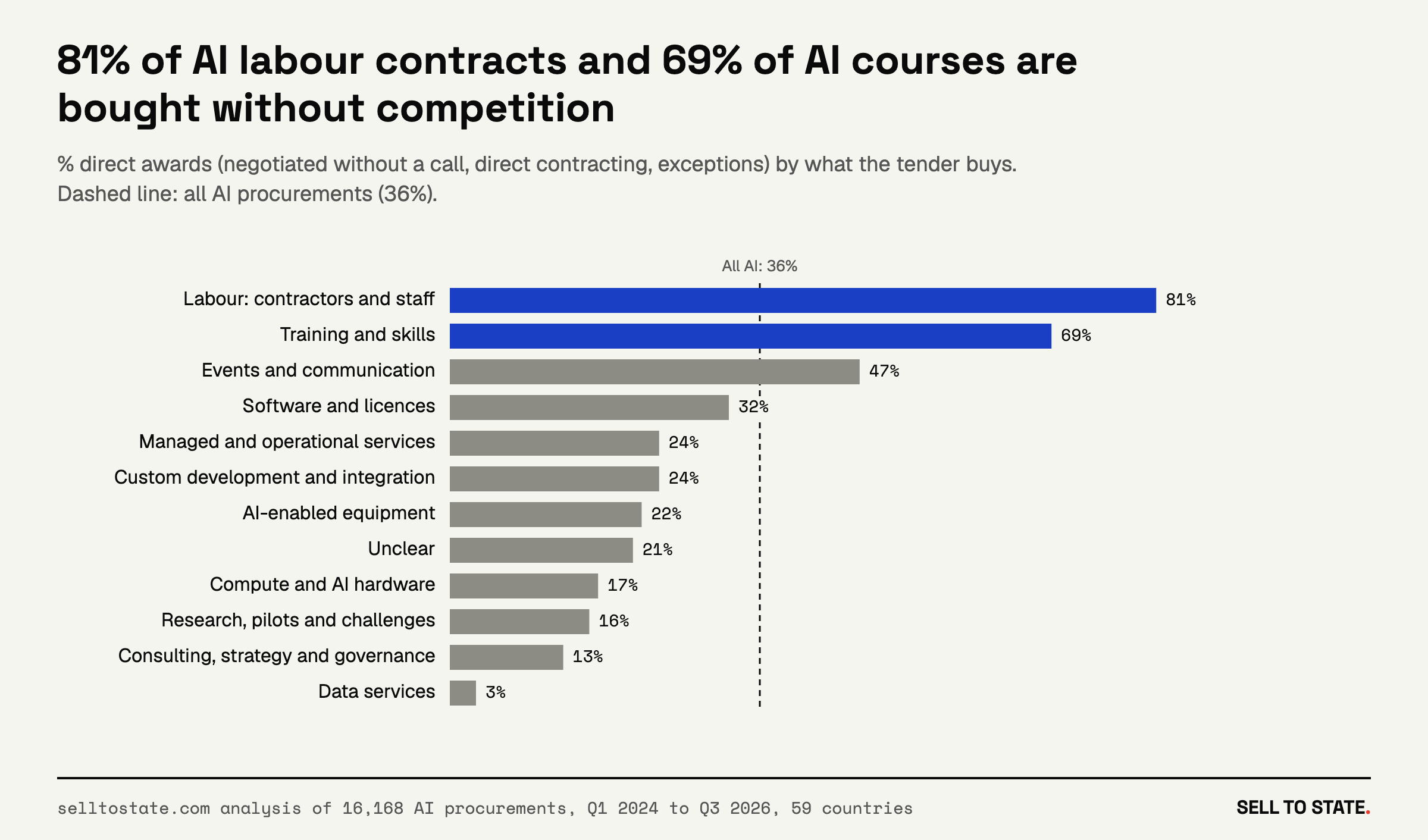
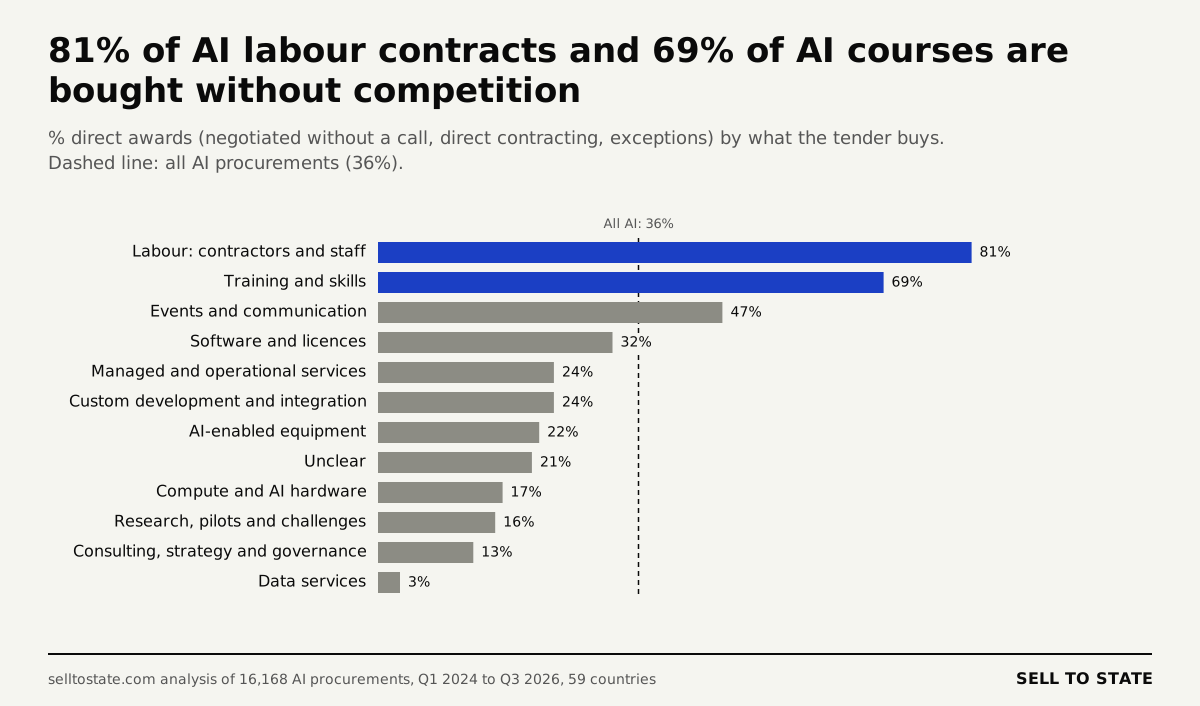
- V32: 81% of AI labour contracts and 69% of AI courses are bought without competition. PNG · SVG
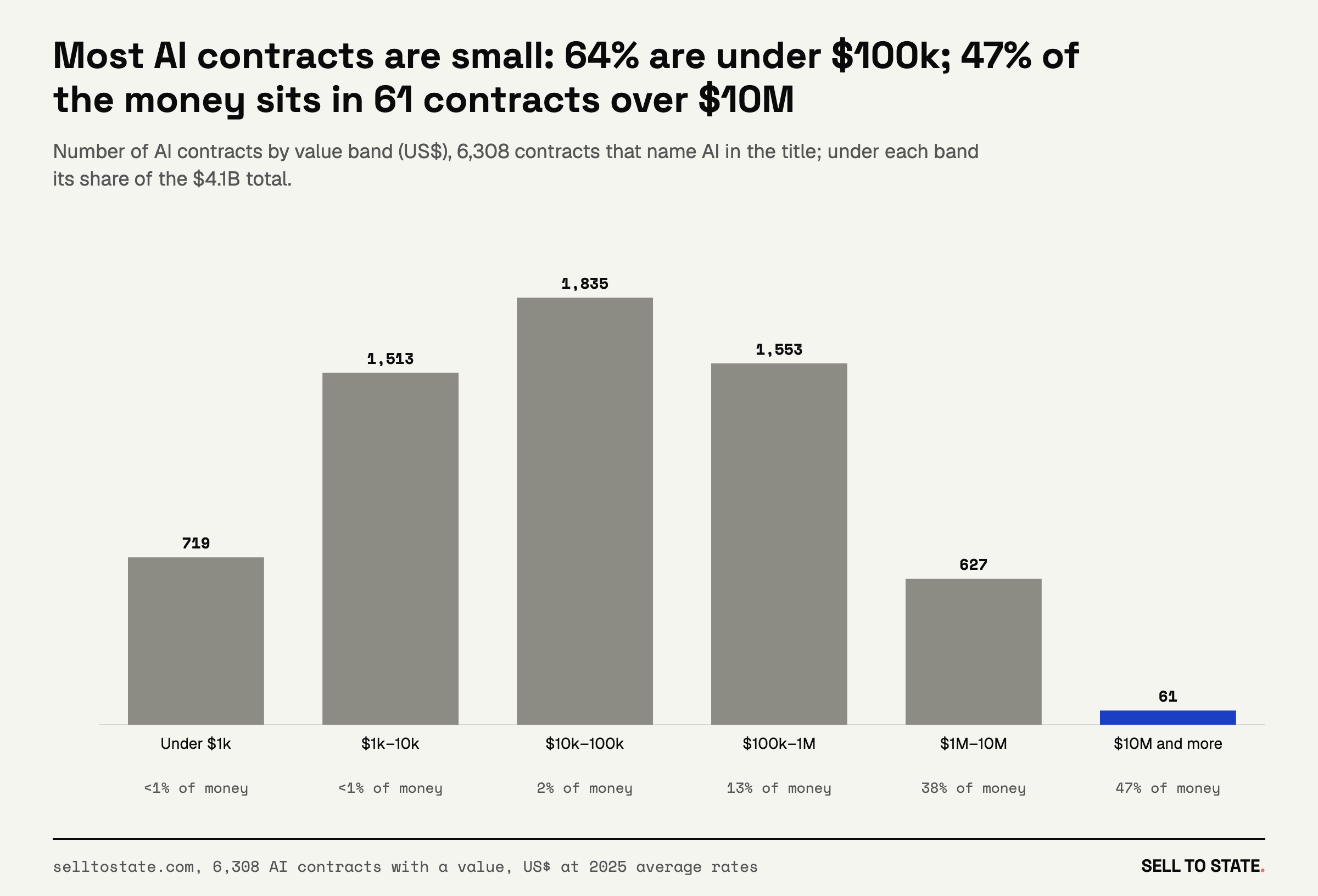
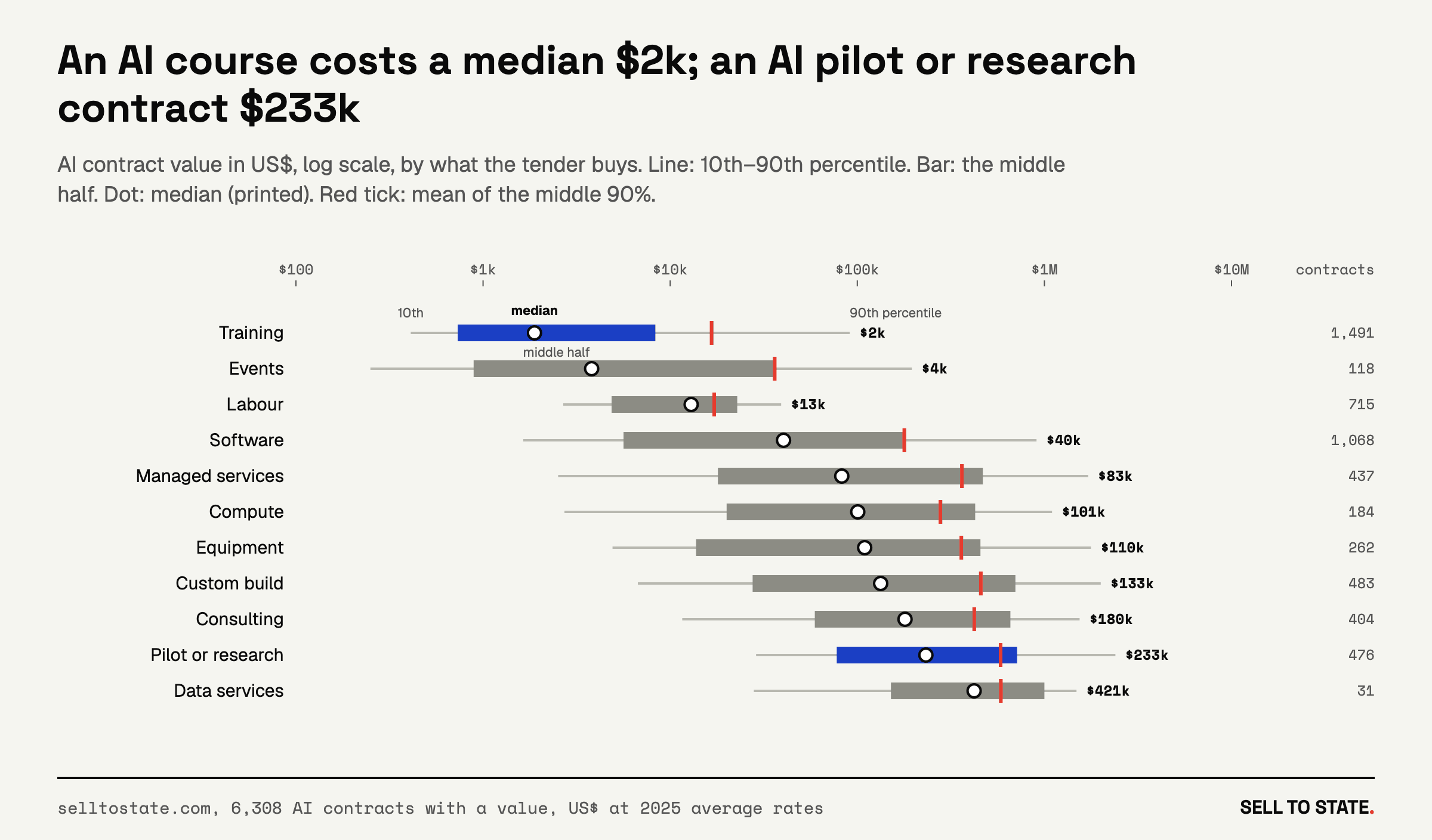
- V33: Most AI contracts are small: 64% are under $100k; 47% of the money sits in 61 contracts over $10M. PNG · SVG
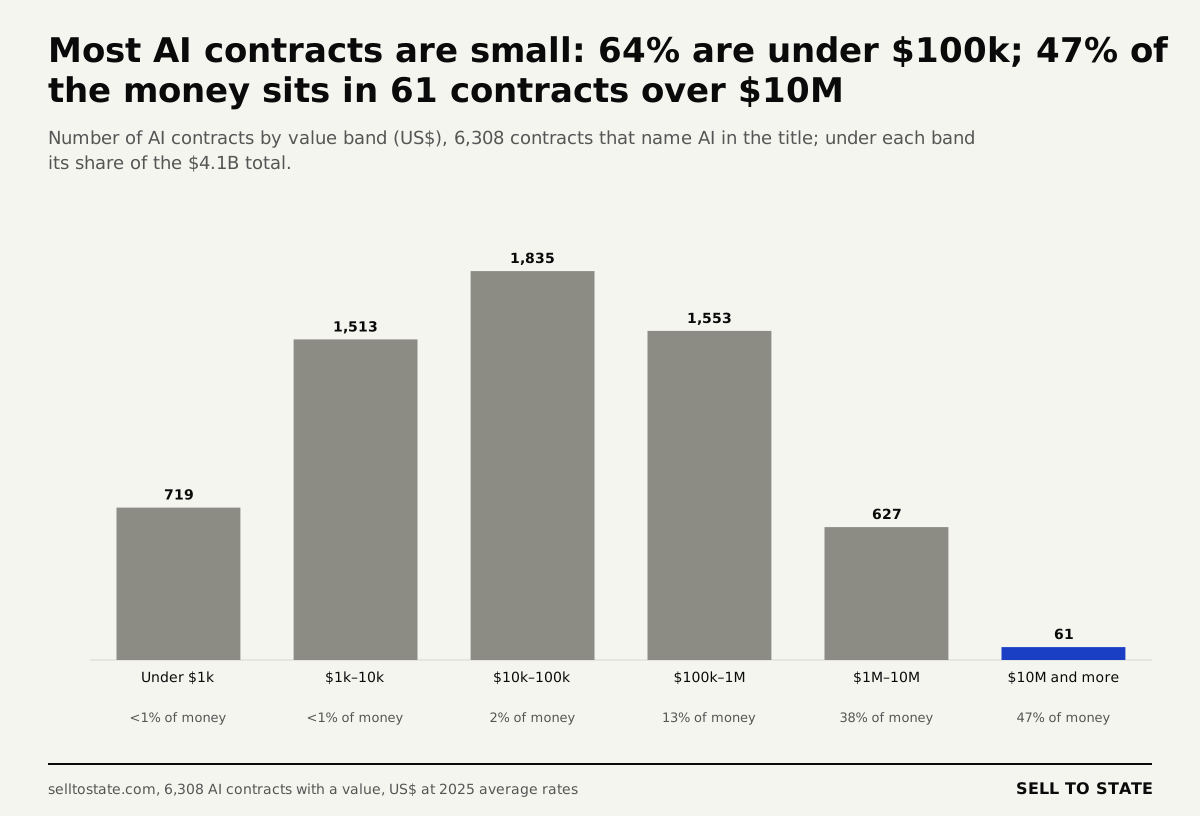
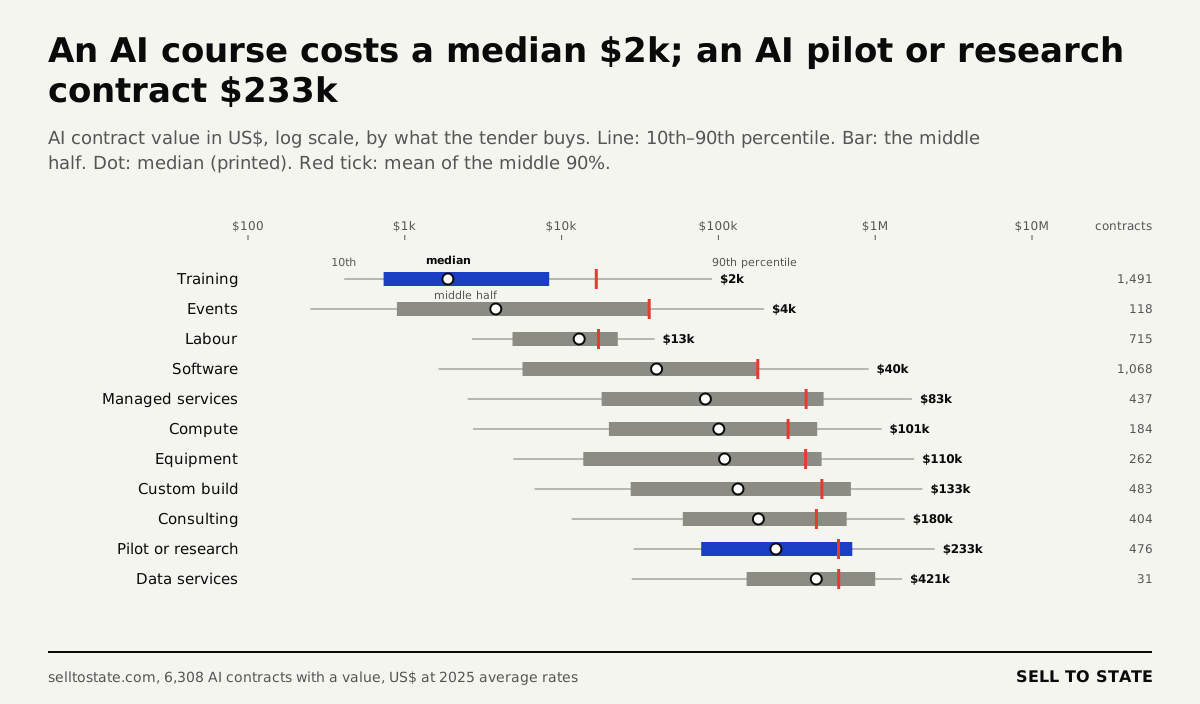
- V34: An AI course costs a median $2k; an AI pilot or research contract $233k. PNG · SVG
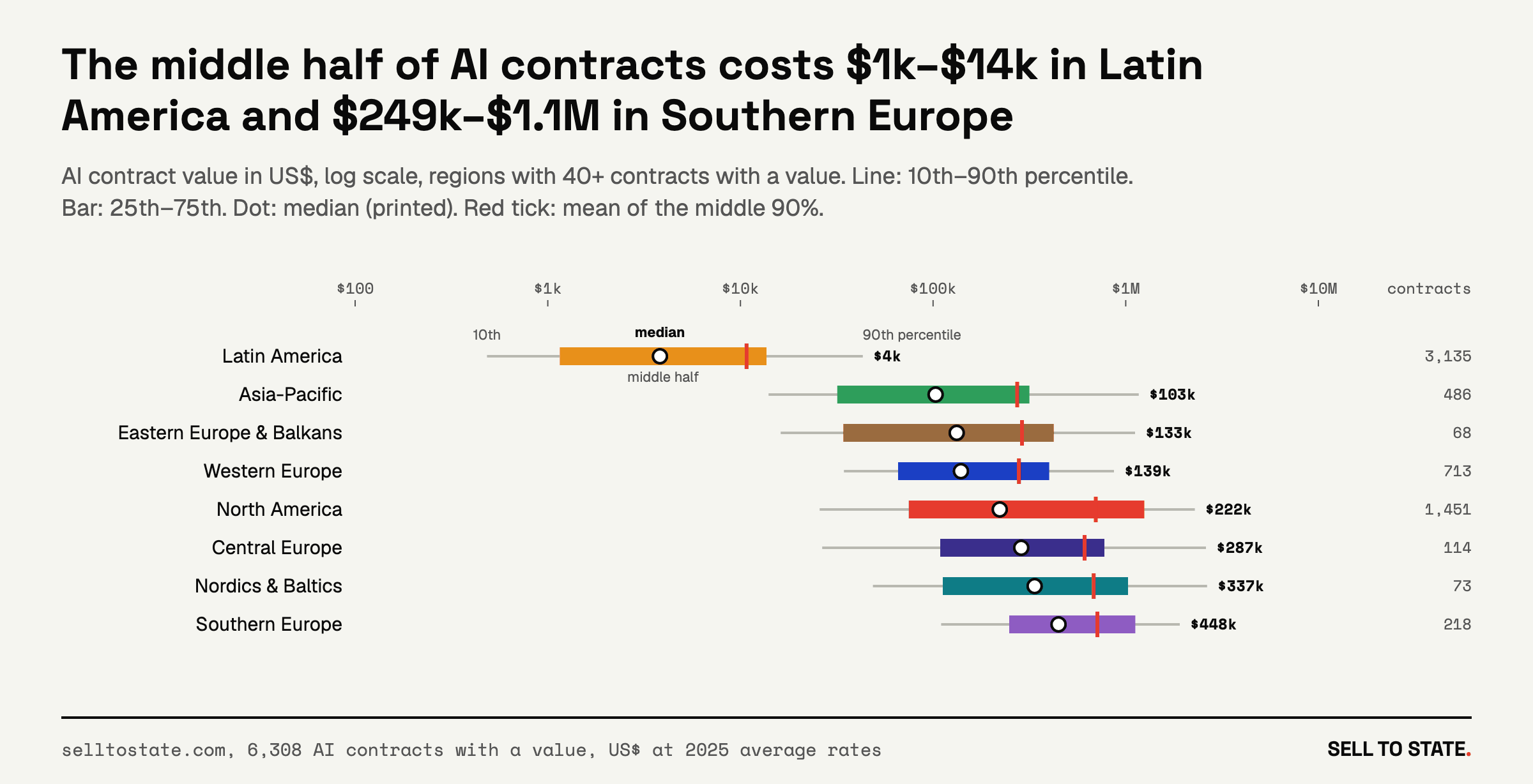
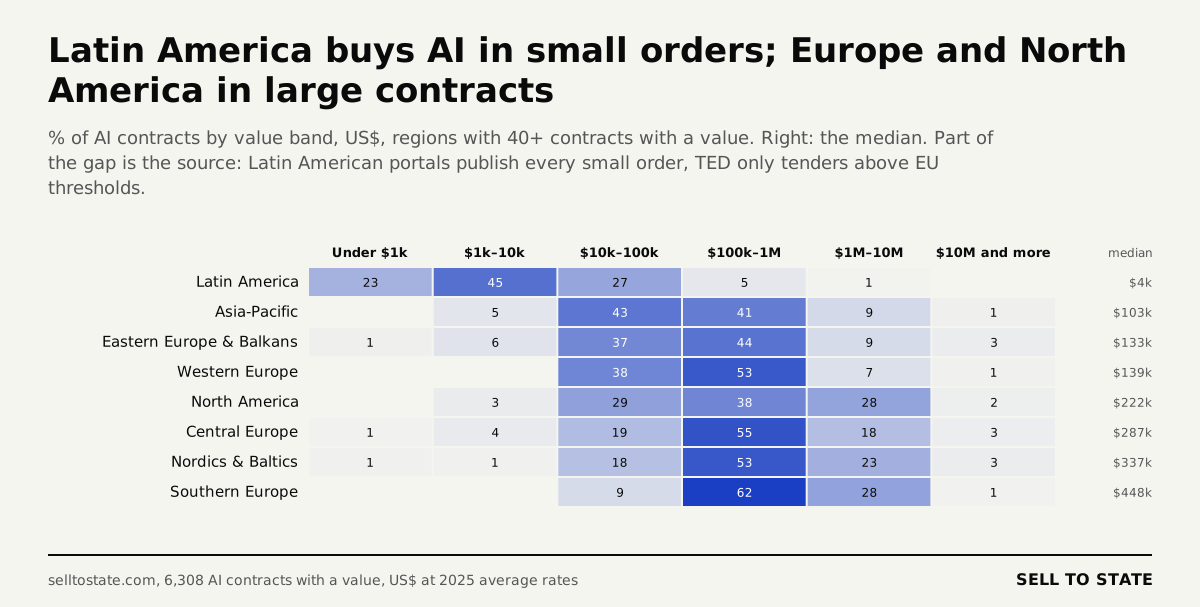
- V35: The middle half of AI contracts costs $1k–$14k in Latin America and $249k–$1.1M in Southern Europe. PNG · SVG
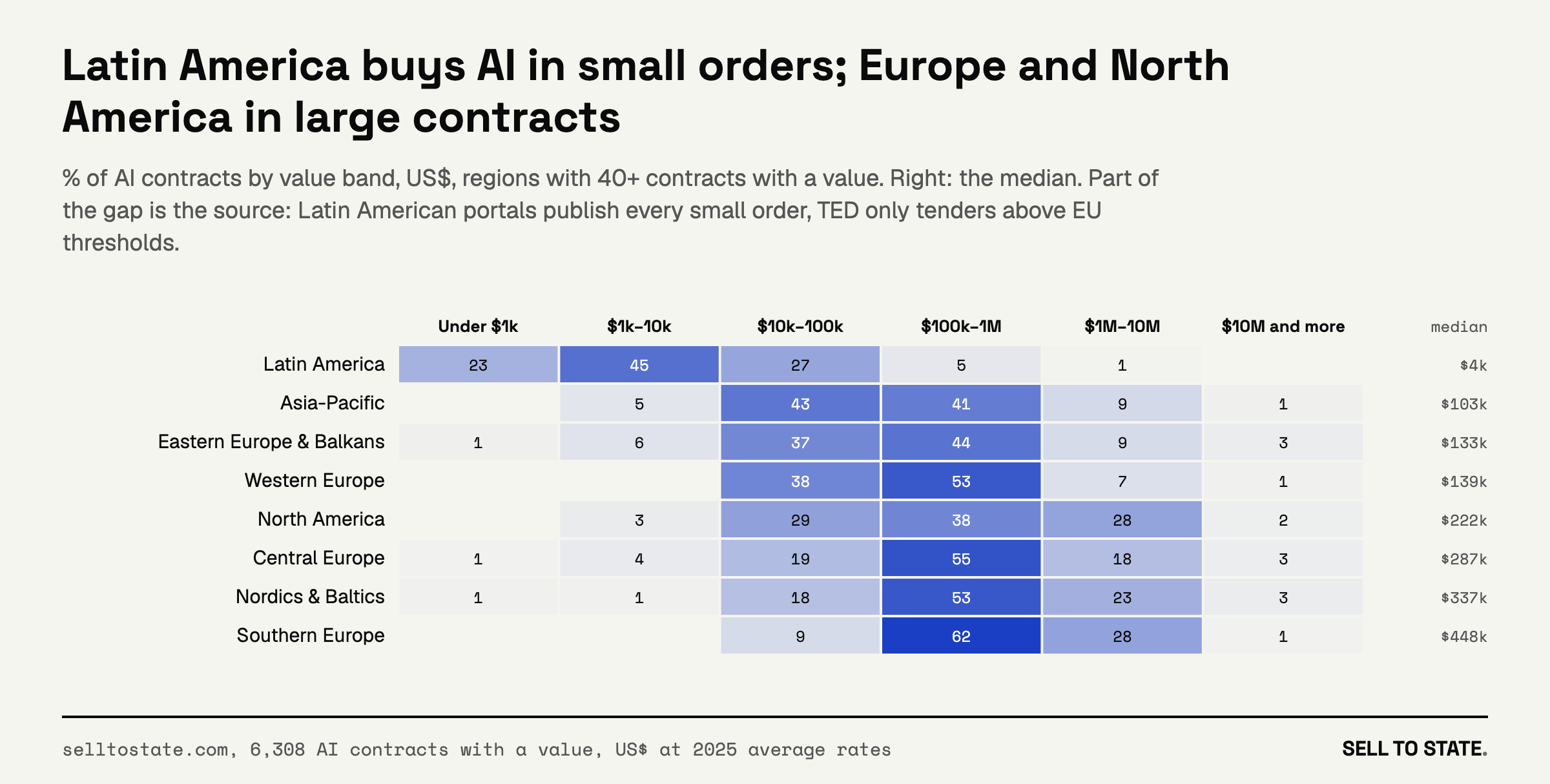
- V36: Latin America buys AI in small orders; Europe and North America in large contracts. PNG · SVG
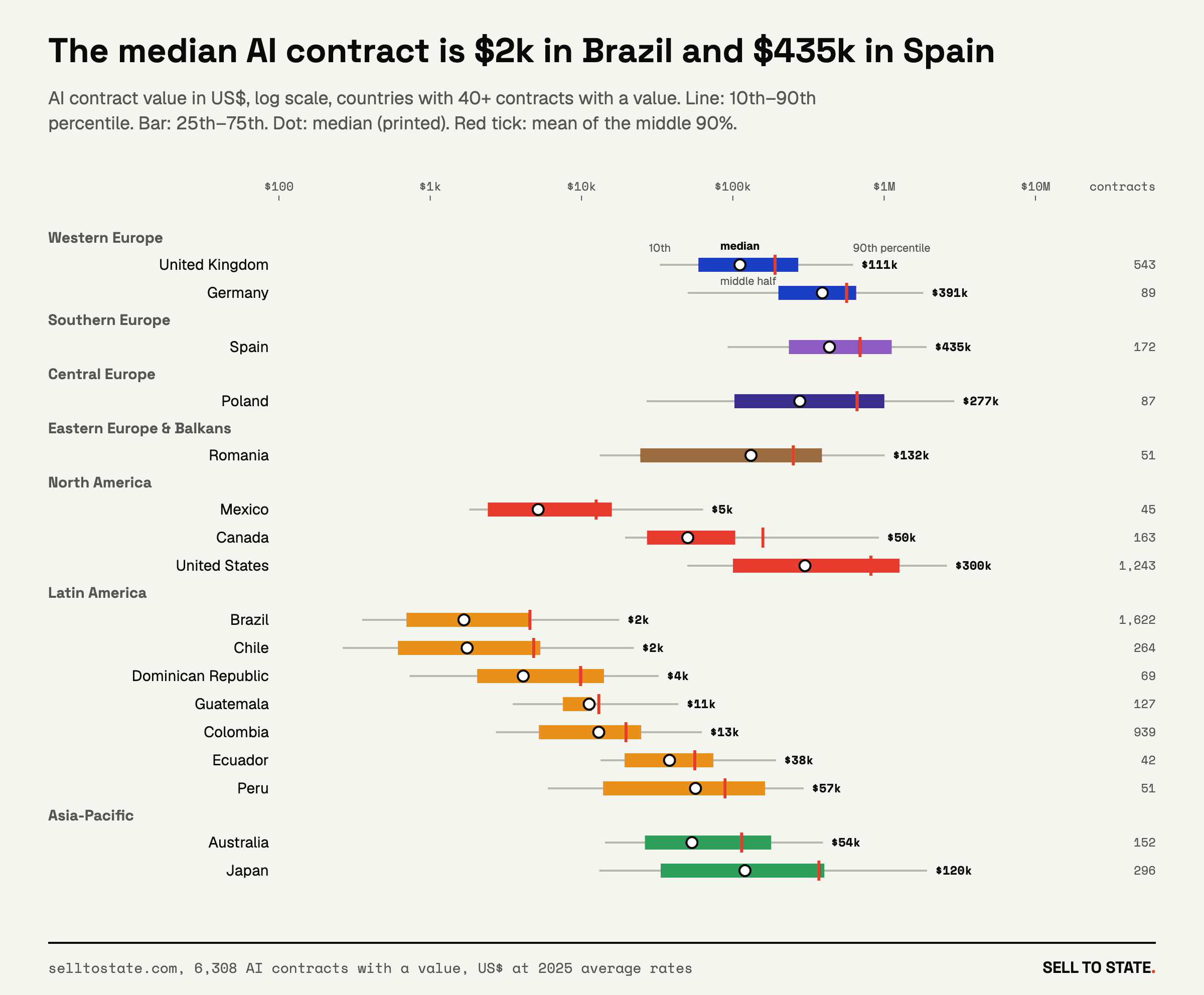
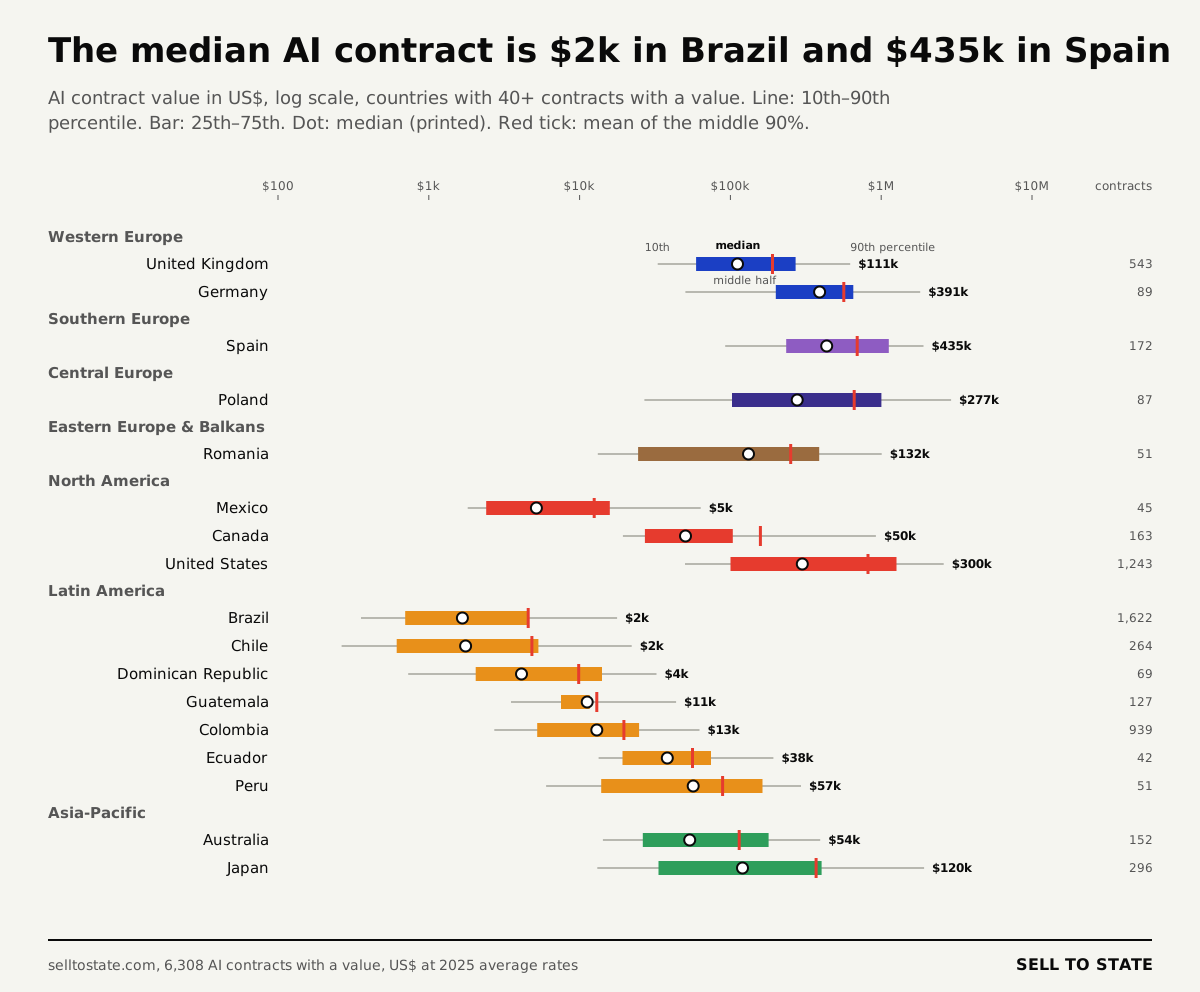
- V37: The median AI contract is $2k in Brazil and $435k in Spain. PNG · SVG
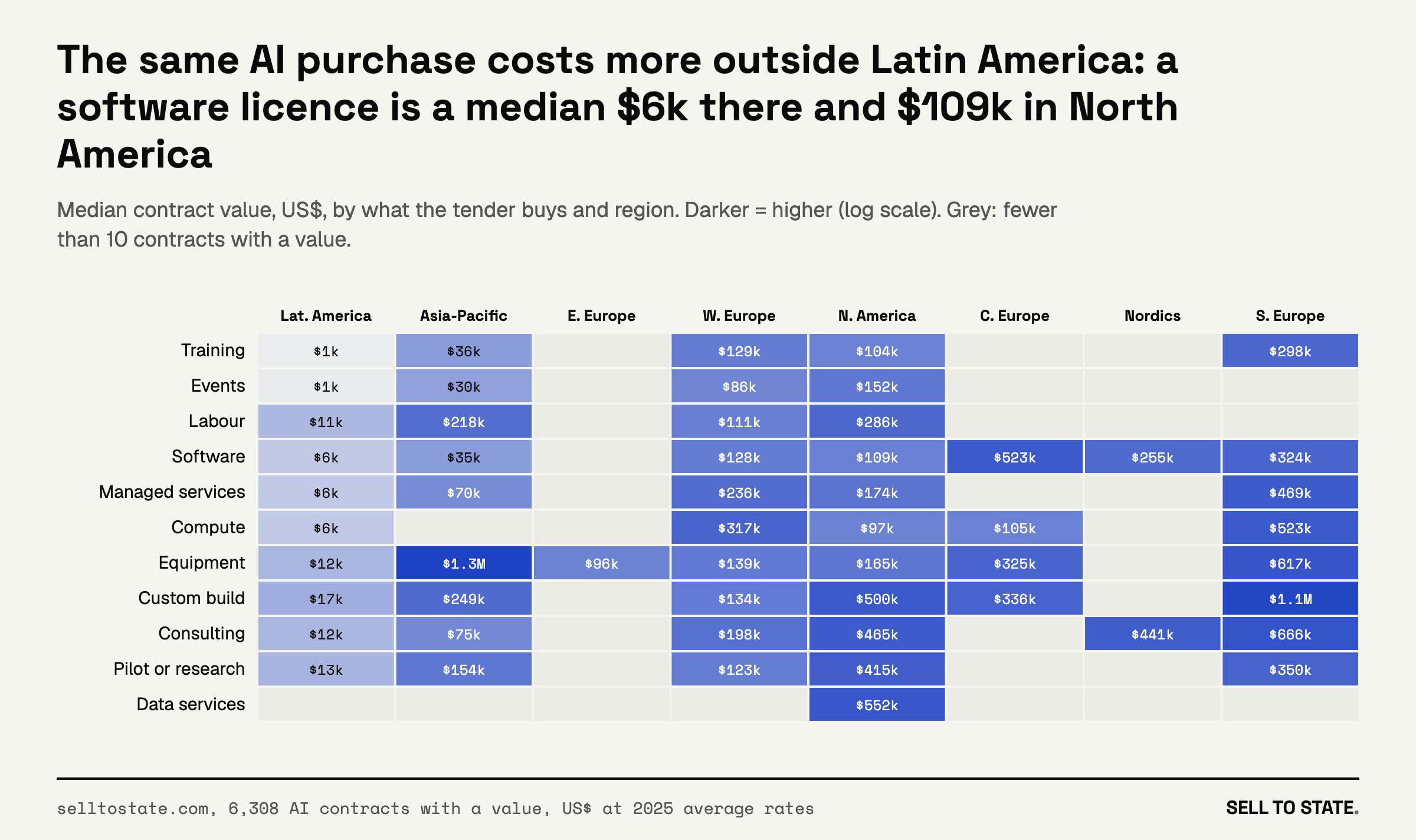
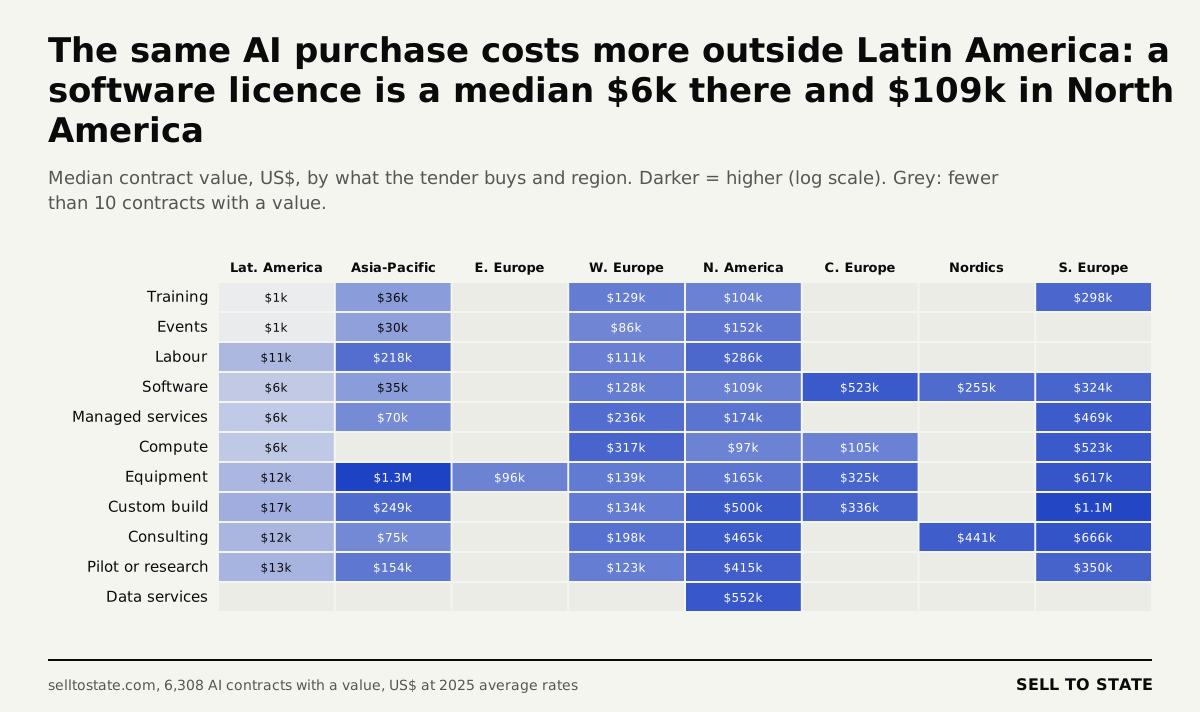
- V38: The same AI purchase costs more outside Latin America: a software licence is a median $6k there and $109k in North America. PNG · SVG
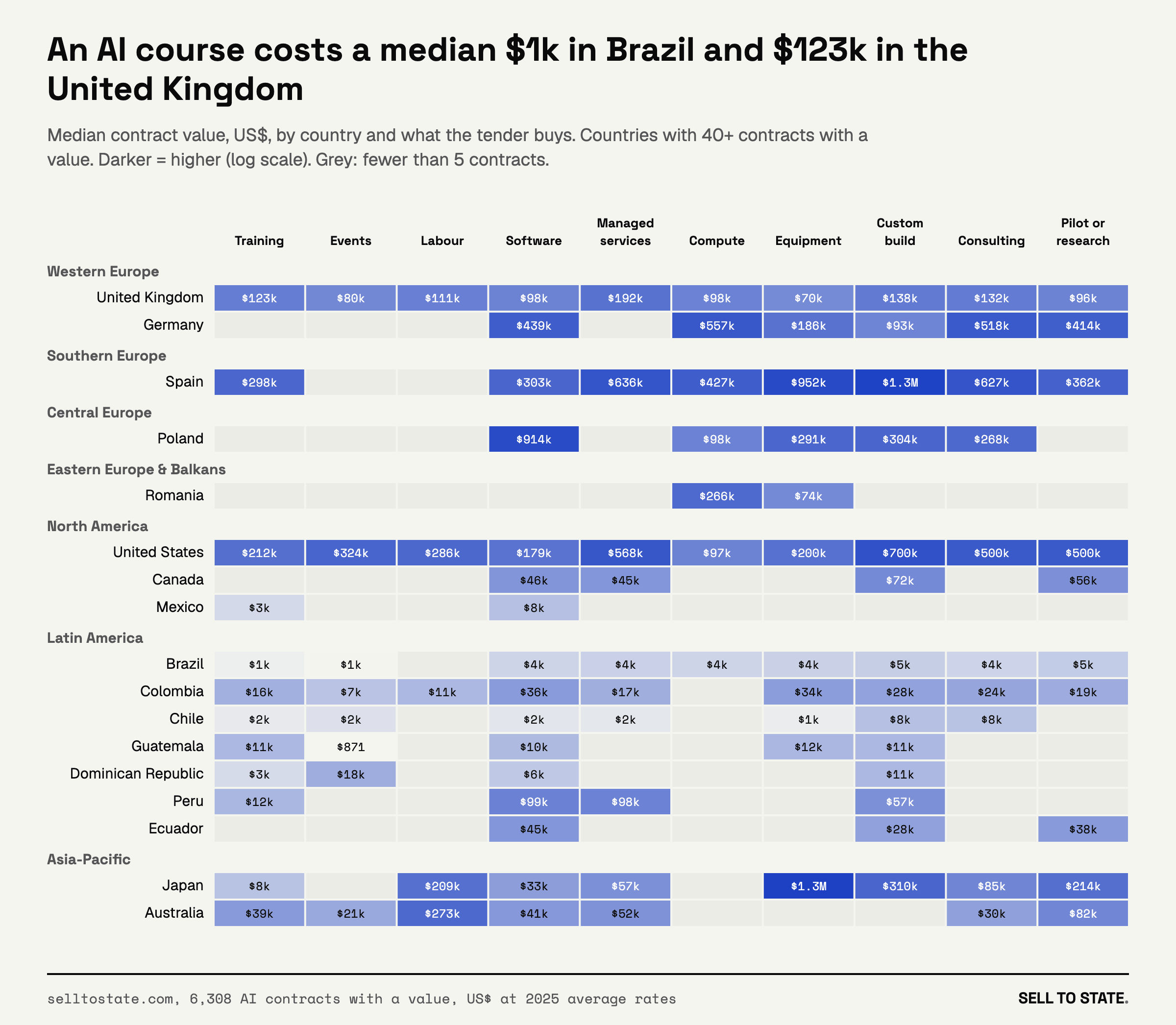
- V39: An AI course costs a median $1k in Brazil and $123k in the United Kingdom. PNG · SVG
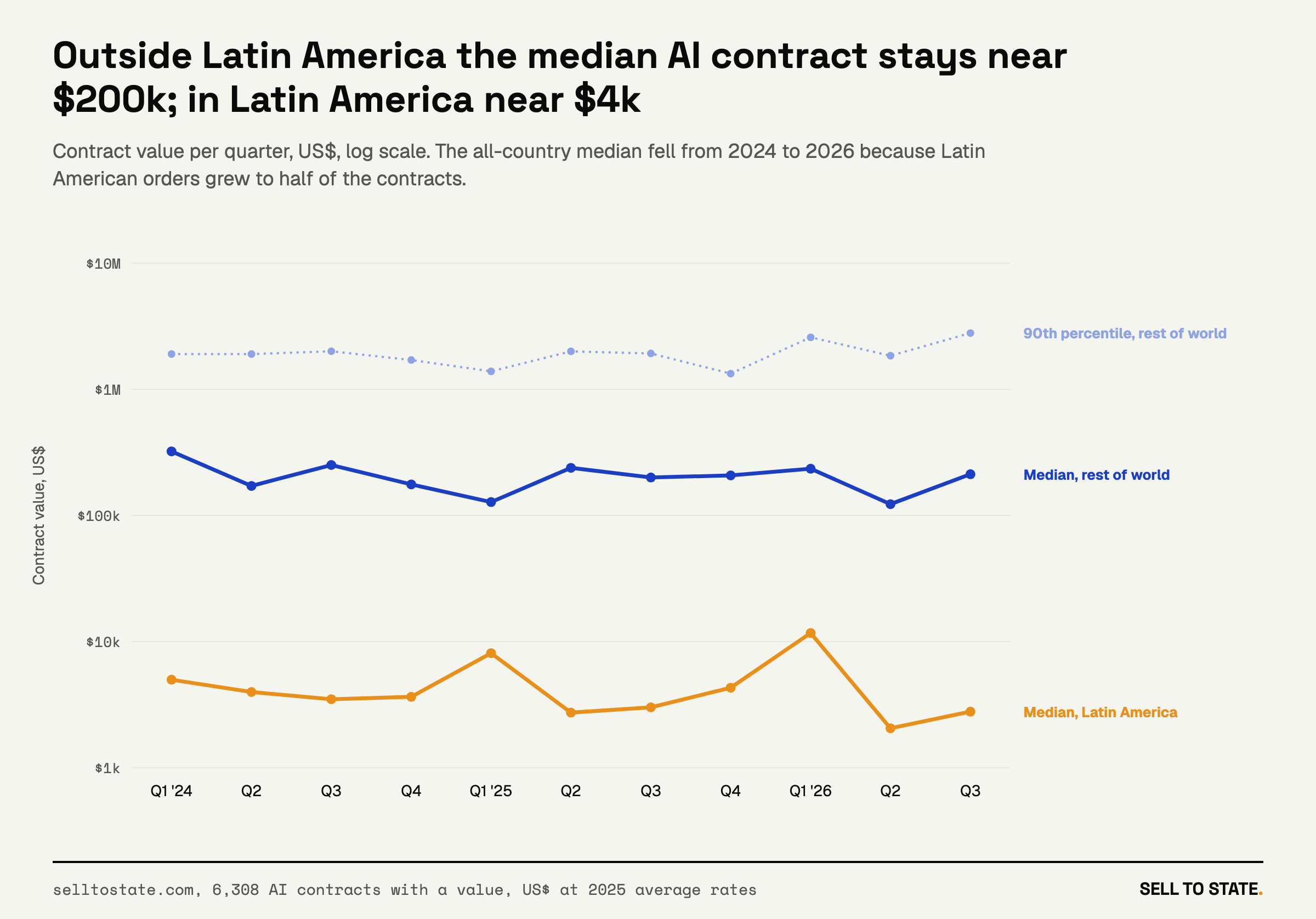
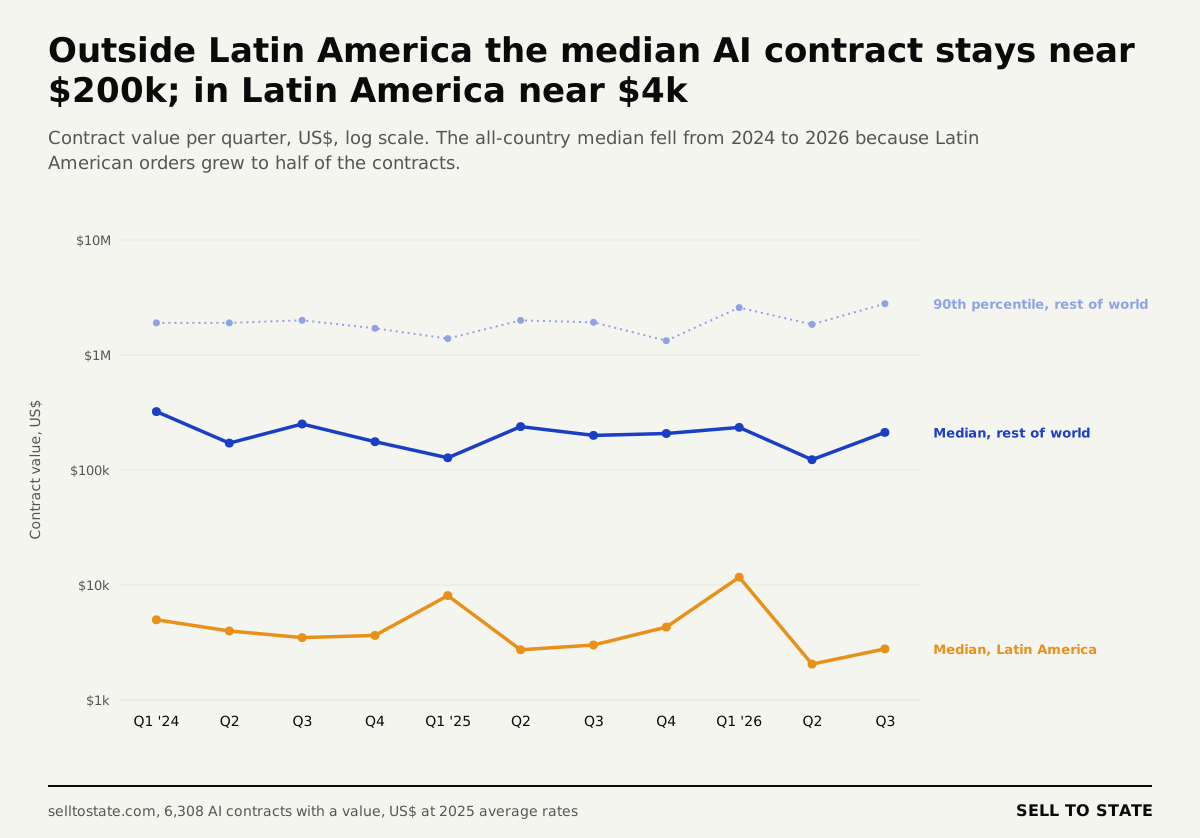
- V40: Outside Latin America the median AI contract stays near $200k; in Latin America near $4k. PNG · SVG
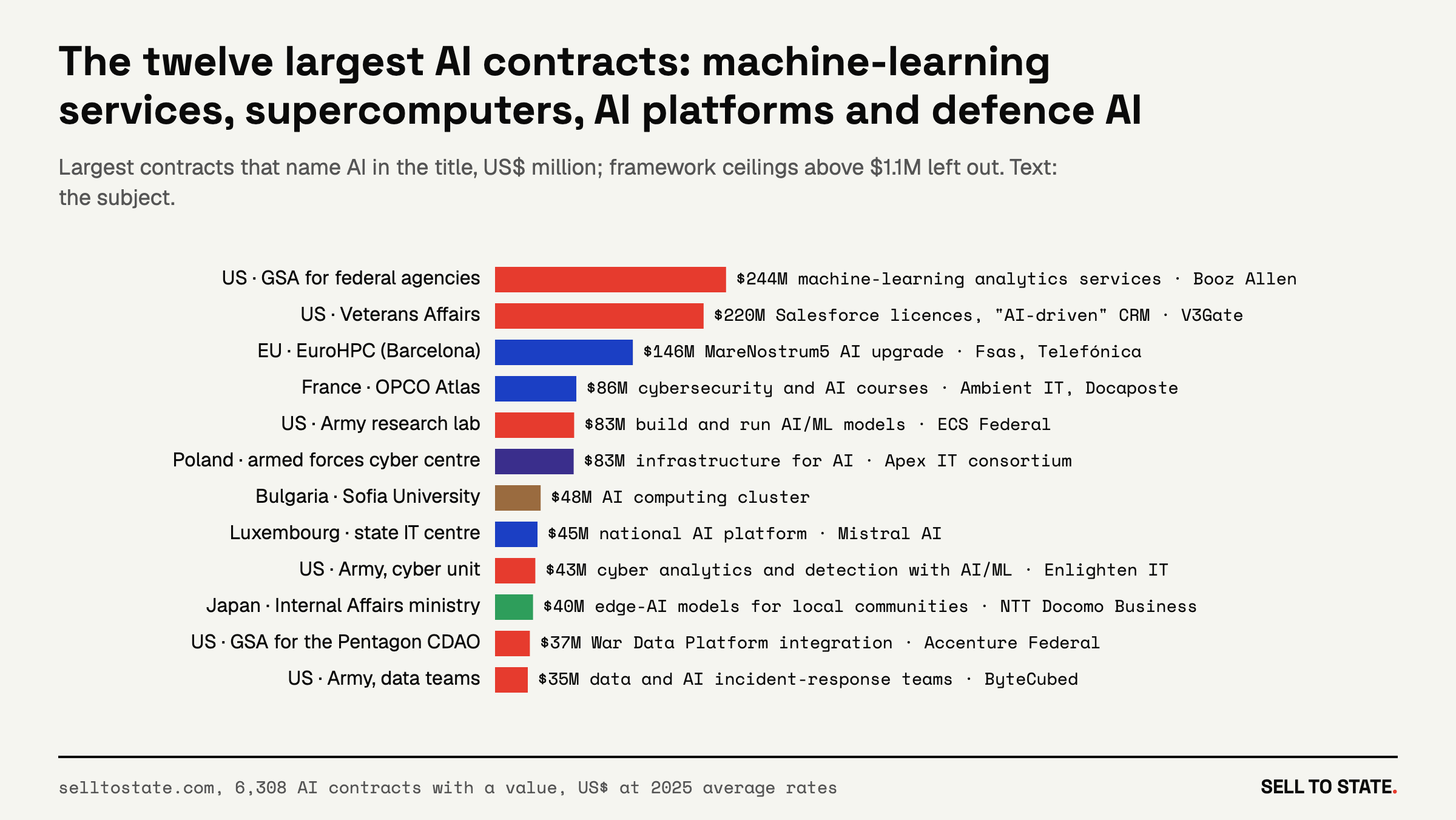
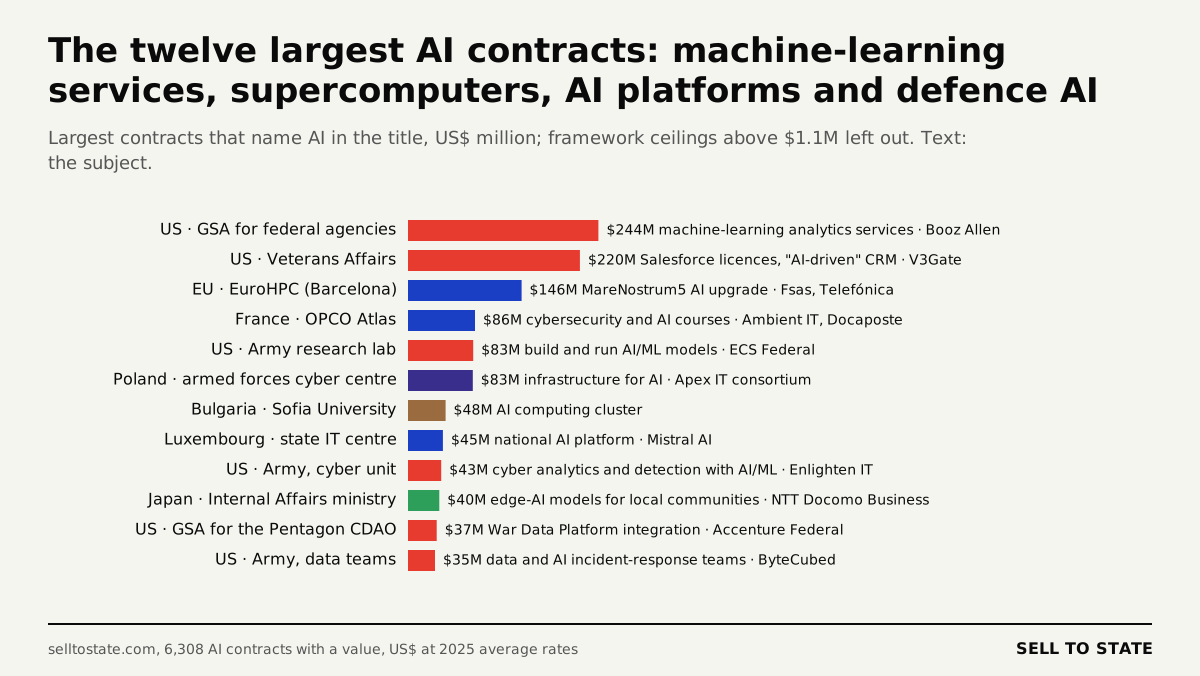
- V41: The twelve largest AI contracts: machine-learning services, supercomputers, AI platforms and defence AI. PNG · SVG
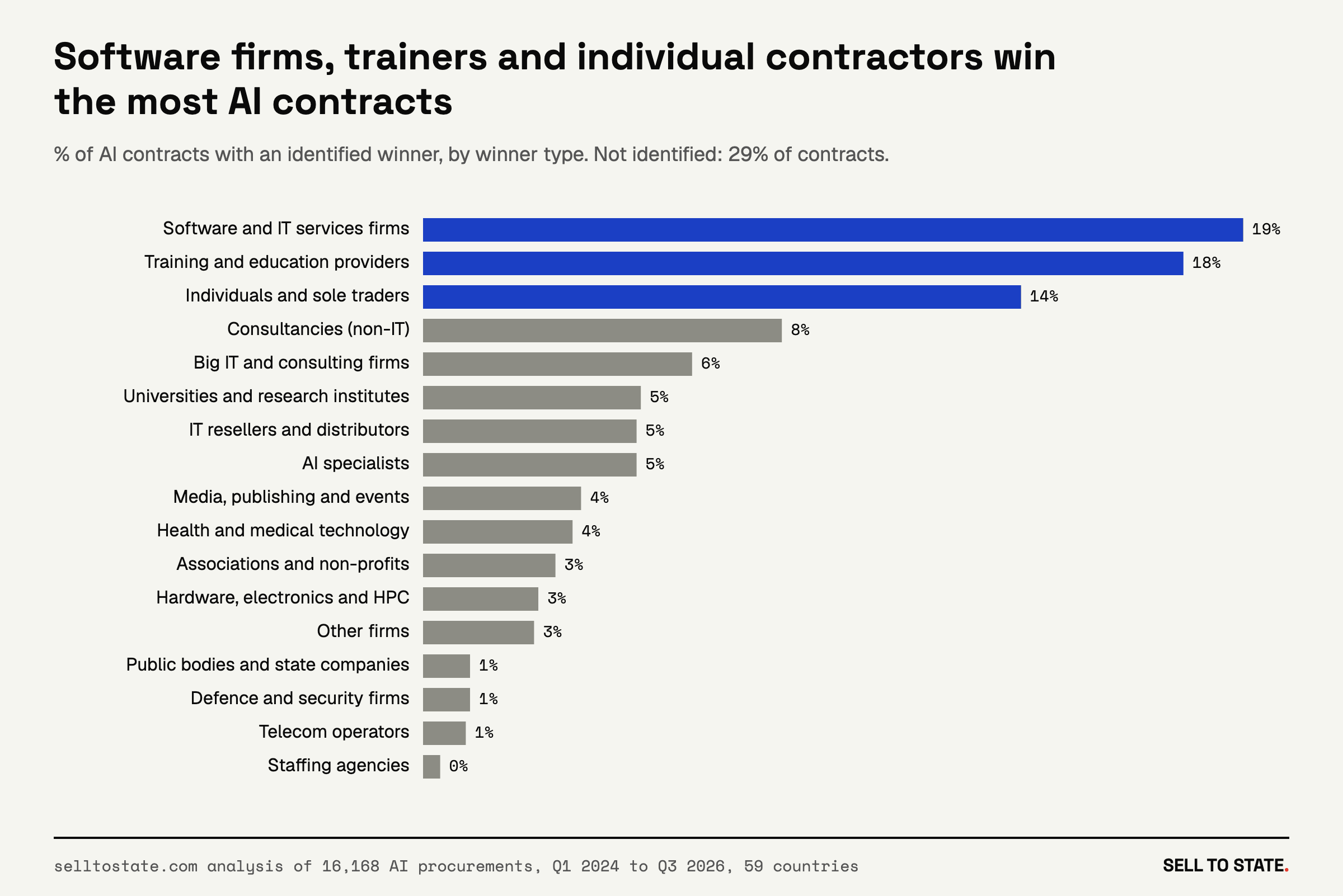
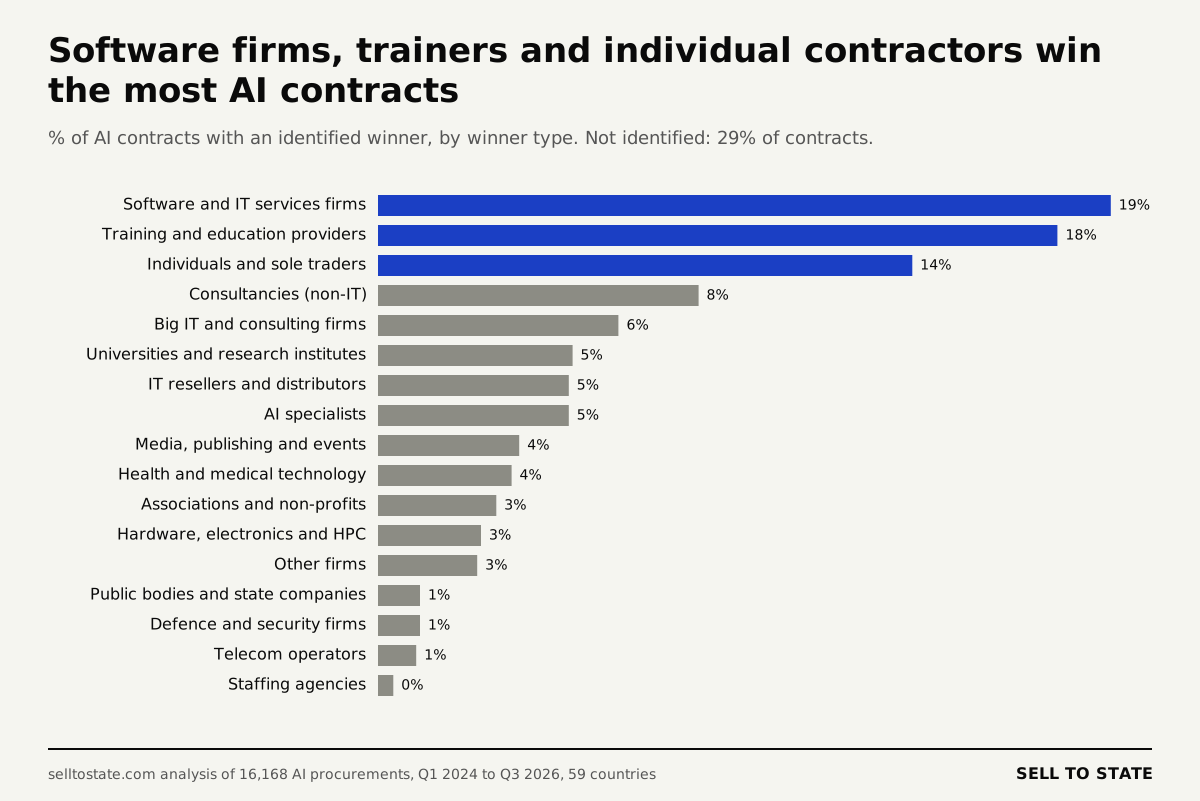
- V42: Software firms, trainers and individual contractors win the most AI contracts. PNG · SVG
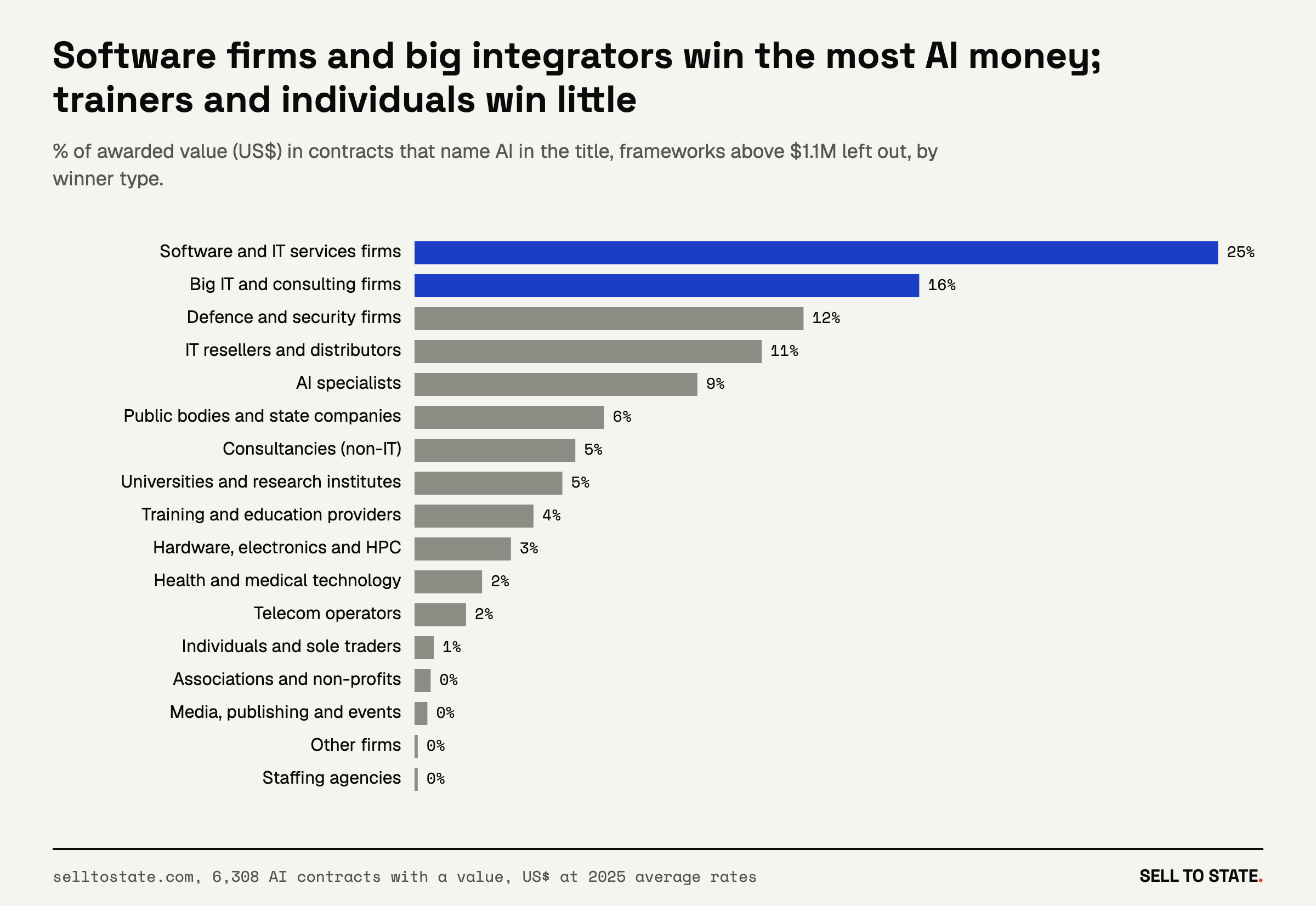
- V43: Software firms and big integrators win the most AI money; trainers and individuals win little. PNG · SVG
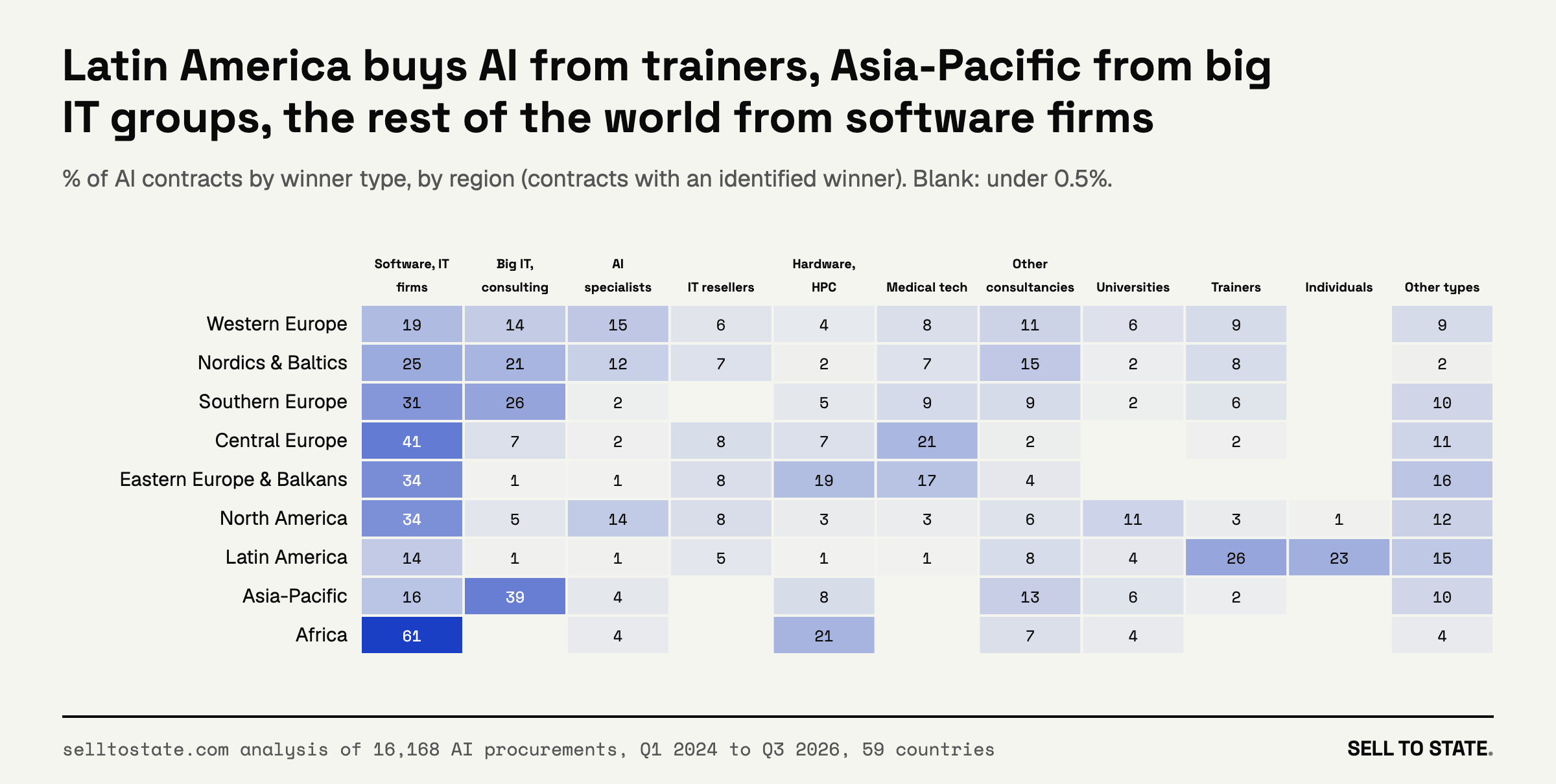
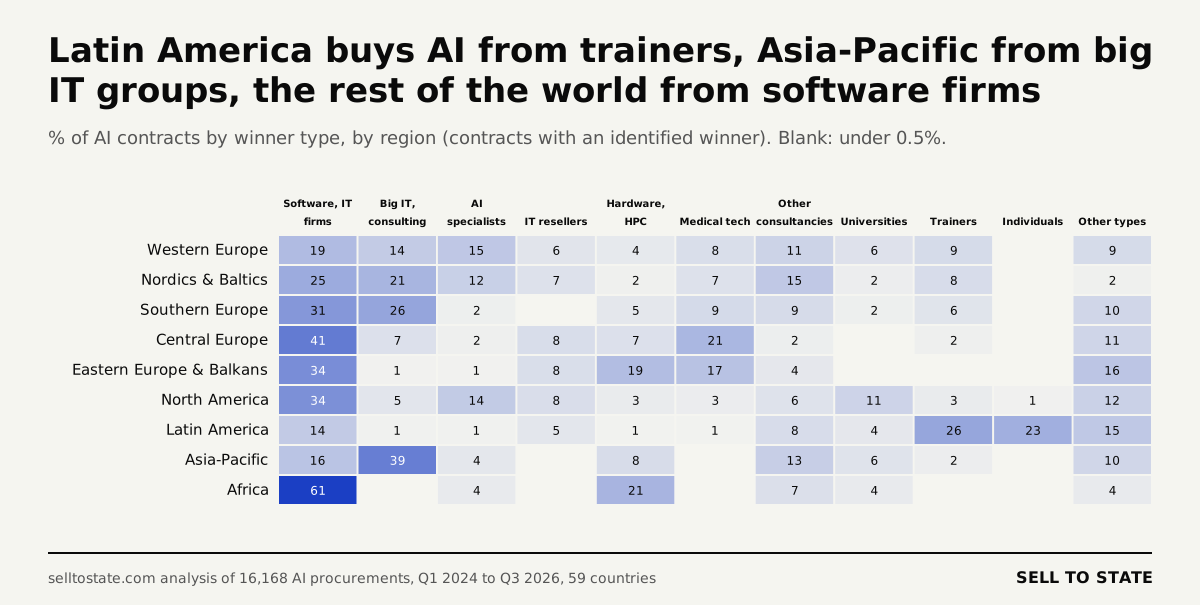
- V44: Latin America buys AI from trainers, Asia-Pacific from big IT groups, the rest of the world from software firms. PNG · SVG
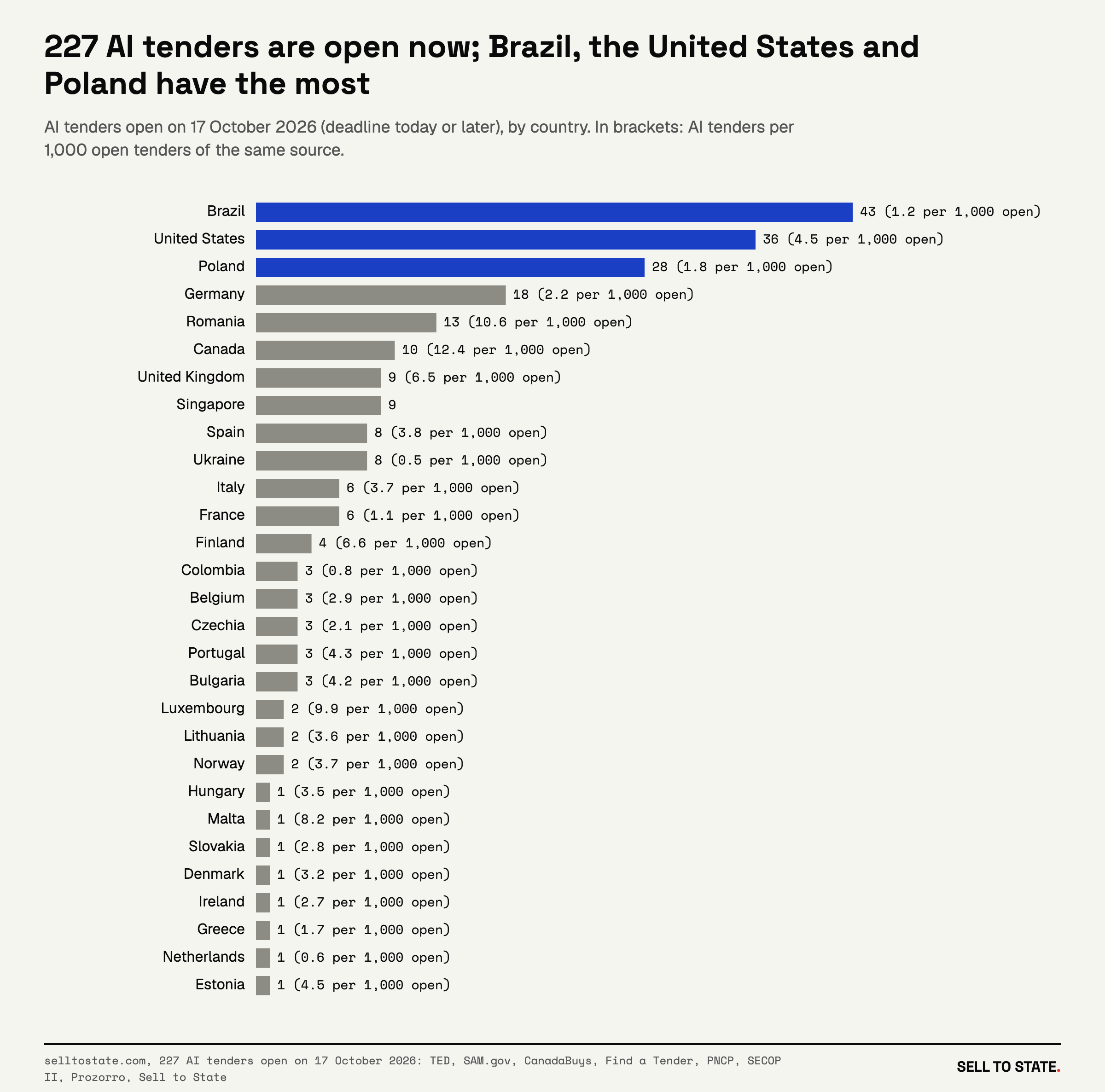
- V45: 227 AI tenders are open now; Brazil, the United States and Poland have the most. PNG · SVG
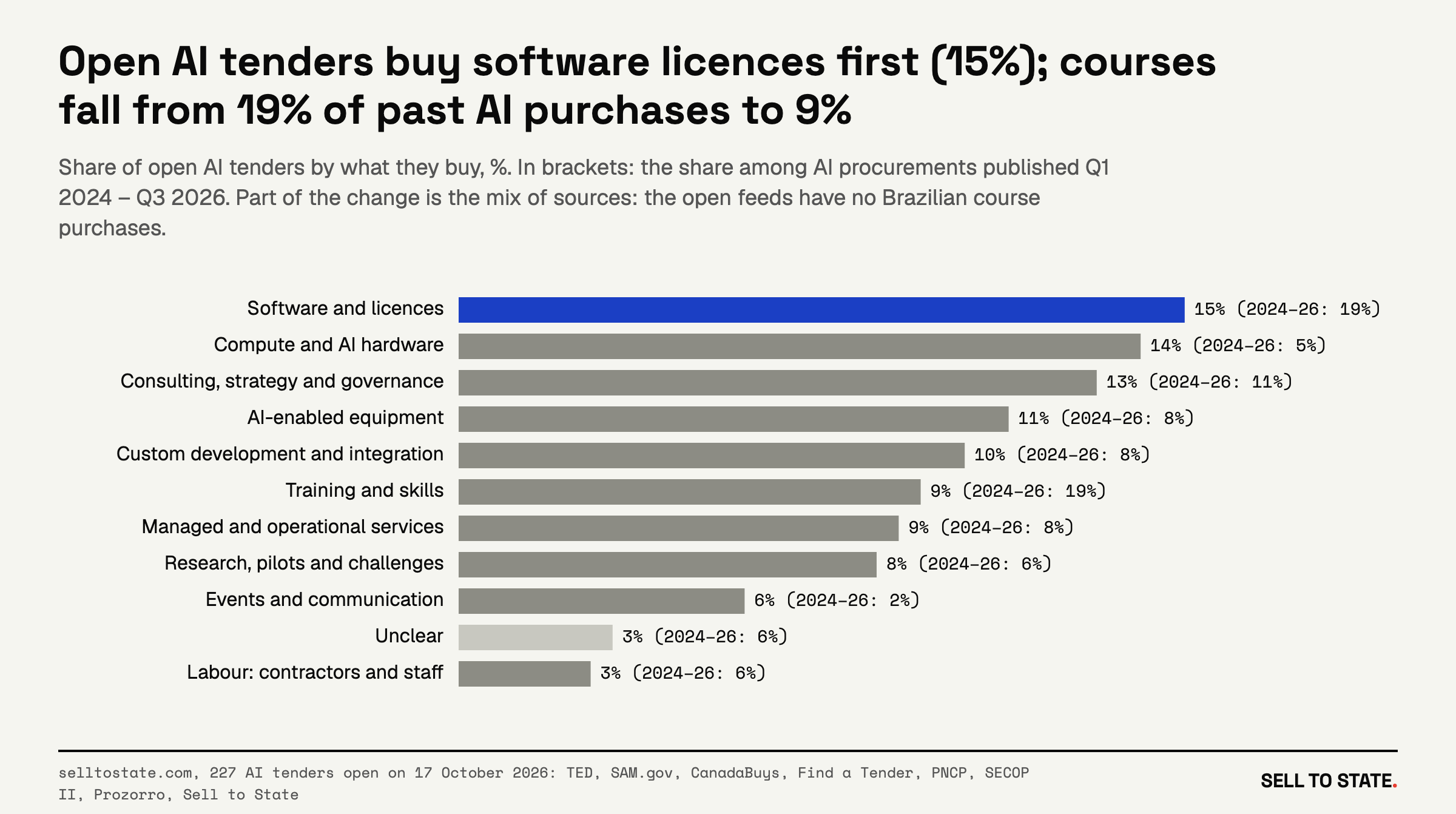
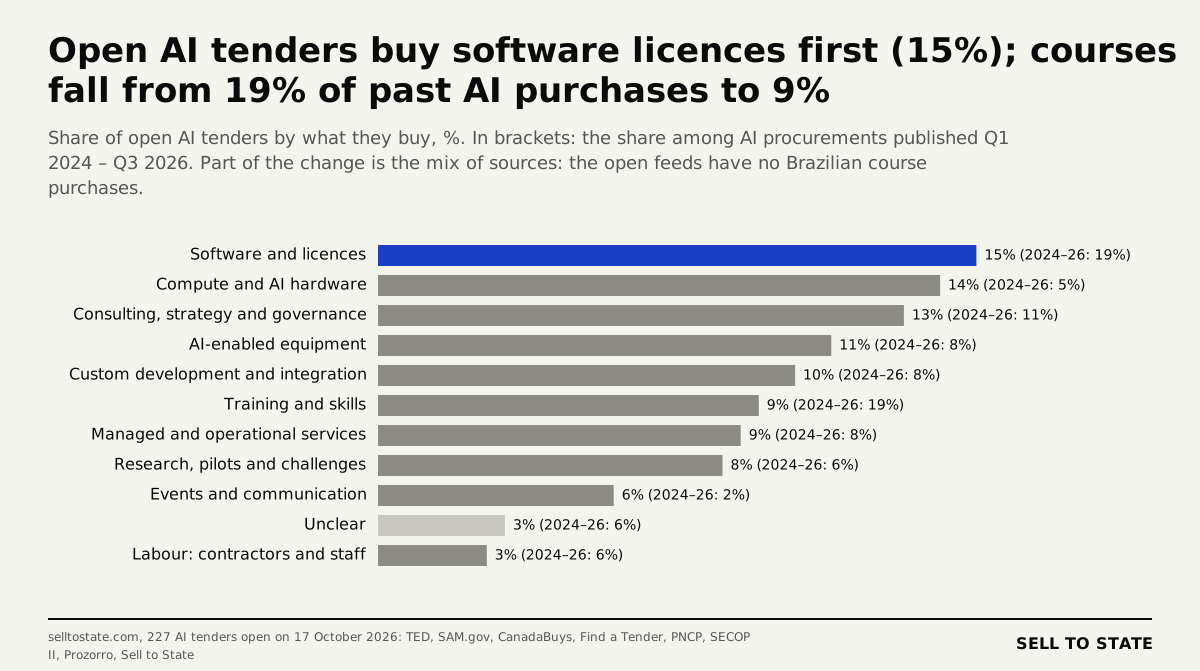
- V46: Open AI tenders buy software licences first (15%); courses fall from 19% of past AI purchases to 9%. PNG · SVG
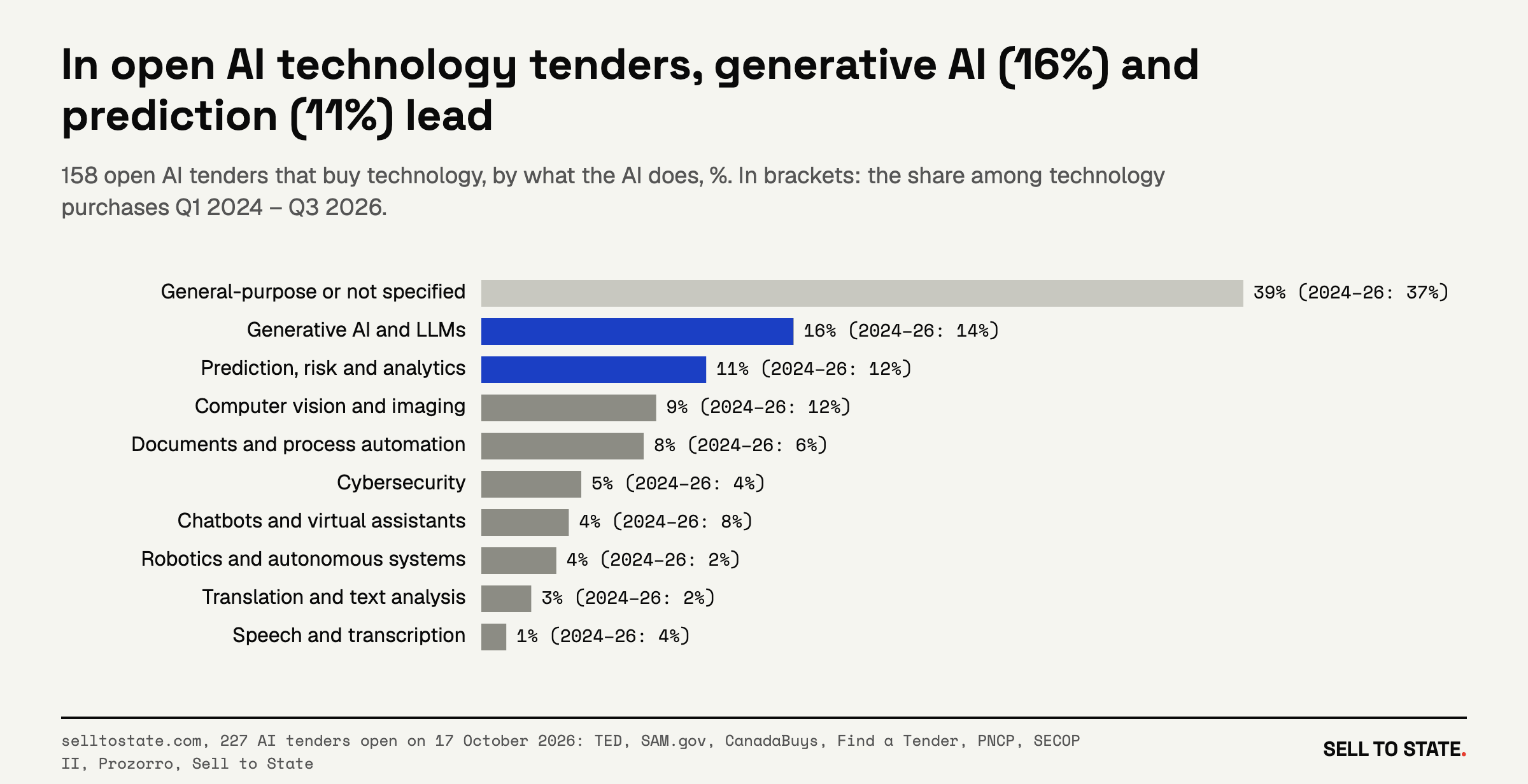
- V47: In open AI technology tenders, generative AI (16%) and prediction (11%) lead. PNG · SVG
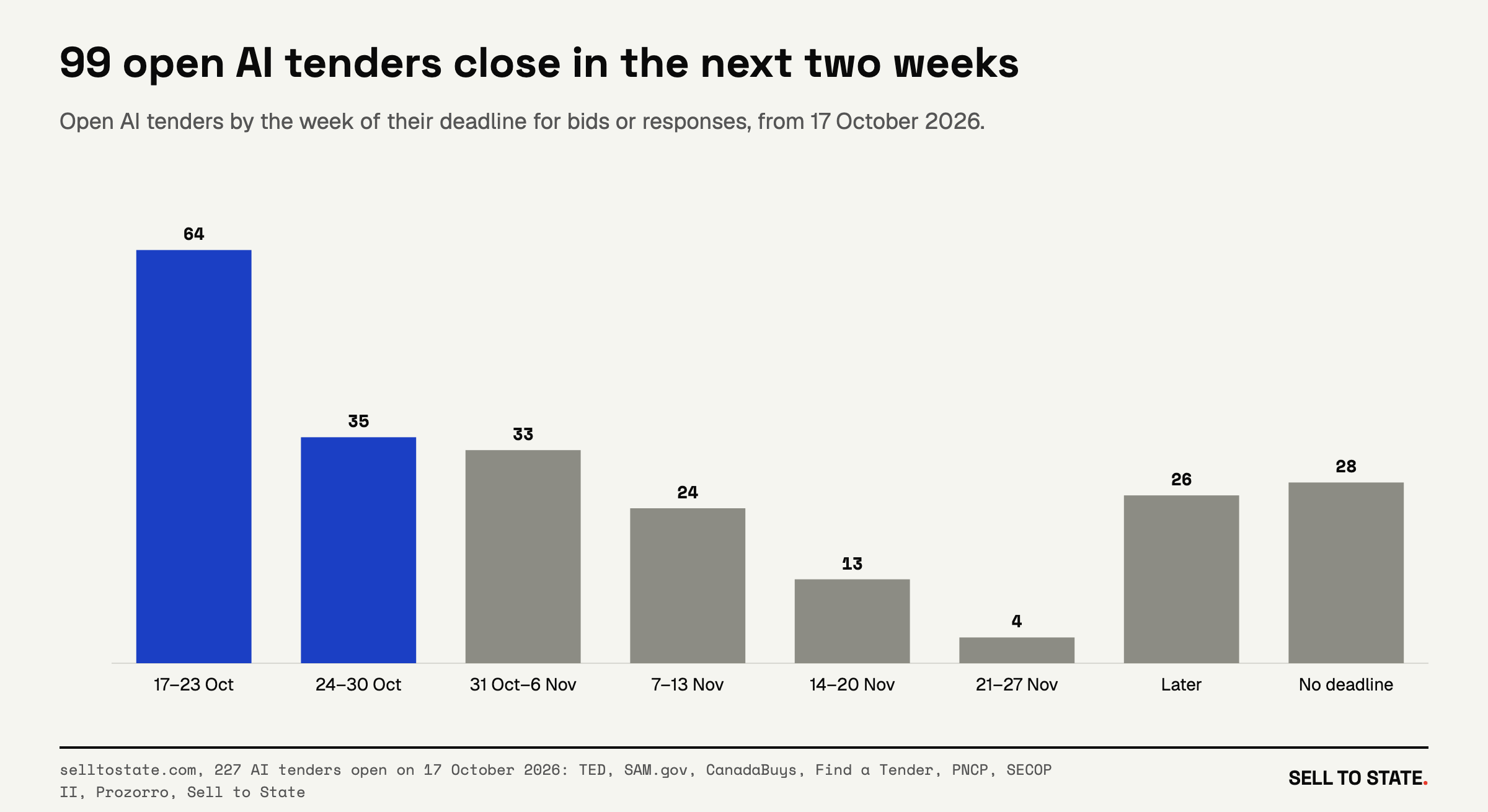
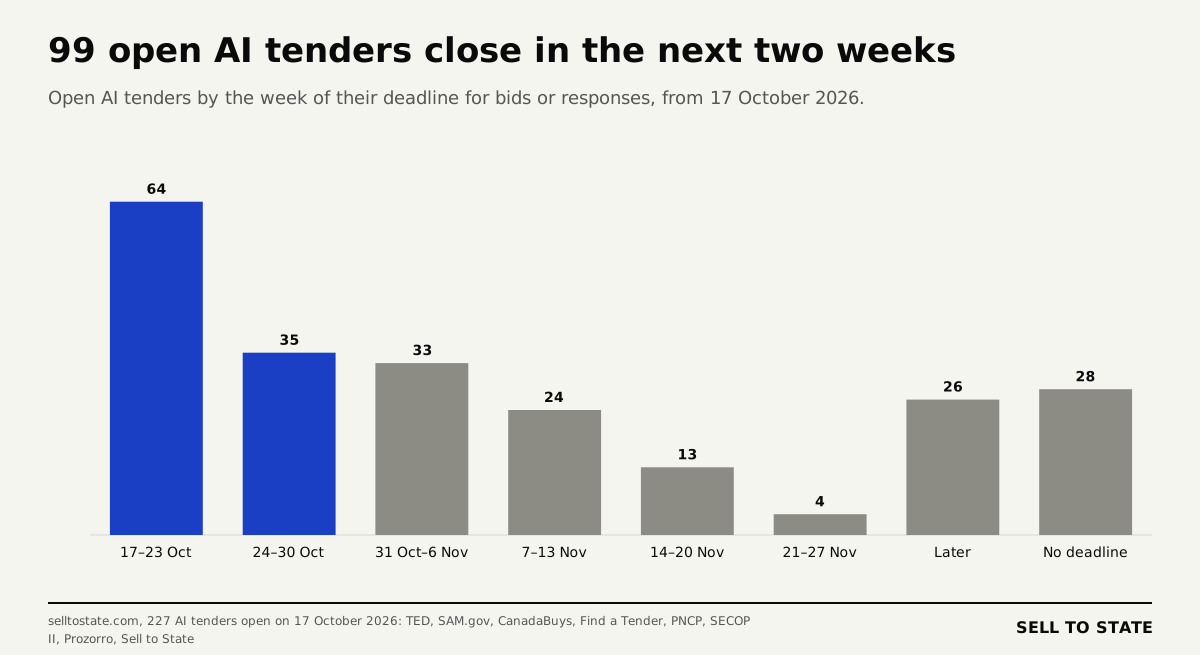
- V48: 99 open AI tenders close in the next two weeks. PNG · SVG
We read 16,168 public procurements for artificial intelligence in 59 countries, published from January 2024 to September 2026. They come from 27.8 million procurements in the same countries and quarters.
In the median country, 6 of every 10,000 public procurements bought AI in 2024. In the last four quarters to September 2026, 21 did. The United Kingdom went from 44 to 84, Poland from 6 to 59, Brazil from 19 to 61. The United States stayed under 1, because its federal data counts about 5 million contract actions a year.
Most of this AI is used by the state’s own staff. Only 5% of AI procurements are tools that the public uses directly: a chatbot, a booking line, a service desk. The rest trains civil servants, gives them software licences, reads medical scans, watches roads and pipes, and pays for research.
Most AI contracts are small, and a few are very large. 64% of the contracts with a value are under $100,000. 61 contracts over $10 million hold 47% of the money. ChatGPT is bought in small direct purchases: a median of $2,000, and 65% without competition. Copilot is bought inside Microsoft licence deals: a median of $40,000, and 24% without competition.
The method is in the closed section below: open it to see how we counted. Then we show how fast AI buying grows, when in the year it peaks, and why the regions differ. The later sections cover who pays, who buys, what they buy, and what the AI does and for whom. Then come cybersecurity, brands, prices in US dollars, the winners and the AI tenders that are open now.
Methodology: 27.8M procurements in 25 languages, 16.2k buy AI
We took all published procurements from Q1 2024 to Q3 2026 from 37 sources in 66 countries, and searched them for AI in more than 25 languages. For each country we use one primary source, so that each country is counted one way through the whole period.
| Countries | Number | Source |
|---|---|---|
| European Union, Norway, Iceland, Liechtenstein | 30 | Tenders Electronic Daily (TED): calls for competition and award notices, mostly above EU thresholds |
| United Kingdom | 1 | Find a Tender and Contracts Finder |
| Latin America | 10 | National portals: ChileCompra, SECOP II, Compras.gov.br, Guatecompras, HonduCompras, DGCP, SERCOP, OECE/SEACE, DNCP, ARCE |
| North America | 3 | USAspending (federal contracts); CanadaBuys (federal) and SEAO (Quebec); ComprasMX through Sell to State |
| Asia-Pacific | 4 | p-portal (Japan, central government); AusTender; GeBIZ and GETS through Sell to State |
| Africa | 9 | National portals of Kenya, Tanzania, Rwanda, Uganda, Ghana, Nigeria, Zambia, Liberia and South Africa |
| Other | 9 | Prozorro (Ukraine), PPRC (Kosovo), PPC (Albania), OpenTender 2024 (Georgia, North Macedonia); Israel, Iran, Moldova and Uzbekistan through Sell to State |
Most national portals publish in the Open Contracting Data Standard. We read them from the Open Contracting Data Registry, record by record, with no sample.
- The unit is the record of the source. A TED notice, an OCDS procurement process, a US contract action, a Colombian signed contract, a Japanese award, a Prozorro procedure. The share of AI is AI records per 10,000 records of the same source, country and quarter. So a country is always compared with itself.
- The search. Keyword families in each language: “artificial intelligence”, “machine learning”, “generative AI”, “chatbot”, “speech recognition” and their translations, from “künstliche Intelligenz” and “sztuczna inteligencja” to 人工知能, “τεχνητή νοημοσύνη”, “штучний інтелект” and “בינה מלאכותית”. Short tokens such as “AI”, “IA” and “KI” count only with a check of the words around them, and “IA” counts only in countries that write it for AI. Product names (ChatGPT, Copilot, Claude, Gemini, Mistral, DeepSeek) count only with a software context.
- False matches. Each check removes a known trap, and the list is long. “AI” is a word in Romanian (“cei ai”) and Italian (“ai sensi”), and it means artificial insemination in Rwandan livestock tenders. “IA” is a customs office in Peru, avian influenza in Chile, an annex number in Brazil (“Anexo I e IA”) and a typing error for “LA” in a Colombian uniform tender. “LLM/LLF” is a code on a closure cap in an operating-theatre tender. “AI&VI” is a salmonella antiserum. A “COPILOT FORWARD AFT SIDE WINDOW” is a part of a C-130 aircraft. “Magentica”, a typing error for a magnetic whiteboard, contains “agentic”. We also remove purchases that only carry an AI name: a printer for a Department of Artificial Intelligence, catering for an AI symposium, the construction of a building for an AI centre. Robotic process automation, OCR, number-plate cameras and face-recognition time clocks are tagged and left out.
- How good the search is. We checked six samples of 100 random AI procurements by hand and fixed the rules after each sample. In the last sample, AI is the main thing bought in 62. In 35, AI is one part of a larger purchase: a lot in an IT framework, a module in a hospital system, a feature of a scanner. 3 were false matches, and we removed their causes.
- Three questions, three answers. Every procurement gets three labels. What the tender buys: one of 12 types, from software licences to training and labour. What the AI does: one of 10 capabilities, only for purchases of AI technology, and a use case inside each capability. Who the AI serves: citizens, civil servants, patients and clinicians, students, police and soldiers, researchers or infrastructure. A hospital that buys radiology software is “software”, “computer vision”, “medical imaging” and “patients”.
- Buyers and money. For TED we use the legal type of the buyer that the notice states. For other sources we use the buyer name and the source fields. We also tag the funding programme that a notice names: the EU recovery fund, EU structural and research funds, or a development bank loan.
- Winners. For Brazil we read the official activity code (CNAE) of each winner from the federal company register. For Colombia, a winner with a personal ID number is a person. Other winners are typed by name rules and by a hand check of the most frequent names. 29% of contracts have a winner we could not type.
- Values. Awarded values in US dollars at 2025 average rates (1 euro = 1.13 dollars). A framework value is a ceiling, so we leave out framework values above $1.13 million (€1 million). In TED we read the framework flag of each lot; in other sources, the notice text. This matters. One German federal framework for AI support services had 24 award notices, each with a ceiling of €24–43 million; counted as spending, it would be the largest AI purchase in Europe. Money figures use only contracts that name AI in the title.
- Regions. Western Europe includes the United Kingdom and Ireland. The Nordics include the Baltic states. Central Europe is Poland, Czechia, Slovakia, Hungary and Slovenia. Eastern Europe and the Balkans are Romania, Bulgaria, Croatia, Ukraine, Moldova, Albania, Kosovo and North Macedonia. North America includes Mexico. The Middle East and Central Asia are Israel, Iran, Uzbekistan and Georgia.
- What is not comparable. TED shows only tenders above EU thresholds (about €140,000 to €220,000 for services). National portals in Latin America and Africa show every purchase, down to a $200 course. USAspending shows every contract action. So the share of AI compares well over time inside a country, and between countries with the same kind of source. Read the ranking with this in mind.
- Coverage. 59 countries have at least four quarters and 2,000 procurements; they are in the ranking. Uzbekistan’s records carry only category labels, so it is out. We have no open bulk data for India, China, South Korea, Indonesia, Vietnam, Thailand, Malaysia or the Philippines. The snapshot is 16 October 2026.
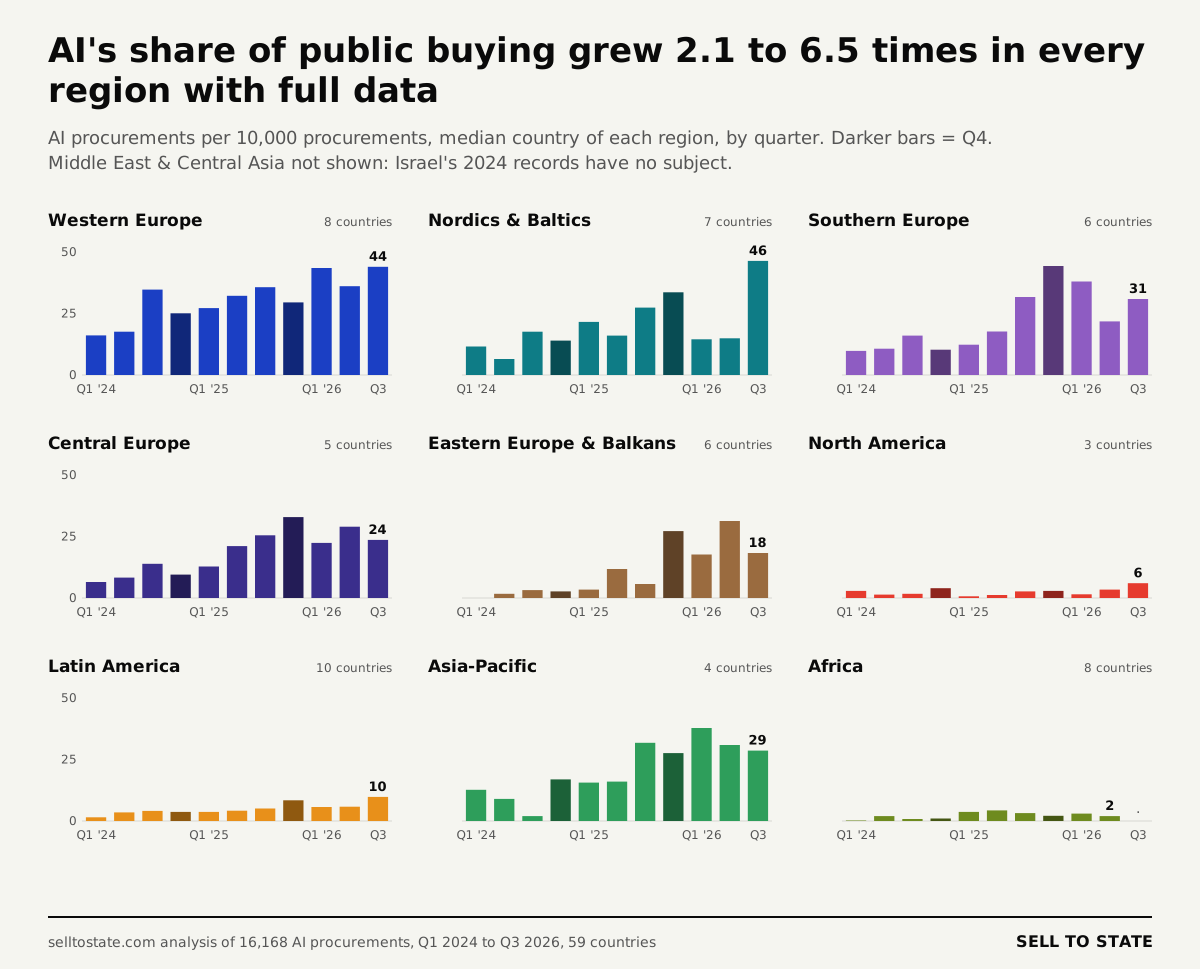
AI’s share of public buying grew 2 to 6.5 times in every region with full data
In every region with full data, the median country bought 2 to 6.5 times more AI per 10,000 procurements in the third quarter of 2026 than in the first quarter of 2024. Latin America grew the most, from 1.5 to 9.8, because Brazil added thousands of small AI courses and licences. The Nordics and the Baltics went from 11.6 to 46.4, Central Europe from 6.5 to 23.6, Southern Europe from 9.8 to 30.9, Western Europe from 16.1 to 44.0. Eastern Europe and the Balkans started at 0 and reached 18.3. North America doubled, from 2.9 to 6.0, and Asia-Pacific went from 12.7 to 28.6.
Two things changed in 2024. Generative AI became a product that a buyer can order from a price list: Copilot for Microsoft 365, ChatGPT Team and Enterprise, Gemini for Workspace. And the EU recovery fund had to be spent. Its deadline for milestones is 31 August 2026, so the digital projects of the national recovery plans reached the tender stage in 2025 and 2026. The darker bars in each region are fourth quarters, and they are high. That is the budget calendar.
AI buying peaks in the last quarter of the budget year
AI buying peaks in the last quarter of the budget year. In the median country where the budget year ends on 31 December, October to December has 1.26 times the AI procurements of an average quarter. For all procurements in the same countries, the figure is 1.08. AI rises more than public buying as a whole at year end in 24 of these 30 countries, and it peaks in the fourth quarter in 18 of them.
The strongest year-end peaks are in Ukraine (2.11 times an average quarter), Peru (2.00), Poland (1.92), Bulgaria (1.72) and Slovenia (1.65). France, Belgium, Latvia and Zambia are the exceptions: their AI buying is at or below average in October to December.
The United States shows the same thing three months earlier. The federal budget year ends on 30 September. US agencies place 2.07 times their average quarterly number of AI contracts in July to September, against 1.16 for all their contracts. In October to December they place 0.31 times. The new budget year usually starts under a continuing resolution, which limits new contracts, and the 2026 budget year started with a shutdown from 1 October to 12 November 2025. Japan and Canada close their year on 31 March, and their AI buying peaks in January to March (1.24 and 1.20). The United Kingdom and Singapore show no year-end peak for AI, and in Australia it is small (1.09).
Our explanation: money that a buyer does not spend by the end of the year is lost. An AI purchase is often small, new and easy to start fast: a course, a block of licences, a pilot. So it is a good use for the money that is left in the last quarter. If you sell AI to governments, October to December is the season in most of Europe and Latin America, July to September in the United States, and January to March in Japan and Canada.
The United Kingdom, Greece and Finland have the most AI per 10,000 tenders; the United States has under 1
Singapore, Luxembourg, Japan, the United Kingdom and Brazil lead when you count only tenders that name AI in the title. Singapore has 68 per 10,000 over its shorter window. Luxembourg (42) is high because EU bodies such as the EuroHPC Joint Undertaking buy there. Japan (41), the United Kingdom (36) and Brazil (35) follow. When you also count AI that appears only in the description, the United Kingdom (84), Greece (82), Finland (71) and Romania (68) lead.
The ranking puts different sources side by side, so the order needs four explanations.
- What the source counts. Brazil, Colombia and Chile publish every small purchase. A single ChatGPT subscription is one procurement there; in TED it does not exist. The United States counts every contract action. Its share of AI is 0.9 per 10,000, the lowest of the large countries, and its 1,269 AI contracts are the fourth-largest count, after Brazil (3,070), the United Kingdom (1,667) and Germany (1,457). Ukraine’s Prozorro also counts every small purchase, so Ukraine is at 1.6.
- How the tender is written. 45% of AI procurements mention AI only in the description. In Hungary it is 93%, in Romania and Greece 78%, in Norway 75%. A Greek digital project of the recovery plan lists AI as one component among many. So Greece has 82 AI procurements per 10,000 when you count the description, and 25 when you count the title. Norway has 49 and 6. In the US, Mexican, Japanese and Ukrainian data, the record has a short title only, so all their AI is in the title.
- How the state buys. Where a central body buys for everybody, one tender covers hundreds of buyers. The Slovak Ministry of Investments, Regional Development and Informatisation bought Microsoft licences with Copilot for the state administration in six notices. Sweden (5 per 10,000) and the Netherlands (11) put AI into broad IT frameworks, and the orders under a framework do not appear in TED.
- When the budget year ends. Shown above.
Each region buys AI for its own reason: hospitals, a new law, consultants or the military
Western Europe: the United Kingdom has the highest share, and hospitals are the largest buyers
The United Kingdom has the highest share of the large European countries: 84 AI procurements per 10,000 in the last four quarters, up from 44 in 2024. Luxembourg (59), Ireland (51), Germany (43) and Austria (37) follow; Belgium (30), France (19) and the Netherlands (11) are lower. Western Europe has 4,002 AI procurements, a quarter of the total. Its buyers buy consulting (23%) and software (20%). Hospitals are the largest buyer branch (20%).
Three reasons stand out. First, the United Kingdom publishes low-value contracts in Contracts Finder, and its councils buy AI tools one by one: Beam Up sold its note-taking tool for social workers to 39 buyers. Second, German hospitals buy AI with money from the Hospital Future Act (KHZG), which is paid from the EU recovery fund; 97 German AI tenders cite it. Third, EU institutions buy in Belgium and Luxembourg. The European Commission bought technical assistance for AI safety under the AI Act ($8.3 million) and AI for breast and prostate cancer imaging ($6.1 million). France and the Netherlands are low because French buyers publish most small contracts outside TED, and Dutch buyers put AI inside broad IT frameworks.
The largest Western European AI contract is the $146 million AI upgrade of the MareNostrum5 supercomputer, bought by EuroHPC from Fsas Technologies and Telefónica. Next is a $45 million national AI platform for Luxembourg’s state IT centre from Mistral AI. In the United Kingdom, the Ministry of Defence bought AI and data science support from Capgemini and Deloitte ($23 million). The Department for Work and Pensions bought “Gen AI Lighthouse” projects from IBM ($18 million).
Track AI tenders in the United Kingdom →
Nordics and the Baltics: AI is bought as hours of consultants
Finland (71 per 10,000) and Norway (49) buy far more AI than Sweden (5). Lithuania (31) and Denmark (28) are in the middle; Estonia (17) and Latvia (15) are lower. The region buys consulting: 38% of its 578 AI procurements, more than any other region. Software and IT firms win 25% of the contracts, big IT and consulting firms 21%, and AI specialists 12%. Only 3% are direct awards.
Nordic buyers buy AI as expert hours. They run dynamic purchasing systems and frameworks for IT consultants and add AI as one competence among many, so 75% of Norwegian AI procurements mention AI only in the description. When they buy a product, it is a service. Finland’s transport agency Traficom bought a generative AI customer service for $11 million. The Norwegian Public Roads Administration bought a chatbot as a service ($4.8 million); Kindly won the next round ($2.9 million). Two Danish regions bought AI for mammography screening together ($3.0 million). Tallinn University of Technology bought ChatGPT licences directly from OpenAI Ireland for $1.1 million under the exclusive-rights exception.
Southern Europe: universities lead, and one in seven AI tenders names the EU recovery fund
Greece (82 per 10,000) and Spain (51) lead; Cyprus (38), Portugal (28), Malta (22) and Italy (20) follow. Universities and schools are the largest buyers (23%). Digital government agencies buy 12% of the region’s AI, more than in any other European region. Regional governments buy 29%: in Spain the autonomous communities run health and education, and they buy 46% of Spanish AI.
The EU recovery fund is the engine here. 15% of Southern European AI procurements name it, and many Portuguese notices start with “PRR”, the name of the national plan. Greece buys AI inside large digital projects: the state company Information Society bought a national early-warning system for civil protection “with the use of artificial intelligence” for $24.5 million. Extremadura’s regional government hired EY to set up and run a centre for hyperautomation and AI ($6.5 million). The Basque IT company IZFE bought licences for a generative AI data platform ($5.9 million). Italy is the lowest because Italian buyers order most IT through Consip frameworks and the MePA marketplace, and those orders do not appear one by one in TED.
Central Europe: Polish hospitals buy AI with EU recovery money
Poland went from 6 AI procurements per 10,000 in 2024 to 59 in the last four quarters, the largest increase of any large country in our data. Hungary (35), Czechia (24), Slovakia (24) and Slovenia (18) follow. Health is 46% of Central European AI procurements, the highest share of any region. The region buys software (24%), equipment with AI (18%), custom development (18%) and compute (15%). Software and IT firms win 41% of the contracts and medical technology firms 21%.
The reason is one EU programme. 36% of Central European AI procurements name an EU fund. In Poland it is 48%, and the largest part is investment D1.1.2 of the national recovery plan (KPO), which pays hospitals to digitise. A typical Polish hospital tender asks for system integration, digital medical records, more cybersecurity and “AI solutions” in one package. Most of these tenders are from 2025 and 2026, and the recovery money must be spent by the end of 2026. Polish AI buying peaks in the fourth quarter, at 1.92 times an average quarter. Other large purchases: the Polish armed forces’ cyberspace centre bought infrastructure for AI ($83 million) and AI for the analysis of cyber threats ($32 million). Poland’s e-Health Centre bought AI models that read medical images ($18.6 million) and a voicebot for the national appointment line ($5.1 million). Slovakia’s health ministry bought AI-supported digital pathology from Sysmex ($5.8 million for hardware).
Eastern Europe and the Balkans: universities buy AI servers and laboratory equipment
Romania (68 per 10,000) leads, then Croatia (30) and Bulgaria (21). Ukraine is at 1.6, because Prozorro counts every small purchase. Kosovo and North Macedonia have one AI procurement each. Universities buy 36% of the region’s AI, and the region buys equipment with AI (24%), software (18%) and compute (13%). Software and IT firms win 34% of the contracts, hardware and supercomputer firms 19%, medical technology firms 17%.
Universities lead because the recovery plans and EU research money pay for new laboratories, and a laboratory tender lists AI servers and AI-enabled instruments. In Romania, 78% of AI procurements mention AI only in the description, often a line in a list of laboratory equipment. Sofia University bought an AI computing cluster for $48 million, the largest AI purchase in the region. Romania’s interior ministry bought a chatbot for electronic public services ($2.3 million). Croatian public television HRT bought AI for its business processes, with a voicebot lot. In Ukraine, the state company Diia, which runs the government’s digital services, tendered a hardware and software complex called “Sovereign AI Factory”. Ukrainian buyers name Claude and Copilot in 11 tenders each; a military unit bought a microcomputer “for AI tasks”.
North America: the US Department of Defense places 61% of US AI contracts
Canada has 16 AI procurements per 10,000, Mexico 3, the United States 0.9. Defence is 51% of North American AI procurements. The US Department of Defense is the buyer of 61% of US AI contracts and 52% of US AI money. 24% of North American AI procurements have an unclear purchase type, because a USAspending record often has a short title such as “AI SOFTWARE”. Universities and research institutes win 11% of the contracts, through research programmes such as SBIR and STTR.
The largest AI contracts in our data are American. The General Services Administration funds enterprise machine-learning analytics services from Booz Allen Hamilton ($244 million). Veterans Affairs bought Salesforce licences with “next generation AI-driven” features through the NASA SEWP contract ($220 million). The Army bought the research, development and operation of AI and machine-learning models from ECS Federal ($83 million). Other orders show what civil agencies buy. The Treasury bought up to 3,000 ChatGPT licences ($3.4 million). Veterans Affairs bought Dragon Medical One speech recognition ($24 million). The Department of Education placed an order “to procure OpenAI” ($711,000). In Canada, Santé Québec bought speech recognition for its Epic health record ($5.0 million). In Mexico, the industrial property institute bought AWS cloud for AI platforms ($1.1 million).
Track AI tenders in the United States →
Latin America: courses are 38% of AI purchases, because Brazil retrained its procurement staff
Brazil has 3,070 AI procurements, more than any other country, and 61 per 10,000. Paraguay (29), Honduras (18) and the Dominican Republic (17) follow. Chile, Peru, Colombia, Guatemala, Ecuador and Uruguay are at 3 to 7, because their portals count every small purchase. Latin America has 6,168 AI procurements, 38% of the total, and 78% of them are direct awards. The median Latin American AI contract is $4,000.
Latin America buys training: 38% of its AI procurements, and 58% of Brazil’s. The reason is a law. Brazil’s new public procurement law (Law 14.133) became the only procurement regime on 30 December 2023, and public bodies sent their procurement staff to courses on it. Trainers added AI to the course title. 754 of Brazil’s 1,786 AI training purchases are courses on public procurement, such as “Practical workshop: artificial intelligence in public procurement and administrative routines”. Colombia hires people: 71% of its AI contracts are labour contracts, because the Colombian state hires most specialists as individual contractors. Latin America also buys 82% of all ChatGPT purchases in our data (437 of 530), mostly small team subscriptions in Brazil (217) and Chile (135).
The large purchases are few. Colombia’s ICT Fund paid the state development bank Findeter to create “sovereign AI foundation models” ($32 million), and the national real-estate agency to build the physical infrastructure for them ($29 million). Brazil’s telecom regulator Anatel bought a multicloud broker for its data and AI solutions from the federal IT company Serpro ($9.2 million). Peru’s energy regulator Osinergmin bought a data and AI platform ($1.4 million). Paraguay’s procurement agency bought AI to improve the procurement process itself ($43,000).
Asia-Pacific and the Middle East: ministries commission AI studies, hospitals buy AI platforms
Singapore has 68 AI procurements per 10,000 over its shorter window, Japan 41, Australia 15. All Asia-Pacific data comes from central governments. 25% of the region’s AI procurements are research contracts, and big IT and consulting firms win 39% of the contracts. In Japan, the Ministry of Defense (32 AI procurements), the Ministry of Internal Affairs and Communications (30) and the Japan Patent Office (27) buy the most. Japanese ministries commission studies before they buy a system: the communications ministry paid NTT Docomo Business $40 million to study edge AI for local communities. The National Tax Agency bought AI-OCR equipment for its tax system ($23 million) and a tax-advice chatbot ($3.3 million). The Children and Families Agency paid for a national AI tool that helps child guidance centres judge urgent cases. In Australia, the largest AI order is for Teradata software subscriptions and AI services ($16 million), and several contracts hire machine-learning specialists.
Israel has 28 AI procurements per 10,000 in the last four quarters. Its 2024 records are exemption notices with no subject, so we do not show a trend for this region. Hospitals are the Israeli buyers: the Sheba Medical Center bought a clinical AI platform for pathology diagnosis ($772,000) and an AI system called LIV ($667,000). Iran’s ICT ministry commissioned studies on AI adoption from Sharif University of Technology. Georgia’s innovation agency bought the organisation of an “AI camp for students”.
Africa: AI comes inside equipment, from X-ray software to smart classrooms
South Africa (31 per 10,000) leads; Nigeria, Tanzania, Zambia and Kenya are at 1 to 4. African AI procurements are often equipment (26%): AI smart classrooms, cameras, servers. Computer vision is 24% of the region’s technology purchases. Software and IT firms win 61% of the contracts, and 53% are direct awards. The data is thin: 272 AI procurements in eight countries.
African buyers buy AI that comes ready to use. Kenya’s medical supplies agency bought the Qure.ai software that reads chest X-rays for tuberculosis; Rwanda’s Biomedical Centre bought an AI chest X-ray system. Kenya Airports Authority bought an AI-based network detection and response system ($433,000). Zambia’s pension authority bought an AI web application firewall and AI endpoint detection. The Institute of Accountancy Arusha bought an AI smart classroom ($299,000). Mossel Bay Municipality in South Africa tendered for “Darktrace or similar” AI security monitoring.
Track AI tenders in South Africa →
Poland names an EU fund in half of its AI tenders
Poland names an EU fund in 48% of its AI tenders. Spain (24%), Italy (19%), Romania (18%) and Portugal (16%) name one in every four to six. Czechia (11%) names mostly structural funds. In all, 655 AI procurements name the EU Recovery and Resilience Facility, 261 name EU structural or research funds, and 110 name a development bank loan.
The recovery fund explains three patterns in this article. It explains why hospitals lead in Central Europe: 46% of health-sector AI procurements name an EU fund, more than any other branch. It explains the growth in 2025 and 2026: the plans must reach their milestones by 31 August 2026. It explains why so many cybersecurity tenders mention AI: the hospital packages that the fund pays for put cybersecurity and AI in one tender (see below). A buyer outside the EU has no such money, and it shows. Outside the EU, only Peru names a funding programme in more than 5% of its AI tenders (13%): an Inter-American Development Bank loan pays for machine-learning courses at the tax agency SUNAT.
National governments buy almost half of the AI; universities and hospitals buy more than digital agencies
National governments buy 47% of AI. Public institutions such as universities, hospitals and state companies buy 14%, local governments 14%, regional governments 14%. 11% of notices do not let us tell the level. The mix depends on who runs the services in each country. In Spain, the autonomous communities buy 46% of AI procurements. In Germany, the federal states buy 29% and public institutions 22%. In Austria and Bulgaria, public institutions buy about 60%: universities and hospitals tender in their own name. In Romania and Colombia, municipalities buy 29% and 28%. In Slovakia and Czechia, central government buys 94% and 78%.
Universities, hospitals, police and the military buy more AI than digital government agencies. Education and universities buy 16% of AI procurements, health 13%, police, justice and home affairs 7%, defence 7%. General administration buys 24%: city halls and regional offices 13%, ministries and central offices 11%. Digital government agencies buy 3%.
AI arrives with the job. A radiology department buys a scanner with AI, a university buys GPU servers for a research group, a police force buys face recognition. Digital agencies buy shared platforms, and a platform tender names AI less often. The region decides the branch: hospitals lead in Western and Central Europe, universities in Southern and Eastern Europe, the Nordics and Africa, the military in North America, ministries in Asia-Pacific.
Courses and software licences are what governments buy most often: 19% of AI purchases each
Training courses and software licences are the two largest AI purchases: 19% of AI procurements each. Consulting, strategy and governance follow with 11%. Custom development is 8%, equipment with AI built in (scanners, cameras, laboratory instruments) 8%, managed services 8%, contractors and staff 6%, research and pilots 6%, and compute 5%. Events, such as AI conferences and hackathons, are 2%; data services 1%. 6% of notices do not let us tell what they buy.
What a country buys looks different when you count tenders, suppliers or money. In Brazil, training is 58% of AI procurements, 31% of the suppliers and 19% of the money. Software is 17% of procurements and 47% of the money. In Colombia, individual contractors are 71% of AI procurements and 7% of the money; custom development is 66% of the money. In Poland, custom development is 22% of procurements and 60% of the money, because the hospital packages are large. In Germany, consulting is 30% of procurements, but research, software and compute take 80% of the money.
Only 5% of AI purchases are tools that the public uses directly
62% of AI procurements buy technology. When they do, generative AI (14%), computer vision (13%) and prediction (12%) come in almost equal numbers. Chatbots follow with 8%, document and process automation with 6%, cybersecurity and speech recognition with 4% each, translation with 2%, robotics with 2%. 37% of technology purchases do not say what the AI does: they buy “an AI platform”, “AI tools” or a server “for AI”. The other 38% of AI procurements buy no technology at all: courses, consulting, contractors and events.
Only 5% of AI procurements are tools that the public uses directly. In the others, the direct users are civil servants in 13%, patients and clinicians in 13%, students and teachers in 12%, police, defence and security staff in 12%, researchers in 10%. 9% serve infrastructure: roads, power grids, water networks. 27% do not say who the AI is for; 43% of these are courses and software licences.
Each kind of AI serves its own users, and none serves only one group. The sections below describe the whole distribution for each capability and give our explanation.
Computer vision reads medical scans first, then watches streets and faces
We found 1,265 computer vision procurements. 38% are medical imaging, 21% video surveillance and 15% face recognition. Laboratory and research imaging is 7%, roads and traffic 5%, Earth observation and drones 4%. Inspection of infrastructure and environment and agriculture are 2% each, and 6% do not say. By user, 37% serve patients and clinicians and 19% police and security staff. 10% serve infrastructure and 9% researchers, 7% students, and under 2% each civil servants and citizens. 16% do not say.
Medical imaging leads because it is a mature, certified product. AI that reads scans is sold as a medical device and often comes inside a new CT, MRI or mammography system: 47% of computer vision procurements are equipment with AI built in. Hospital digitisation money pays for it. Poland (109 medical imaging tenders), Germany (76), Romania (49) and the United Kingdom (48) buy the most. Surveillance and face recognition come second because police forces and cities buy cameras, and the cameras now come with analytics. The United Kingdom set up a national framework for live facial recognition for the police; the US State Department bought AI facial recognition software ($9.5 million).
Speech recognition is mostly doctors who dictate their notes
We found 384 speech recognition procurements. 52% are clinical dictation. Courts, police and investigations are 7%, meetings of councils and parliaments 5%, subtitles and accessibility 5%. Notes for social workers are 4%, emergency and contact-centre calls 3%, translation 1%, and 24% do not say. By user, 49% serve patients and clinicians, 8% police and security staff, 7% civil servants, 7% infrastructure, 4% researchers, 3% citizens and 3% students; 19% do not say.
Doctors’ notes are the most expensive typing in the public sector, and dictation software existed long before generative AI. Nuance Dragon is named in 26 of the speech tenders. German hospitals (132 speech procurements in Germany) and British hospitals and councils (76 in the United Kingdom) buy the most. Veterans Affairs bought Dragon Medical One for the whole department ($24 million); Beaumont Hospital in Dublin bought digital dictation and voice recognition ($5.6 million). The newer use is social care: Wrexham and Angus councils bought AI transcription for social workers, so that a home visit produces its notes.
Generative AI is mostly Copilot and ChatGPT licences for civil servants
We found 1,377 generative AI procurements. 53% are office assistants for staff: licences for Copilot (349), ChatGPT (276), Claude (55) and Gemini (25). Compute and hosting for generative AI is 10%, and document drafting and knowledge search 9%. Studies and pilots are 6%, teaching 4%, assistants for citizens 2%, software development 1%. 15% do not say. By user, 42% serve civil servants, 12% police and defence staff, 11% students and teachers, 8% researchers, 8% patients and clinicians, 6% infrastructure and 3% citizens; 10% do not say.
Generative AI goes to staff first because an internal licence is a small and safe step. It needs no new system and no integration. A mistake stays inside the office. A citizen-facing assistant needs a data protection assessment, and in the EU it can fall under the AI Act, so it becomes a large project. The large generative AI purchases are infrastructure. The state IT service of North Rhine-Westphalia bought AI inference on confidential computing ($19 million). Poland’s central IT centre bought a cluster to train and run large language models ($3.2 million). The citizen-facing ones are trials: DEFRA in the United Kingdom bought live trials of generative AI for customer contact ($535,000).
Predictive AI watches roads, power grids and water pipes
We found 1,186 prediction and analytics procurements. 26% watch infrastructure, energy and water. Research and science is 19%, and health risk and diagnostics 17%. Public safety and defence is 6%, social services and education 5%, weather and climate 3%. Dashboards are 3%, fraud, tax and audit 2%, and 19% do not say. By user, 21% serve infrastructure, 17% patients and clinicians, 14% researchers, 11% students, 10% police and defence, 4% citizens and 3% civil servants; 20% do not say.
Infrastructure leads because utilities have sensor data and a clear cost of failure: a burst pipe or a power cut. Many Polish municipalities bought renewable energy systems with “self-learning algorithms” for energy management. Fraud and tax audit, a favourite example in national AI strategies, is only 2% of prediction tenders. The tax agencies that buy it are large: the US Internal Revenue Service bought AI and enterprise data analytics. Japan’s Children and Families Agency paid for an AI tool that helps child guidance centres judge which cases are urgent.
Chatbots replace the front desk and the phone line
We found 819 chatbot and virtual-assistant procurements. 32% answer general citizen questions. Contact-centre platforms for voice and chat are 13%, and health bookings and patient helplines 12%. Staff helpdesks are 6%. Customers of utilities and transport, courts and police, students, and tax and benefits offices are 4% each. Assistant features in office software and tourism are 1% each. 12% are chatbot licences that do not name the user, and 6% do not say. By user, 46% serve citizens, 13% patients, 9% customers of utilities and transport, 7% civil servants, 5% students, 4% police and 1% researchers; 15% do not say.
Chatbots face citizens because they replace the most visible cost of a public office: the front desk and the phone line. A municipality can buy one as a service with no integration, so city halls and regional offices are the largest buyer branch (206 procurements). The median chatbot contract is $29,000. The large ones are national lines. Poland’s e-Health Centre bought a voicebot for the central appointment system ($5.1 million). Deutsche Bahn’s IT company bought a conversational AI platform ($3.4 million), and Japan’s National Tax Agency a tax-advice chatbot ($3.3 million). Transport Canada bought AI chatbots and process automation ($2.4 million), and the Finnish Tax Administration a voicebot ($1.4 million).
Phone bots outnumber WhatsApp bots 2 to 1: 248 tenders against 114. Web and app bots are 154, staff bots 11, and 292 tenders do not name a channel. Many buyers replace or extend a call centre, and a call centre is a phone line.
37% of AI cybersecurity tenders are hospital IT packages, most of them in Poland
We found 406 cybersecurity procurements that name AI. 80% do not name a type of security product. So we looked at the larger project of each one. 37% of all 406 are hospital digitalisation packages, 133 of them in Poland. 13% are office software suites with security features, such as Microsoft 365 with Defender and Copilot. University laboratories and cyber research are 8%, defence and national security 8%, networks, servers and firewalls 8%, digital public-service platforms 1%. Where the tender names a product type, it is a security operations centre (20), endpoint protection (19) or network detection and response (18). Fewer name email protection (6), threat intelligence (5), industrial security (4), vulnerability testing (4), identity protection (1) or security awareness training (6).
The Polish hospital package is one programme in many tenders. 81 of the 133 cite KPO investment D1.1.2, and 90 name the EU recovery fund. The notices repeat the same project name: “Accelerating the digital transformation of health care through the further development of digital services”. They also repeat the same scope. It has integration of the hospital information system (named in 80 tenders), digital medical records (53) and the PACS image archive (41). It has a higher level of cybersecurity (130) and AI solutions (63), with a connection to the national medical data repository. So “cybersecurity” and “AI” sit in one tender because the funding programme lists both, and the hospital buys them from one integrator.
The largest AI security purchases are elsewhere. The UK Department for Education bought network connectivity and cyber security services for further education colleges ($55 million). The UK Ministry of Defence bought the Microsoft Threat Analysis Centre ($35 million). The Polish armed forces bought AI for the analysis of cyber threats ($32 million). The US Army bought cyber analytics and detection with AI and machine learning ($43 million).
ChatGPT is bought in small direct purchases, Copilot inside licence deals
530 procurements name ChatGPT or OpenAI, and 482 name Microsoft Copilot or Azure OpenAI. That is more than every other AI brand together. Nvidia follows with 108, Claude with 67, Gemini with 57, Nuance Dragon with 31, DeepL with 19, Mistral with 11 and Darktrace with 10. IBM watsonx and Perplexity appear 7 times each, Meta’s Llama twice, DeepSeek once and Alibaba’s Qwen not at all.
65% of ChatGPT purchases skip competition. 24% of Copilot purchases do. The share of direct awards for all AI procurements is 36%. Gemini (56%), Mistral (55%), Claude (51%) and Darktrace (50%) are above it; DeepL (42%) is close. Copilot (24%), Nuance (19%) and Nvidia (10%) are below it.
The median ChatGPT purchase is $2,000. The median Copilot purchase is $40,000, and the median Nvidia purchase $101,000. 79% of ChatGPT purchases are under $10,000, and fewer than 1% are over $1 million. Claude and Gemini ($3,000 each) look the same. Copilot purchases spread over every size: 26% are between $100,000 and $1 million and 9% are above $1 million.
The three charts tell one story. ChatGPT, Claude and Gemini are bought as subscriptions for a few users, at a list price, from the vendor or a small reseller. There is nothing to compete on, and the amount is under the limit for a direct purchase, so the buyer pays directly: a “dispensa” in Brazil, a “compra ágil” or “trato directo” in Chile. 82% of ChatGPT purchases are in Latin America. The Chilean reseller Flex SSS won 55 AI contracts from 39 buyers, and 32 of them name ChatGPT. Copilot is an add-on to Microsoft 365, sold through licensing partners in tendered enterprise agreements, so it comes with the competition of the licence deal. Nvidia GPUs are tendered as hardware, and hardware tenders are competitive.
Few tenders steer to a brand. Most brand names appear because the brand is the product: the buyer wants ChatGPT Team or Claude Pro and buys it. 6% of the procurements that name a brand add “or equivalent”. The TV and radio studio of Ukraine’s Ministry of Defence asked for a “Claude AI Team plan Standard (або еквівалент)”, that is, “or equivalent”, for 15 seats. 17 brand-naming procurements cite exclusive rights.
More than one in three AI purchases skips competition
36% of AI procurements are direct awards. The share depends on what is bought. 81% of labour contracts, 69% of training courses and 46% of events go to a named supplier without competition. For consulting it is 13%, and for data services 3%. Courses and people have one seller each: a trainer with a named course, a contractor with a name. The share also depends on the source. It is 78% in Latin America and 53% in Africa, where the portals publish every direct purchase. It is 0% to 3% in the EU countries of Central, Southern and Eastern Europe, where TED shows the tenders above the thresholds.
The median AI contract is $32,000, and 61 contracts hold 47% of the money
We have a value for 6,308 contracts that name AI in the title. Together they are worth $4.1 billion. The median contract is $32,000. The mean is $656,000, 20 times the median, because a few contracts are very large. The mean of the middle 90% of contracts is $204,000.
So we describe the whole distribution. 10% of AI contracts are under $851. A quarter are under $4,000. Half are under $32,000. Three quarters are under $226,000. 90% are under $1.1 million, and 99% under $9.7 million.
Most AI contracts are small, and most of the money is in a few large ones. 719 contracts are under $1,000, 1,513 are $1,000 to $10,000, 1,835 are $10,000 to $100,000, and 1,553 are $100,000 to $1 million. 627 contracts are $1 million to $10 million, and they hold 38% of the money. The 61 contracts over $10 million, 1% of the total, hold 47%. The 4,067 contracts under $100,000, 64% of the total, hold 2%.
An AI course costs a median of $2,000; a pilot or research contract $233,000
The price depends on what is bought. The chart shows five points of each distribution: the 10th, 25th, 50th, 75th and 90th percentiles, with the mean of the middle 90%.
- Training: median $2,000. 90% of courses cost under $91,000. A place on a course costs a few hundred dollars.
- Events: median $4,000.
- Labour: median $13,000, and the narrowest range: 80% of contracts are between $2,700 and $39,000. A contractor costs about the same everywhere.
- Software and licences: median $40,000, from $1,600 at the 10th percentile to $902,000 at the 90th. A ChatGPT seat and a state-wide licence deal are both “software”.
- Managed services: median $83,000. Compute: median $100,000. Equipment with AI: median $110,000.
- Custom development: median $133,000, with 10% above $2.0 million.
- Consulting: median $180,000.
- Research and pilots: median $233,000, the highest of the large categories, with 10% above $2.4 million.
- Data services: median $421,000, from only 31 contracts.
By capability, translation and text analysis is the cheapest AI technology (median $19,000), then chatbots ($30,000), generative AI ($66,000), speech recognition ($79,000), computer vision ($118,000), cybersecurity ($149,000) and prediction ($194,000). Generative AI is cheap at the median because most of it is licences, and it has a long tail of compute and platform contracts.
The middle half of AI contracts costs $1,000 to $14,000 in Latin America and $249,000 to $1.1 million in Southern Europe
Where the contract comes from changes the price more than what it buys. The chart shows the full range in each region: the line runs from the 10th to the 90th percentile, the bar covers the middle half, the dot is the median.
- Latin America: median $4,000; the middle half is $1,000 to $14,000, and 90% of contracts are under $43,000.
- Asia-Pacific: median $103,000; middle half $32,000 to $316,000.
- Western Europe: median $139,000; middle half $66,000 to $401,000.
- Eastern Europe and the Balkans: median $133,000; middle half $34,000 to $423,000.
- North America: median $222,000; middle half $75,000 to $1.2 million, the widest range of any region.
- Central Europe: median $287,000. The Nordics and the Baltics: median $337,000.
- Southern Europe: median $448,000; middle half $249,000 to $1.1 million.
Part of the gap is the source. Latin American portals publish every small order, and TED shows only tenders above EU thresholds, so a European AI contract under $100,000 is often not in our data. The band chart shows the same thing as shares: 68% of Latin American AI contracts are under $10,000, and 91% of Southern European ones are over $100,000.
North America has 23% of the contracts with a value and 55% of the money. Western Europe has 17% of the money, Asia-Pacific 8%, Southern Europe 6%, Central Europe 5%. Latin America has half of the contracts and 5% of the money.
The median AI contract runs from $2,000 in Brazil and Chile to $435,000 in Spain
By country, the median is $2,000 in Brazil and Chile, $13,000 in Colombia and $50,000 in Canada. It is $111,000 in the United Kingdom, $120,000 in Japan, $277,000 in Poland, $300,000 in the United States, $391,000 in Germany and $435,000 in Spain. The range inside a country is wide too. In the United States, the 10th percentile is $50,000 and the 90th is $2.6 million. In Japan it is $13,000 to $1.9 million, because ministries buy both small studies and large systems.
An AI software licence has a median of $6,000 in Latin America and $109,000 in North America
A software licence has a median of $6,000 in Latin America, $35,000 in Asia-Pacific and $109,000 in North America. Latin America has the lowest median for every purchase type with enough contracts. A training contract has a median of $1,400 in Latin America, $36,000 in Asia-Pacific and $104,000 to $298,000 in Europe and North America. Consulting is $12,000 in Latin America and $198,000 to $666,000 in Europe and North America. Custom development is $17,000 in Latin America and $1.1 million in Southern Europe.
The country heatmap shows the same purchase at very different sizes. An AI course has a median of $1,300 in Brazil, $16,000 in Colombia, $123,000 in the United Kingdom, $212,000 in the United States and $298,000 in Spain. The Brazilian course is a seat for one civil servant. The British one is usually a programme: a skills bootcamp or an apprenticeship scheme for many people. A software licence has a median of $4,000 in Brazil, $98,000 in the United Kingdom, $439,000 in Germany and $914,000 in Poland, where the hospital packages count as software. If you bid in a new country, compare your price with the cell for that country and that purchase type.
The median fell after 2024 because Latin America’s small orders grew
The median AI contract fell from $54,000 in 2024 to $26,000 in 2025 and $29,000 in 2026. The mix of contracts changed, and the price inside each group held. Latin American contracts were 45% of the contracts with a value in 2024 and 53% in 2025. Inside each group, the median held: about $200,000 outside Latin America ($207,000 in 2024, $200,000 in 2025, $177,000 in 2026), and about $4,000 inside it. An average over all countries suggests that AI got cheaper. The real change is that the small orders grew faster.
The twelve largest AI contracts are machine-learning services, supercomputers, AI platforms and defence AI
Six are American: three Army orders, a GSA order for the Pentagon’s AI office, the GSA’s machine-learning services and the Veterans Affairs licences. The others are the MareNostrum5 AI upgrade ($146 million), a French training fund’s courses in cybersecurity and AI ($86 million) and the Polish armed forces’ AI infrastructure ($83 million). Then come Sofia University’s AI cluster ($48 million), Luxembourg’s national AI platform with Mistral AI ($45 million) and the Japanese communications ministry’s edge AI study ($40 million).
Software firms win the most AI contracts and money; Brazilian trainers are the most frequent single winners
By count, software and IT firms win 19% of AI contracts, trainers 18% and individual contractors 14%. Non-IT consultancies win 8%, big IT and consulting firms 6%. Universities, IT resellers and AI specialist firms win 5% each, event and media firms and medical technology firms 4% each. Associations and hardware firms win 3% each, and public bodies, defence firms and telecom operators 1% each. 29% of contracts have a winner we could not type.
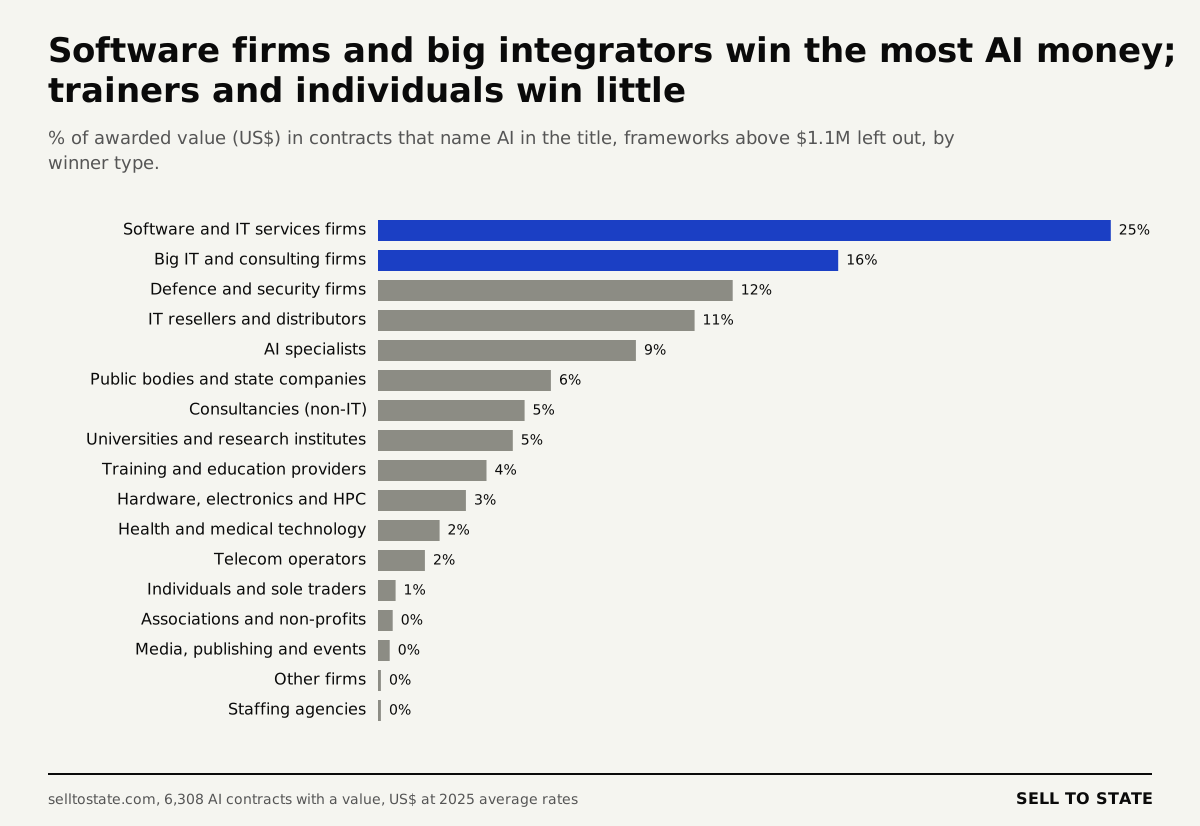
By money, software and IT firms win 25%, and big IT and consulting firms 16%. Defence firms win 12% of the money with 1% of the contracts. IT resellers win 11%, AI specialists 9%, public bodies and state companies 6%. Trainers win 4% of the money and individuals 1%: their contracts are many and small.
The region decides who sells. Latin America buys AI from trainers (26%) and individuals (23%). Asia-Pacific buys from big IT groups (39%), such as NTT Data and NTT Docomo Business in Japan. Central and Eastern Europe buy from software firms and medical technology firms, because the hospital packages need both. Western Europe and North America buy from software firms first and AI specialists second (15% and 14%).
The most frequent winners of AI contracts are Brazilian sellers of courses for civil servants. Consultre won 124 AI contracts from 64 buyers, Negócios Públicos 94 from 61, Zênite 85 from 57, ESAFI 85 from 50, Virtu 69 from 52, Inove 67 from 41. They sell courses on the new procurement law with AI to federal and state bodies, for $1,500 to $2,500 a contract on average. Outside Brazil, the most frequent winner is the Chilean reseller Flex SSS (55 contracts, 39 buyers, mostly ChatGPT subscriptions). Beam Up in the United Kingdom follows (42 contracts, 39 buyers, $11.6 million), then Chile’s Universidad Adolfo Ibáñez (40 contracts, 23 buyers, mostly AI courses).
227 AI tenders are open now; they buy licences, compute and consulting, and 99 close within two weeks
On 17 October 2026, 227 public tenders that buy AI were open for bids in 29 countries. We read the live feeds of seven portals. TED covers the EU and the EEA, SAM.gov the US federal government, Find a Tender the United Kingdom. CanadaBuys, PNCP (Brazil), SECOP II (Colombia) and Prozorro (Ukraine) cover their countries. Sell to State adds Mexico, Singapore and Poland’s national notices. A tender counts as open when its deadline for bids or responses is today or later. We applied the same rules as in the rest of this article, and we kept one notice per tender when a buyer republished or corrected it.
Brazil has the most open AI tenders (43), then the United States (36), Poland (28), Germany (18) and Romania (13). Canada and the United Kingdom have 10 and 9. The share tells a different story, because the feeds differ in size. AI is 12 of every 1,000 open tenders in Canada, 11 in Romania and 10 in Luxembourg. It is 6 to 7 in the United Kingdom and Finland, 4.5 in the United States and 2.2 in Germany. It is 1.3 in Brazil, 1.1 in France and 0.5 in Ukraine, where the portals list thousands of small open purchases.
What they buy now looks different from what they bought. Software licences are 15% of the open AI tenders, compute 14%, consulting 13% and equipment with AI 11%. Custom development is 10%, courses 9%, managed services 9%, research and pilots 8%, events 6%. Courses fall from 19% of past AI purchases to 9%. The reason is the feed: a Brazilian course is a direct purchase that closes on the day it is published, so it is never open for bids. The open feeds show the competitive tenders.
When an open tender buys AI technology, it is most often generative AI (16%). Prediction follows with 11%, computer vision 9%, document automation 8%, cybersecurity 5%, chatbots 4% and robotics 4%. 39% do not say what the AI does. Claude is named in 5 open tenders, ChatGPT and Copilot in 3 each, Gemini in 2. Most brand tenders are Brazilian. Embrapa, the federal agricultural research company, wants 40 Claude Team seats. The Amapá public prosecutor wants Claude Code, and the municipality of Orleans wants ChatGPT and Claude. Universities are the largest buyers of open AI tenders (45), then city halls and regional offices (39), defence (24), ministries (23) and health (18).
64 open AI tenders close this week and 35 next week. 33 close in the week after, 24 in the week after that, and 43 close later. 28 have no fixed deadline: they are rolling research announcements or planned tenders.
In the United States, 15 of the 36 open AI opportunities are early notices: 9 sources-sought notices and 6 presolicitations. In these, the agency is still asking the market what exists, so a seller can shape the requirement. Most of the others are Defense research announcements that name AI among their topics, from the Army Applications Laboratory, DARPA and the Defense Logistics Agency. The Marine Corps also asks for operational support for its cyberspace environment and for enterprise AI.
The largest open AI tender in our data is EuroHPC’s call for AI Gigafactories. The EU’s supercomputing body selects consortia that will build and run AI Gigafactories and sell it compute time. The two lots have estimated values of €4 billion and €6 billion, and bids close on 3 December 2026. Below that, 109 open AI tenders state an estimate, with a median of $238,000. The largest is a Slovak data centre with GPUs and AI services for the national science and technology information centre ($28.6 million). Next are the information system of the Italian training fund Fondimpresa ($23.8 million) and Microsoft licences, subscriptions and credits for the Paraná state audit court ($20.8 million).
One open AI tender per country, with a link to the notice or to its Sell to State page:
| Country | Buyer | What they buy | Estimate | Deadline | Link |
|---|---|---|---|---|---|
| Brazil | TCEPR - Tribunal do Contas do Estado do Paraná | Contratação de empresa especializada para o fornecimento de licenciamento, subscrições e… | $20.8M | 2026-10-23 | Notice |
| United States | DEPT OF DEFENSE / DEPT OF THE NAVY | Marine Corps Cyberspace Environment (MCCE) Operational Support Services (OSS) and Enterpr… | – | 2026-11-03 | Notice |
| Poland | Miasto Bielsko-Biała Urząd Miejski w Bielsku-Bi… | Zaprojektowanie, wykonanie i wdrożenie systemu portali miejskich z wykorzystaniem sztuczn… | $517k | 2026-10-21 | Notice |
| Germany | Georg-August-Universität Göttingen Stiftung Öff… | Beauftragung von KI-Multiplikatoren im Rahmen des BMFTR-geförderten Forschungsprojekts Ev… | $1.6M | 2026-10-29 | Sell to State |
| Romania | SC ROVISOPTICS SRL | Achiziție materiale necesare desfășurării activităților de cercetare industrială, în cadr… | $467k | 2026-10-19 | Notice |
| Canada | Canada Revenue Agency (CRA) | AI-POWERED OFFICIAL LANGUAGES LEARNING SOLUTION | – | 2026-10-22 | Notice |
| United Kingdom | Caerphilly County Borough Council | Framework Agreement for AI Enabled Transcription Tools | $10.5M | 2026-10-23 | Notice |
| Singapore | Ministry of Education | ITQ for supply, delivery and set up of an AI marking solution for Anglo-Chinese Junior Co… | – | – | Notice |
| Spain | DIPUTACIÓN DE BARCELONA | Suscripción de una solución SaaS modular de inteligencia artificial para la mejora de pro… | $746k | 2026-11-12 | Notice |
| Ukraine | Комунальне підприємство "Вінницький інформаційн… | Персональний комп’ютер для задач штучного інтелекту | $16k | 2026-10-23 | Notice |
| Italy | FONDAZIONE CNAO | Procedura aperta per la realizzazione del progetto di rinnovo dei servizi della piattafor… | $1.8M | 2026-11-07 | Notice |
| France | DITP | Accord-cadre interministériel relatif à la réalisation de prestations de conseil en strat… | $3.6M | 2026-11-17 | Notice |
| Finland | Metsähallitus | ICT-asiantuntijapalveluiden puitejärjestely 2026-2030 osa-alue 14 Tekoälyn asiantuntijapa… | $1.7M | 2026-11-09 | Sell to State |
| Colombia | SECRETARÍA GENERAL DE LA ALCALDÍA MAYOR DE BOGO… | Solicitud de cotización para prestar servicios especializados para diseñar; desarrollar;… | – | 2026-10-19 | Notice |
| Belgium | European Commission, DG CNECT - Communications… | Supporting the AI Observatory | $2.8M | 2026-11-03 | Notice |
| Czechia | Vysoká škola báňská - Technická univerzita Ostr… | Distribuovaný systém pro akcelerovaný vývoj AI, lokální okrajové výpočty a robotické syst… | $221k | 2026-11-16 | Notice |
For sellers: plan for the last quarter, compete on licences, follow the EU money
In two years, the median country went from 6 to 21 AI procurements in every 10,000. Most of what governments buy is small and internal: a course, a block of licences, a pilot, a scanner with AI inside. Only 1 in 20 AI procurements is a tool that the public uses directly. The money is in a few large contracts, through defence in the United States, supercomputers and platforms in Europe, and hospital packages paid by the EU recovery fund.
If you sell AI to governments, five facts from this data matter. The season is the last quarter of the budget year. Small subscriptions skip competition, and licence deals and hardware go through it. The EU recovery money ends in 2026. The buyer is usually a hospital, a university, a police force or a ministry, with the AI inside a larger purchase. And 227 AI tenders are open now, 99 of them closing within two weeks.