By Vlad Nadymov 11 min read
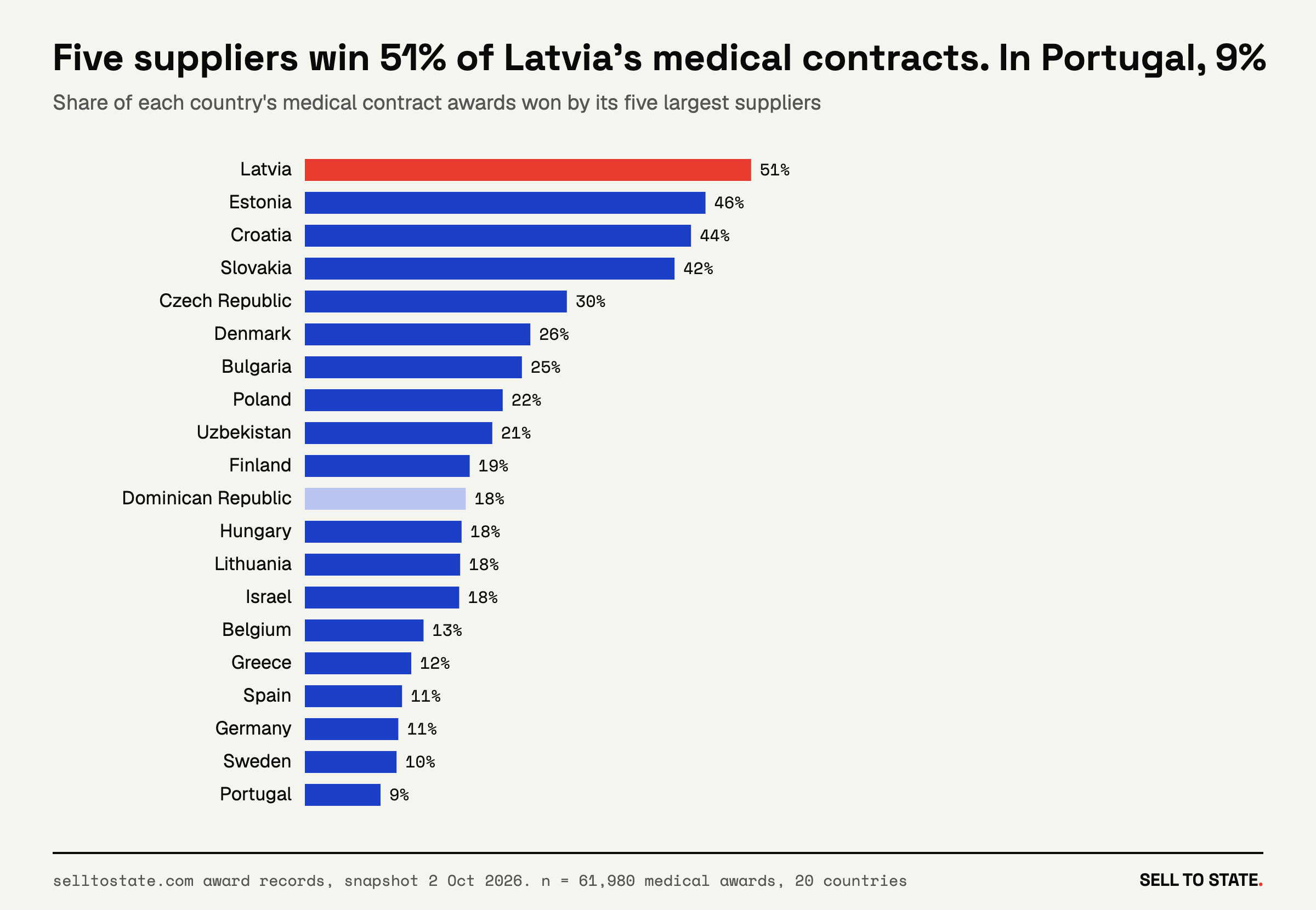
Medical tenders are the public contracts through which hospitals, health ministries, health insurers and their central buyers buy medicines, medical devices and health services. We counted who won them in 20 countries. Five suppliers won 51% of Latvia's public medical contracts last year. In Portugal, the five largest suppliers won 9%.
The count covers 61,980 medical contract awards from each country's latest 12 months of data. Before the count, we read 2,900 award descriptions by hand to check which records are truly medical. Below are the sources, the 20 countries, the winners and the buyers. Then come the value of one award and a procedure to find medical tenders in your target market.
Where medical tenders are published: TED and national portals
Most European medical tenders reach Tenders Electronic Daily (TED). TED lists the contracts above the EU thresholds, and each notice carries a code from the Common Procurement Vocabulary (CPV). Medical equipment and medicines are CPV division 33. Health services are group 851 (CPV codes on TED). Our guide to TED explains how to search it.
National portals publish the rest. In our data, the medical awards of the 20 countries come from these sources:
| Country | Where the awards come from | Read more |
|---|---|---|
| Belgium, Bulgaria, Croatia, Czech Republic, Denmark, Estonia, Finland, Germany, Greece, Hungary, Lithuania, Slovakia, Sweden | TED | TED guide |
| Latvia | IUB, the Procurement Monitoring Bureau | EIS guide |
| Poland | BZP, the national procurement bulletin | BZP guide |
| Portugal | BASE, the public contracts portal | BASE guide |
| Spain | PLACE, the public sector contracting platform | Spain |
| Dominican Republic | DGCP, the public procurement directorate | Dominican Republic |
| Israel | Mr.gov (Michrazim) | Israel |
| Uzbekistan | Xarid.uz | xarid guide |
Most records from Latvia, Poland and Spain carry the same CPV labels as TED notices, so we read all 16 European sources with one rule.
20 countries ranked by medical contract awards
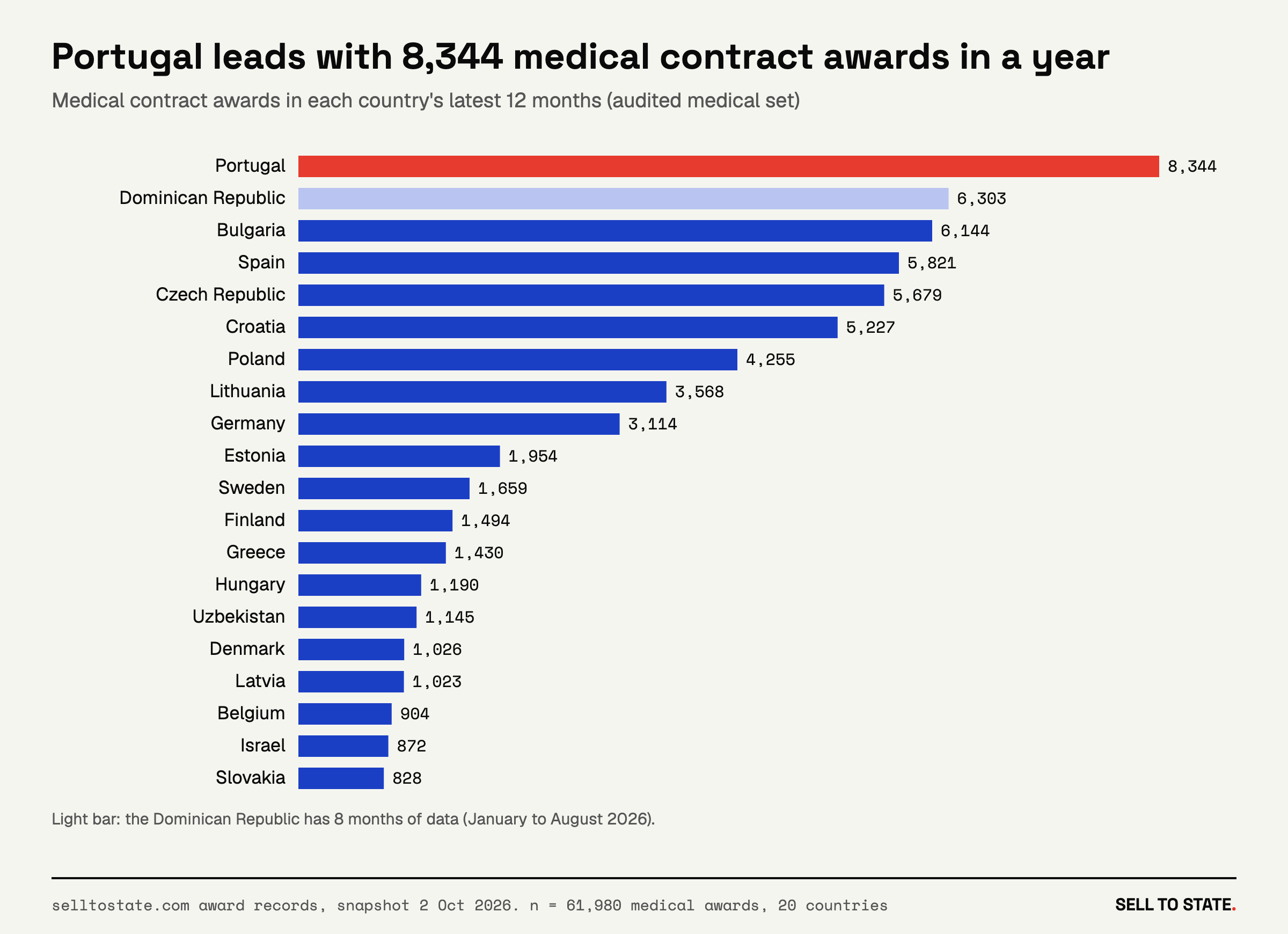
Portugal published the most medical contract awards in our data: 8,344 in 12 months. The Dominican Republic follows with 6,303 in 8 months, then Bulgaria (6,144), Spain (5,821), the Czech Republic (5,679) and Croatia (5,227). Slovakia has the fewest of the 20, with 828.
Some countries did not make the list. Colombia and the United Kingdom have many records with a medical label. Our audit found too few of them truly medical (see How we counted). Kenya, Austria, Cyprus, Malta, the Netherlands, Ireland and Luxembourg have fewer than 500 medical awards in the window.
Who wins: five suppliers take half of Latvia's medical contracts
In Latvia, five suppliers won 51% of the medical contract awards. In Portugal, the five largest won 9%. Estonia (46%), Croatia (44%) and Slovakia (42%) are close to Latvia. Sweden (10%), Germany (11%) and Spain (11%) are close to Portugal. The four most concentrated markets are small countries.
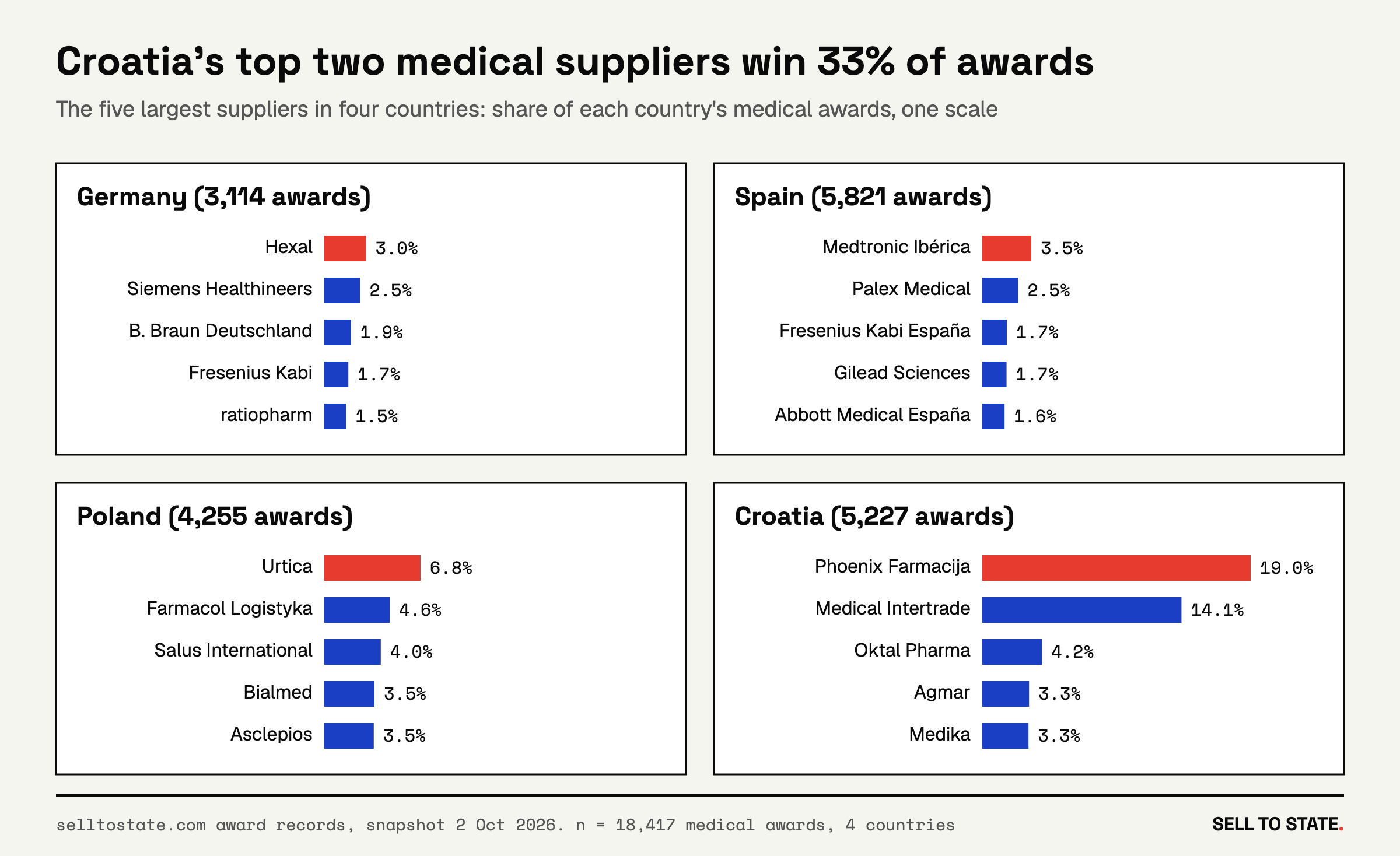
One supplier leads Latvia. Arbor Medical Korporācija won 342 medical awards from 33 buyers, 33% of the country's total. In Croatia, two suppliers, Phoenix Farmacija and Medical Intertrade, won 1,730 awards between them: 33%.
In the larger markets, the leaders hold a few percent each. In Poland, Urtica won 6.8% of the medical awards. In Spain, Medtronic Ibérica won 3.5%. In Germany, Hexal won 3.0%.
Repeat winners in medical procurement
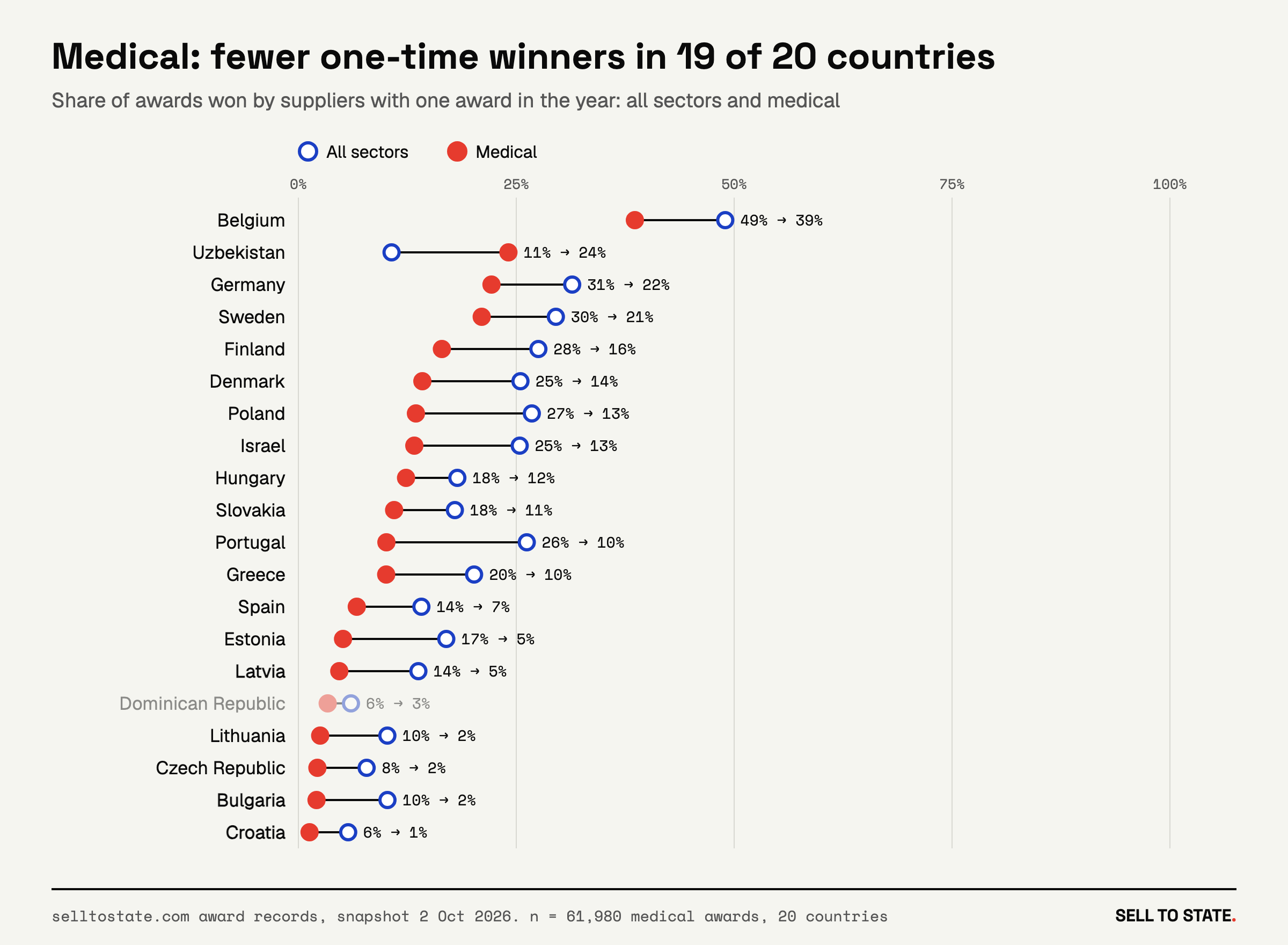
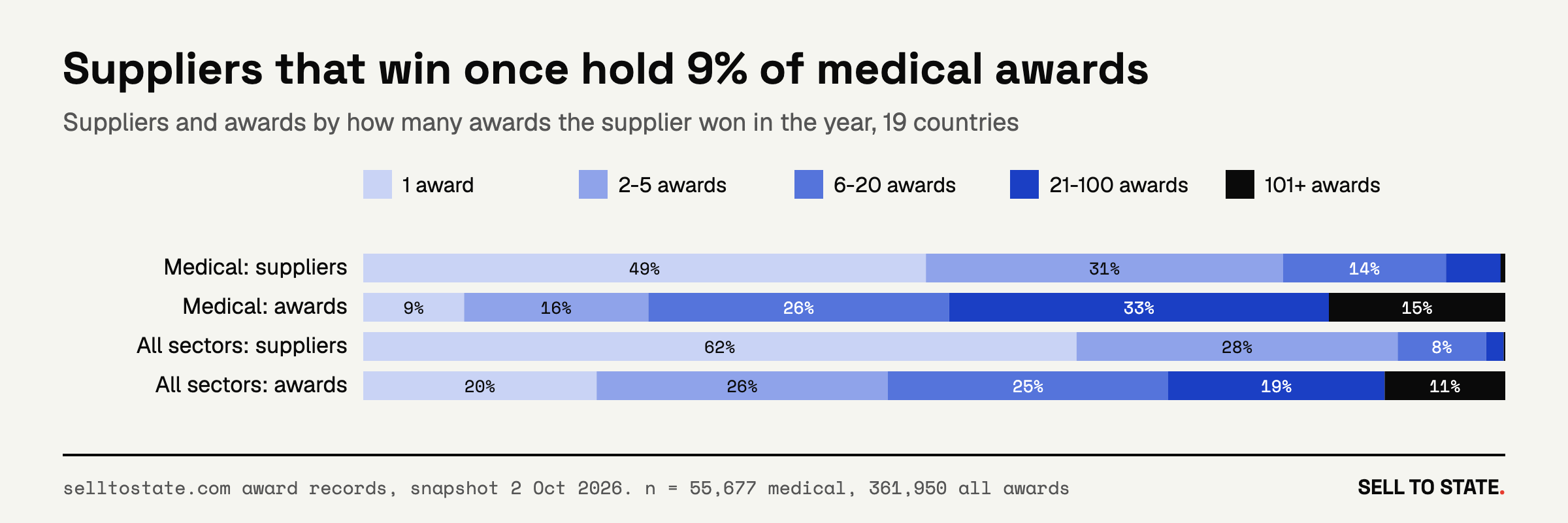
Suppliers that won once in the year hold 9% of the medical contract awards. In all sectors, they hold 20%. We pooled the 19 countries with a full 12-month window. Of the 9,981 medical suppliers, 49% won exactly one award. The 19% of suppliers with six or more awards won 75% of the contracts.
The pattern holds in 19 of 20 countries. In Croatia, suppliers that won once hold 1% of the medical awards, against 6% in all sectors. In Bulgaria, the Czech Republic and Lithuania they hold 2%. Belgium has the highest share in our data: 39%. Uzbekistan is the one exception, at 24% against 11% in all sectors. There, 700 of the 1,145 medical awards are health services. Their sellers include district medical associations, clinics and sanatoriums.
How this fits our earlier count. In our story on who wins government contracts, the keyword label "healthcare" gave one-time winners 16% of the awards in 30 countries. On the 19 countries here, the same label gives 13%. The audited medical set gives 9%. The label also holds IT, building and insurance contracts, where one-time winners are more common.
Hospital tenders and central buyers: who signs the contracts
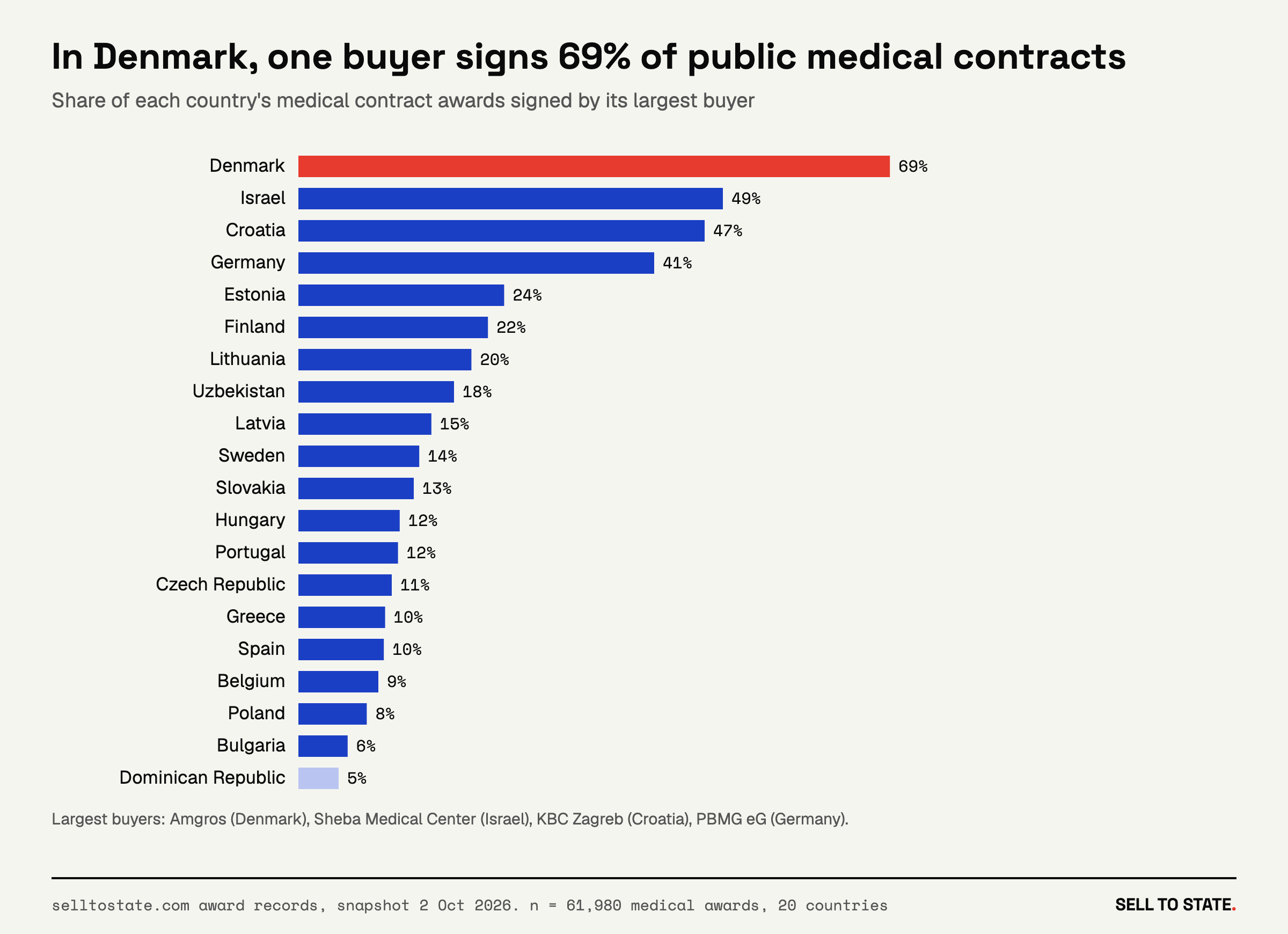
In Denmark, one buyer signed 69% of the public medical contract awards. Amgros is owned by the Danish regions and buys "medicines for public hospitals" (Amgros). 702 of its 705 awards in our data are pharmaceutical products.
Three more countries have one buyer with more than 40%. In Croatia, the Clinical Hospital Centre Zagreb (KBC Zagreb) signed 2,467 awards, 47% of the total. 1,639 of them come from notices for "health institutions in the Republic of Croatia". In Germany, PBMG eG signed 1,287 awards, 41%. PBMG is a cooperative in which hospitals organise their joint purchase of medicines (PBMG). In Israel, the Sheba Medical Center signed 49% of the awards of the 13 Ministry of Health hospitals in our data.
Health insurers buy medicines too. In Germany, four statutory health insurers (DAK-Gesundheit, Techniker Krankenkasse, AOK Baden-Württemberg, IKK classic) and GWQ ServicePlus signed 319 medical awards, 10% of the German total. 174 German medical awards cite § 130a or § 130c of the Social Code, Book V, the sections on drug discount agreements.
Elsewhere, the large hospitals buy for themselves. In Estonia, three hospitals signed 67% of the medical awards: the North Estonia Medical Centre, West Tallinn Central Hospital and Tartu University Hospital. In Spain, Osakidetza, the Basque health service, signed 10%. In Lithuania, the central purchasing body CPO LT signed 20%. In Uzbekistan, the largest buyer is the railway infrastructure company: 207 awards, 199 of them for health services.
For a bidder in these markets, the central buyer's tender calendar decides when the market opens. Check it before you plan a year of bids.
What a medical contract is worth in euro countries
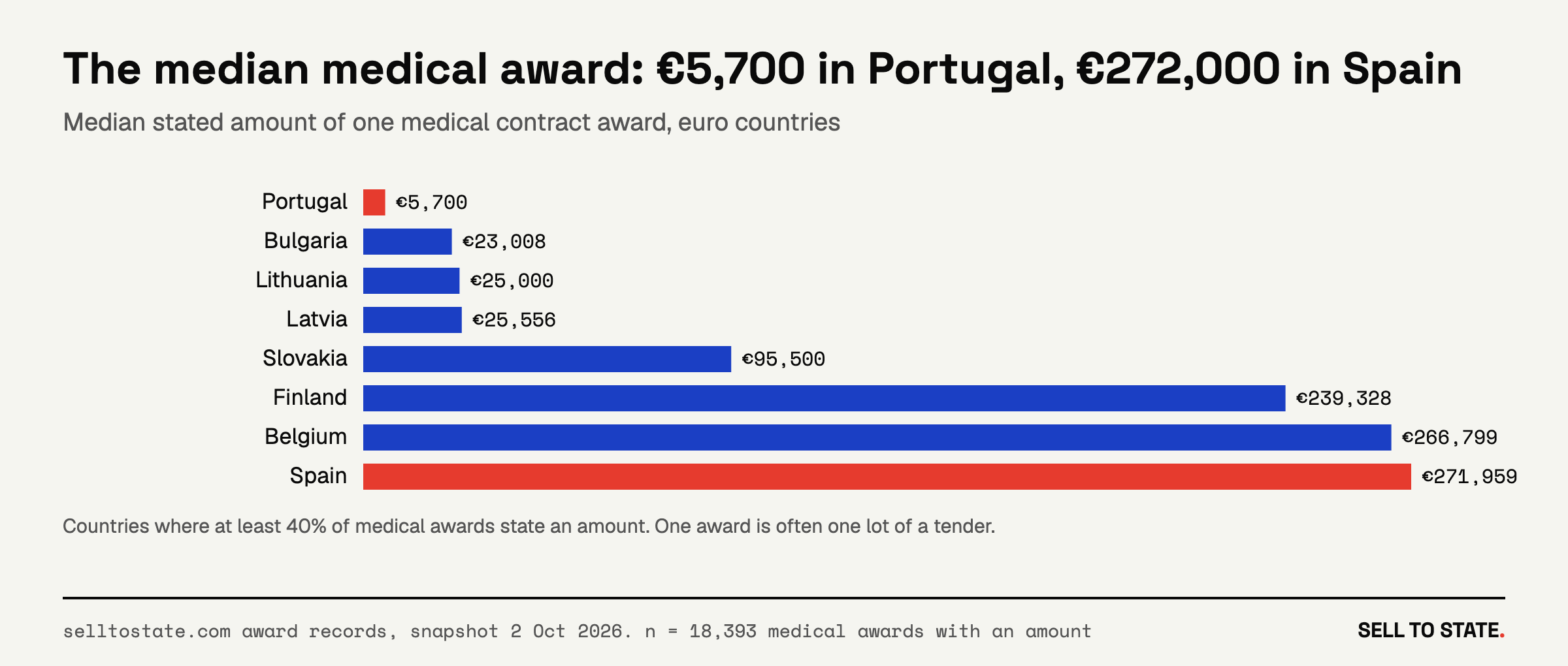
The median medical award is €5,700 in Portugal and €271,959 in Spain. Among the euro countries where at least 40% of medical awards state an amount, Bulgaria (€23,008), Lithuania (€25,000) and Latvia (€25,556) are near the bottom. Finland (€239,328) and Belgium (€266,799) are near the top.
By value, suppliers that won once hold 11% of the money. In the 11 countries with enough stated amounts, they hold 10.8% of $16.1 billion of stated medical value. With the keyword label on the same 11 countries, the share is 34%, and our earlier count found 55% in 26 countries. The label adds large one-off contracts that are not medical, such as buildings and IT.
How we counted the medical awards
Records and countries
- One record is one contract award: a buyer, a supplier, a date and, where the source gives it, an amount. A tender with many lots gives one award per lot and winner.
- Each country gets its latest 12 months with full data, the same windows as in our story on who wins government contracts. For most countries the window is September 2025 to August 2026. Portugal's is February 2025 to January 2026, Poland's December 2024 to November 2025, and Sweden's and Latvia's August 2025 to July 2026. The Dominican Republic has 8 months, January to August 2026, and we leave it out of the pooled numbers.
- We include the 20 countries with at least 500 medical awards that passed the audit.
The audit: which awards are medical
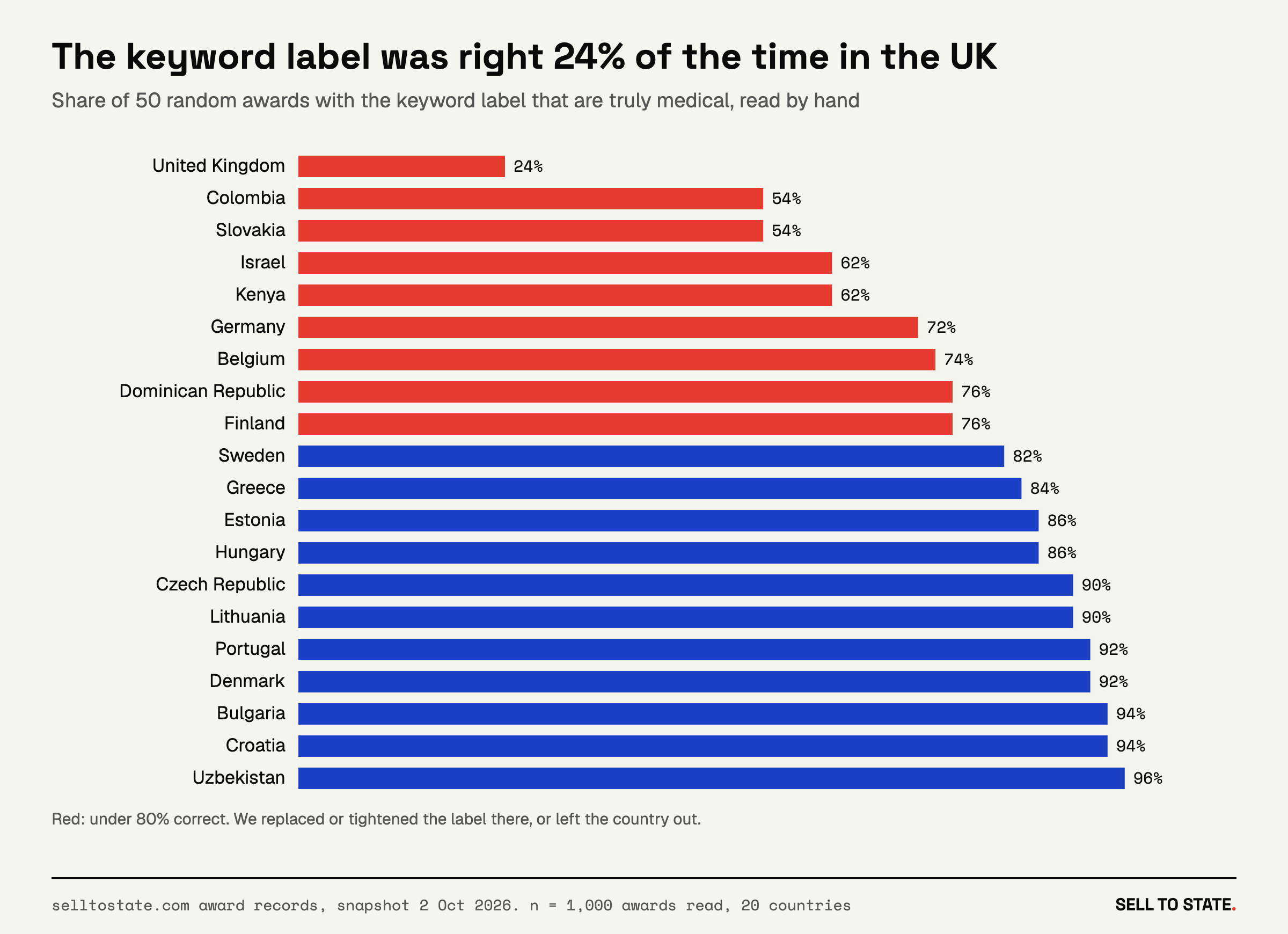
- Our sector labels come from keywords in each award's description. For this story we checked them. We drew 50 random awards with the medical label in each of 20 countries and read them. A record is medical when it buys medicines, medical devices or consumables, diagnostic reagents, health services or the upkeep of medical equipment. IT, buildings, insurance, cleaning and research-lab equipment do not count.
- The label was right less than 80% of the time in 9 of the 20 countries, from 24% in the United Kingdom to 76% in Finland and the Dominican Republic. It also missed almost all medical awards in Spain (11 labelled, 5,821 medical), Poland (18 and 4,255) and Latvia (3 and 1,023).
- Where the record carries the CPV label of the notice, we use the CPV code. Medical means division 33 without personal care, mortuary products and lab chemicals, plus health services (group 851), medical gases and the repair of medical equipment. In Portugal we use the CPV code where we have it and the label elsewhere. In the Dominican Republic we keep labelled awards that name a medical product. In Israel we keep labelled awards of Ministry of Health hospitals. In Uzbekistan the description is the product class, and the label was right 96% of the time.
- Then we drew a new sample of 50 per country and read it again: 84% to 100% medical in each of the 20 countries. Colombia (74% at best) and the United Kingdom are left out. In total we read 2,900 award descriptions.
Cleaning and supplier names
- We count each award once (one notice, amount and date), and we leave out supplier names that are not suppliers, as in our earlier count. In the medical set we also leave out one name in Uzbekistan. It is a Ministry of Economy and Finance institution, named as the supplier on 300 awards from 123 buyers in 13 sectors.
- We count suppliers by their normalised name. A firm under two spellings counts twice, so every "won once" share is an upper bound. For the named top five, we join the records that share one supplier name.
Values and snapshot
- Amounts follow the rules of our earlier count. We split an amount that several winners share, and we cap each award at its country's 99.9th percentile. US dollar values use the exchange rates of 2 October 2026. The value numbers leave out the countries where fewer than 40% of medical awards state an amount: Croatia, Denmark, Estonia, Germany, Greece, Hungary, Poland and Sweden.
- The snapshot date is 2 October 2026. The numbers will move as new awards arrive. This research is based on the award data behind Sell to State.
How to find medical tenders in your target country
Use this procedure for one country at a time.
- Find the portal. For EU countries, start on TED. For other countries, use the national portal in the table above.
- Search by CPV code. Use division 33 for medical equipment and medicines, and group 851 for health services.
- Find the central buyer. Look for one buyer that signs a large share of the awards, such as Amgros or KBC Zagreb.
- Look up last year's winners. On Sell to State, open the country page, for example Latvia or Croatia, then the buyer's page.
- Count the competition. Check how many suppliers won the buyer's awards, and how many of them won only once.
- Export the awards. Download them as CSV or pull them through the API.
Plans are on the pricing page. To see who won every contract a buyer awarded, create an account.
Medical procurement: the short version
Medical contracts go to repeat winners. In the 19 countries with a full year of data, suppliers that won once hold 9% of the medical awards, against 20% in all sectors. A few central buyers sign much of the work: 69% in Denmark, 47% in Croatia, 41% in Germany. Five suppliers won 51% of Latvia's public medical contracts last year. In Portugal, 9%.
Download the charts
Free to reuse. Give a link to this article.
- V1 — Portugal leads with 8,344 medical contract awards in a year. (PNG, 2400 px)
- V2 — Medical: fewer one-time winners in 19 of 20 countries. (PNG, 2400 px)
- V3 — Croatia's top two medical suppliers win 33% of awards. (PNG, 2400 px)
- V4 — In Denmark, one buyer signs 69% of public medical contracts. (PNG, 2400 px)
- V5 — The median medical award: €5,700 in Portugal, €272,000 in Spain. (PNG, 2400 px)
- V6 — Suppliers that win once hold 9% of medical awards. (PNG, 2400 px)
- V7 — Five suppliers win 51% of Latvia's medical contracts. In Portugal, 9%. (PNG, 2400 px)
- V8 — The keyword label was right 24% of the time in the UK. (PNG, 2400 px)