By Vlad Nadymov 4 min read
The math on manual monitoring
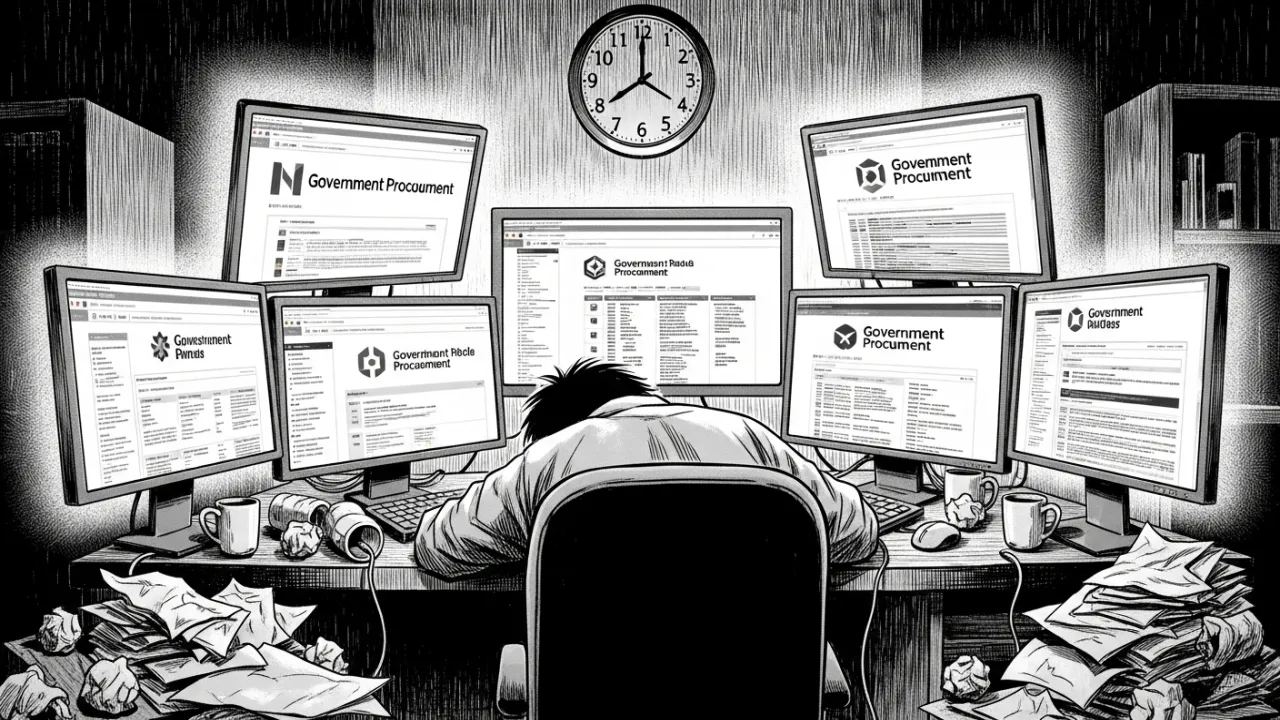
ASEAN has six major national procurement portals. Each requires its own login, its own search interface, and its own set of keyword variations. Here's what comprehensive monitoring actually costs:
\22.5 hours per week. That's more than half a full-time role dedicated exclusively to checking procurement portals. And this assumes you can read Thai, Vietnamese, Bahasa Indonesia, and Malay — which most BD teams cannot.
What "monitoring" actually involves
"Checking the portal" sounds simple. In practice, a single monitoring session looks like this:
- Navigate and authenticate — log in to the portal (some require OTP or hardware tokens). Navigate to the search interface.
- Run multiple keyword searches — a single keyword rarely catches everything. You need 5–10 keyword variations to cover how agencies might describe your services. "Cloud hosting" + "ICT infrastructure" + "server hosting" + "cloud services" + "infrastructure modernisation."
- Filter and sort results — remove expired tenders, filter by relevant categories, sort by closing date. Each portal has a different filter interface.
- Read and qualify each result — open each potentially relevant tender. Read the scope. Check eligibility requirements. Note the deadline, estimated value, and agency.
- Copy data into your pipeline — manually enter tender details into your CRM, spreadsheet, or tracking system. No portal offers structured data export.
- Repeat for the next portal — then do the same thing in a completely different interface, in a different language.
45 minutes per portal is conservative. For portals in Thai or Vietnamese, add translation time. For Indonesia's 600+ LPSE portals, the process is exponentially more complex.
Three levels of tender monitoring
Level 1: Manual portal checks
Works for: single-country vendors with narrow focus and dedicated BD staff
Level 2: Procurement agents / consultants
Works for: companies with budget for local agents and willingness to manage multiple vendor relationships
Level 3: AI search across all portals
Works for: any vendor serious about government procurement across ASEAN
The "found it too late" problem
Many ASEAN government tenders have a 14–21 day window between publication and closing date. Some are as short as 7 days.
If you check the portal twice a week, you might find a tender on day 7. That leaves you 7–14 days to:
- Read and understand the full tender documents
- Assess technical and commercial fit
- Attend the pre-bid conference (if required)
- Submit clarification questions
- Prepare your technical and financial proposal
- Assemble compliance documentation
- Get internal approvals and authorisations
- Submit before the deadline
A response that usually takes 2–3 weeks is now being compressed into 7 days. The result: rushed bids, missing documents, incomplete technical responses, and lower win rates.
Vendors who find tenders on day 1 have double the preparation time of vendors who find them on day 7. That time advantage compounds into better-quality bids, more thorough compliance checks, and higher win rates.
The real cost of manual monitoring
It's not the 22.5 hours per week. It's the tenders you never found. The contract you would have won if you'd had two more days to prepare. The market you never entered because you couldn't read the portal. The cost of manual monitoring is invisible — it's the revenue you never earned.
Setting up an effective monitoring workflow
Whether you use Sell to State or not, an effective tender monitoring workflow has four components:
- Define your target: Which countries, which agencies, which procurement categories, which minimum contract value. Be specific — "IT contracts in Singapore" is too broad. "Cybersecurity assessment and managed security services from Singapore statutory boards above SGD 200K" is actionable.
- Set review cadence: New tenders should be reviewed within 24 hours of publication. For tenders with short windows (7–14 days), same-day review is critical.
- Build a qualification scorecard: Not every tender is worth bidding on. Score each tender on: contract value, timeline fit, geographic fit, technical fit, competitive position (do you know the incumbent?), and compliance readiness.
- Track and measure: How many tenders did you find this month? How many did you bid on? How many did you win? If you're finding fewer than 10 relevant tenders per month across ASEAN, you're probably missing opportunities.
Stop checking portals manually
Sell to State collects records from GeBIZ, ePerolehan, INAPROC, Thai EGP, PhilGEPS, and VNEPS on a regular schedule. Search in plain English. Get structured results, each with its publication date.
Join the waitlist →