By Vlad Nadymov 10 min read
Why most tender responses fail
Government procurement evaluation is mechanical. Evaluators use scoring sheets. They check boxes. They assign points against published criteria. This is fundamentally different from B2B sales, where you can adjust your pitch in real time based on buyer reactions.
In a government tender, your written response is the only thing the evaluator sees. There is no follow-up call. There is no demo unless you reach the shortlist. The document is the sale.
And yet, most vendors treat tender responses as marketing collateral — long on capability statements and short on specifics. Here's what actually gets responses rejected or scored low:
- Generic responses: Copy-pasting capability statements without addressing the specific requirements in the tender document. Evaluators can tell when you haven't read the scope of work.
- Missing mandatory requirements: Every tender has mandatory requirements (sometimes called "pass/fail" or "threshold" criteria). Miss one, and you're disqualified — regardless of how strong the rest of your response is.
- Not understanding the evaluation criteria: If the tender says technical quality is weighted 70% and price is 30%, a response that leads with low pricing and skimps on technical detail is playing the wrong game.
- Wrong format: Many ASEAN government tenders specify a required response format — number of copies, section headings, page limits, annexure numbering. Deviate from the format and you make the evaluator's job harder. Some agencies will disqualify non-compliant formats outright.
- Late discovery: Vendors who find a tender 3 days before closing submit rushed, incomplete responses. The vendors who win found the tender 3 weeks before closing.
The uncomfortable truth
Most government tenders are won not by the best vendor, but by the vendor who most precisely addressed every line of the evaluation criteria. Procurement is a compliance game first and a quality game second.
Understanding evaluation criteria across ASEAN
Each ASEAN country has its own procurement methodology, and the evaluation criteria differ significantly. Knowing which method applies determines how you structure your response.
Singapore — Price-quality method (PQM)
Singapore uses a price-quality method for most tenders above SGD 90,000. Quality is typically weighted 60–80%, with price making up the remainder. The quality component is scored against criteria published in the tender document — technical approach, experience, team qualifications, methodology. GovTech and DSTA tenders tend to weight quality higher (70–80%). Construction tenders under BCA may use lower quality weightings. The key: Singapore publishes the exact weighting in the tender. Read it. Build your response to score maximum points on the higher-weighted criteria.
Malaysia — Merit point system with Bumiputera preference
Malaysian federal tenders use a merit point system where technical and financial proposals are evaluated separately. Technical proposals must meet a minimum threshold (typically 70–80 out of 100) to proceed to financial evaluation. For some categories, Bumiputera-status vendors receive preference points — typically 2–10% of the total score. Open tenders above MYR 500,000 generally use this two-envelope system. Your technical proposal needs to pass the threshold independently before your price is even opened.
Philippines — Lowest calculated responsive bid (for goods)
Under RA 9184 (Government Procurement Reform Act), the Philippines uses "lowest calculated responsive bid" for goods procurement and "highest rated responsive bid" for consulting services. For goods and infrastructure, pass the technical requirements and the lowest price wins. For consulting services, quality-based selection applies with published criteria. The Philippine system is unusually transparent — evaluation criteria and methodology must be published in the tender documents and the PhilGEPS posting.
Indonesia — Merit point system (Sistem Nilai)
Indonesia's procurement regulation (Perpres 12/2021) uses a merit point system (Sistem Nilai) for complex procurements and lowest price (Harga Terendah) for simple goods and construction. For IT and consulting services, the merit system typically weights technical at 60–80% and price at 20–40%. Proposals are evaluated by a Pokja (procurement committee) that scores against published criteria. Local content requirements (TKDN — Tingkat Komponen Dalam Negeri) may add bonus points for bids with high domestic content.
The anatomy of a winning response
Regardless of which ASEAN country you're bidding in, every winning tender response contains five core components. The quality and specificity of each component determines your score.
1. Compliance matrix
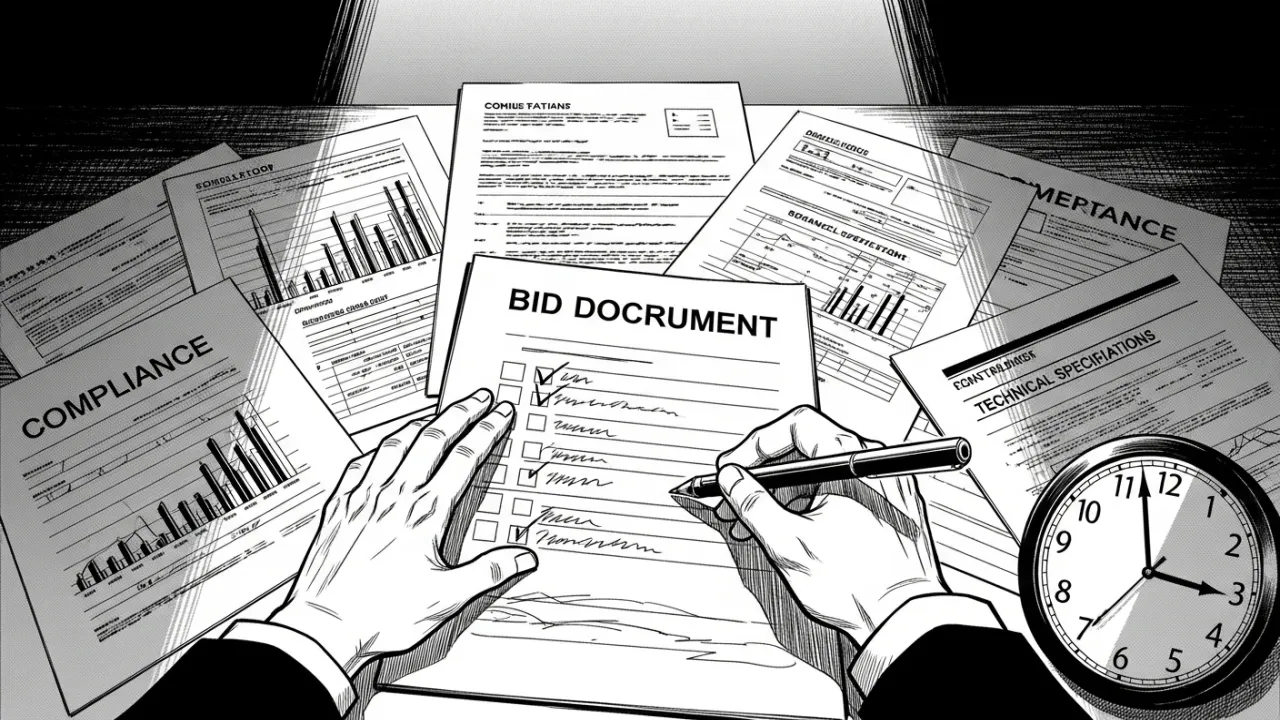
Before writing a single word of your response, build a compliance matrix. This is a table that maps every requirement in the tender document to the section of your response that addresses it. Every mandatory requirement gets a row. Every evaluation criterion gets a row.
A compliance matrix serves two purposes: it ensures you don't miss anything, and it makes the evaluator's job easy. Some experienced bidders include the compliance matrix as the first page of their response — it signals immediately that you've read every requirement and you know exactly where to find the answer.
2. Executive summary
Your executive summary is not a company profile. It's a one-page summary of why you are the right vendor for this specific contract. Reference the agency's stated objectives. State your proposed approach in one paragraph. Highlight your two or three strongest differentiators that directly address the evaluation criteria. If the tender weights "relevant past experience" at 25%, your executive summary should mention your most relevant project within the first three sentences.
3. Technical approach
The technical approach section is where most bids are won or lost. This is not a product brochure. It's a detailed description of how you will deliver the specific scope of work described in the tender.
Structure your technical approach to mirror the tender's scope of work — use the same section headings, the same terminology, the same numbering. If the tender says "The vendor shall provide a network security assessment covering items (a) through (f)," your technical section should have subsections (a) through (f) explaining exactly how you'll address each item.
4. Pricing strategy
Government pricing is not like commercial pricing. Agencies have budget constraints, often publicly available through budget documents or past awarded contract values. Your pricing needs to be competitive — but not suspiciously low. Evaluators in Singapore and Malaysia are trained to flag "abnormally low tenders" (ALTs) that may indicate the vendor doesn't understand the scope or intends to cut corners.
Present pricing in the exact format the tender specifies. Use line items. Show the breakdown. If the tender asks for a bill of quantities, complete every line — leaving blanks is grounds for disqualification in most ASEAN jurisdictions.
5. Past performance and references
ASEAN government evaluators weight past performance heavily — typically 15–30% of the technical score. The projects you reference must be relevant: similar scope, similar scale, similar industry. A USD 10M ERP implementation for a bank is not relevant experience for a USD 200K website redesign for a ministry, even if both are "IT projects."
Include: client name (with permission), contract value, duration, specific deliverables, and a named reference contact. Vague references to "a major government client" score zero.
Country-specific compliance requirements
Beyond the technical response, each ASEAN country requires specific compliance documents. Missing any of these is typically an automatic disqualification.
| Document | SG | MY | ID | TH | PH | VN |
|---|---|---|---|---|---|---|
| Company registration certificate | Yes | Yes | Yes | Yes | Yes | Yes |
| Tax clearance / compliance certificate | Yes | Yes | Yes | Yes | Yes | Yes |
| Audited financial statements (2–3 years) | — | Yes | Yes | Yes | Yes | Yes |
| Bid bond / bid security | — | Yes | Yes | Yes | Yes | Yes |
| Portal registration (vendor ID) | Yes | Yes | Yes | Yes | Yes | Yes |
| Local entity / subsidiary required | — | Yes | Yes | Yes | — | Yes |
| Notarised document copies | — | — | Yes | Yes | — | Yes |
| Professional license (industry-specific) | — | Yes | Yes | Yes | Yes | Yes |
| Anti-corruption / integrity declaration | Yes | Yes | Yes | — | Yes | — |
| Local content declaration (TKDN etc.) | — | — | Yes | — | Yes | — |
Requirements vary by tender value and category. Always verify against the specific tender document. This table covers the most common requirements for open tenders.
Pricing strategy for government contracts
Government pricing operates under constraints that commercial sales don't face. Understanding these constraints helps you price competitively without pricing yourself out of profit.
- Don't underbid. Abnormally low tenders trigger review in Singapore (under MOF guidelines), Malaysia, and Indonesia. If your price is significantly below the estimated contract value, the agency may ask you to justify it — or simply reject it as non-credible. Government buyers are risk-averse. A price that looks too good to be true signals risk.
- Research the budget. In the Philippines, the Approved Budget for the Contract (ABC) is published in the PhilGEPS posting — your bid must be at or below the ABC. In Singapore, past awarded contracts on GeBIZ reveal what agencies have paid for similar work. In Malaysia, check the award notices on ePerolehan. This data is your pricing intelligence.
- Price on total cost of ownership. Sophisticated evaluators — especially in Singapore and Thailand — evaluate lifecycle cost, not just upfront price. If your solution has lower maintenance costs, lower training requirements, or longer warranty periods, make this explicit in your pricing breakdown. A higher upfront price with lower TCO can score better than a low upfront price with expensive renewals.
- Use the specified pricing format. If the tender provides a pricing template (bill of quantities, rate card, line-item schedule), use it exactly. Do not submit your own pricing format. Do not leave lines blank. Fill in every field, even if the answer is "included in base price" or "N/A."
- Account for local taxes and duties. Quote in the local currency specified in the tender. Include GST/VAT/PPN as required. Foreign vendors often forget to account for withholding taxes — in Indonesia (PPh 26 at 20%) and Thailand (withholding tax at 1–5%), these can significantly affect your effective margin.
Common disqualification triggers
These are the most common reasons ASEAN government tenders are disqualified at the administrative review stage — before the evaluator even reads your technical proposal.
Missing signatures
Unsigned bid forms, bid security documents, or declarations. In Indonesia, the Surat Penawaran must be signed and stamped (materai).
Late submission
Even by minutes. Government portals (GeBIZ, PhilGEPS, LPSE) lock at the exact closing time. Physical submissions that arrive after the stated deadline are returned unopened.
Wrong format or copies
Tender says 3 hard copies plus 1 USB — you submit 2 copies and email the file. Disqualified. Follow the format instructions exactly.
Incomplete bid security
Bid bond in wrong currency, wrong amount, from a non-approved bank, or with expiry date before the tender validity period. Common in MY, ID, PH, and VN.
Non-compliant technical specs
The tender requires a specific certification (ISO 27001, CMMI Level 3) and your response doesn't include the certificate. Pass/fail. No partial credit.
Exceeding the budget ceiling
In PH, bidding above the ABC is automatic disqualification. In other countries, exceeding the estimated value by a large margin may result in rejection.
Expired documents
Tax clearance certificates, financial statements, or professional licenses that have expired before the tender closing date.
Conflict of interest declaration
Failure to disclose relationships with the procuring agency's personnel. This is taken seriously in SG and PH.
Bid/no-bid discipline
The best tender teams don't bid on everything. They qualify opportunities rigorously: Do we meet all mandatory requirements? Can we demonstrate relevant past performance? Do we have enough time to prepare a quality response? If the answer to any of these is no, walk away. A strong bid on the right tender beats ten weak bids on the wrong ones.
The discovery advantage: finding tenders early
Everything in this guide assumes you've found the tender with enough time to prepare a quality response. In practice, this is where most vendors fail.
ASEAN tender closing periods vary, but most fall in the 14–30 day range for open tenders. A vendor who discovers a tender on day 1 has 4x the preparation time of a vendor who discovers it on day 21. That extra time translates directly into response quality:
- Time to build a proper compliance matrix and identify gaps
- Time to source subcontractors or consortium partners if needed
- Time to obtain fresh reference letters and updated financial documents
- Time for internal technical review before submission
- Time to attend the pre-bid conference (mandatory or optional, these give critical clarification)
- Time to submit clarification questions to the agency before the Q&A deadline
This is why tender monitoring matters as much as tender writing. The most polished response in the world loses to a mediocre response that was submitted on time — and the most capable vendor loses when they discover the tender too late to prepare properly.
Find tenders before your competitors do
Sell to State collects records from government procurement portals across Singapore, Malaysia, Indonesia, Thailand, Philippines, and Vietnam on a regular schedule, and every record shows its publication date — so your BD team can see how much preparation time is left for every relevant opportunity.
Join the waitlist →